


Most major U.S. airlines allow carry-on suitcases up to 22 x 14 x 9 inches, including wheels and handles, though each airline’s requirements can vary. Choosing a smooth rolling carry on suitcase means balancing that size limit with the way you travel and the amount you want to pack.
It’s easy to focus on the suitcase, but airline allowances and total cost matter too. This guide covers common carry-on dimensions, why airline limits vary, and what affects suitcase prices. It also explains how wheel design and construction shape your choice, helping you find a carry-on that suits your plans.
Key Takeaways
- Use 22 x 14 x 9 inches as a common U.S. carry-on benchmark, then compare the airline’s allowance and measure the case with its wheels and handles.
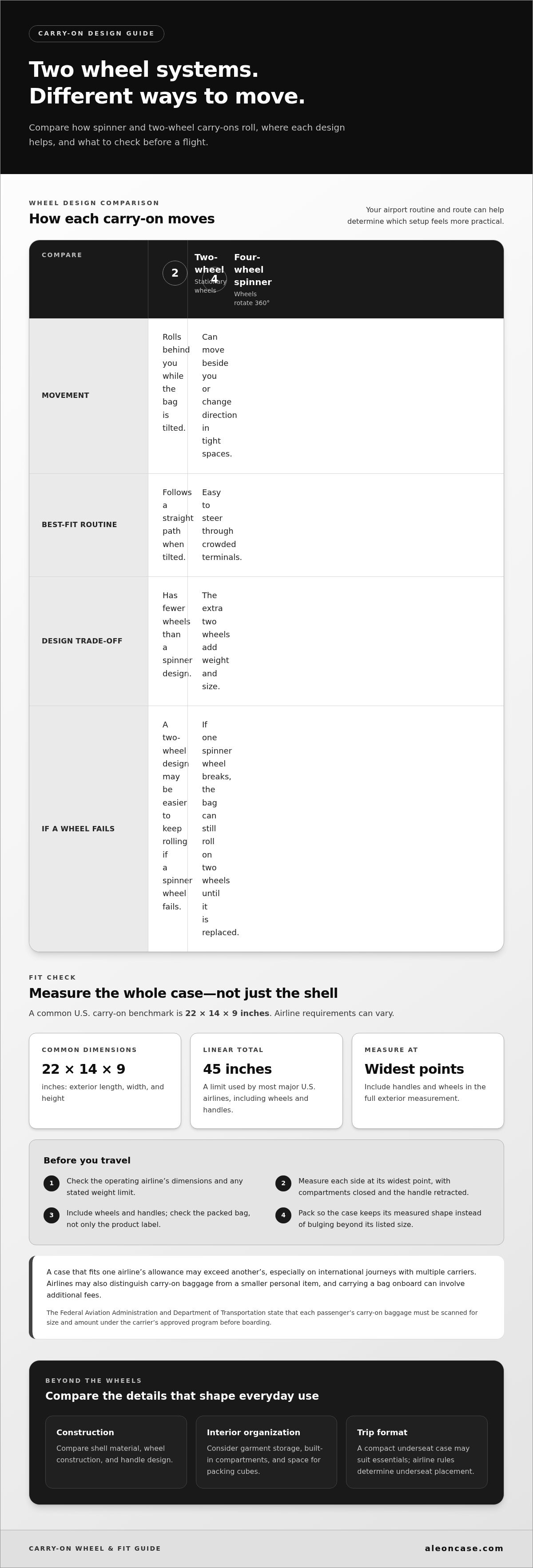
- Choose between spinner wheels for multidirectional movement and two-wheel designs, which have fewer wheels and may be easier to keep rolling if a spinner wheel fails.
- Market prices for wheeled carry-ons typically range from $140 to $340, with a median of about $210; compare construction and design as well as the price.
- Match the case format to your trip and packing needs, including whether a compact underseat option better suits your travel plans.
What Size Is Allowed for Carry-On Luggage?
A smooth rolling carry-on needs more than a convenient wheel setup; its packed dimensions must suit airline limits. A common U.S. benchmark is 22 x 14 x 9 inches, but requirements vary. Wheel design also affects maneuverability, weight, and how the suitcase handles when full.
See how carry-on designs compare in this luggage test:
Two-wheel bags have stationary wheels and roll behind you at an angle. Four-wheel spinner luggage has wheels that rotate 360 degrees, allowing it to move beside you or change direction in tight spaces. Those extra two wheels add weight and size, so check the case’s full exterior measurements when comparing lightweight options.
Spinner and two-wheel Rollaboard designs suit different routines. A spinner is easy to steer through crowded terminals, while a two-wheel bag follows a straight path when tilted. Both can hold clothing secured with compression straps, but a duffel or wheeled duffel has a different shape and packing layout.
Wheel durability matters on uneven floors and repeated trips. If a spinner wheel breaks, the bag can still roll on two wheels until the broken wheel is replaced. According to the Federal Aviation Administration and the Department of Transportation, each passenger’s carry-on baggage must be scanned for size and amount under the carrier’s approved program before boarding. Allowance and handling are separate considerations, so choose wheels that suit your route and measure the packed case before travel.
Carry-on bag dimensions and airline allowances
Most major U.S. airlines allow carry-ons up to 22 x 14 x 9 inches, but requirements vary. Measure the packed bag, including its handle and wheels, before choosing a case for your flight.
Carry-On Dimensions and Size Limits
The common 22 x 14 x 9-inch allowance describes the bag’s exterior length, width, and height. Most major U.S. airlines also limit carry-ons to 45 linear inches total, including handles and wheels. Measure each side at its widest point, with compartments closed and the handle retracted. A garment bag or hardside case may have a different shape, so compare its full dimensions rather than relying on the label.
Airline Size Compliance
According to the Federal Aviation Administration and Department of Transportation, each passenger’s carry-on baggage must be scanned for size and amount under the carrier’s approved program before boarding. A case that fits one airline’s allowance may exceed another’s, especially on international journeys with multiple carriers. Check the operating airline’s dimensions and any stated weight limit. Pack the overhead bag so it retains its measured shape, rather than bulging beyond its listed size.
Airlines may distinguish carry-on baggage from a smaller personal item. In some cases, carrying a bag onboard can involve additional fees. Check the allowance for your specific flight, then compare it with your case’s full exterior dimensions, including wheels and handles.
For a practical comparison, consider how a case’s compartments and construction suit your packing needs. Explore aluminum carry-on luggage as you assess dimensions and case design for your journey.
Carry-on suitcase prices
Carry-on prices reflect more than exterior size. Materials, wheel assemblies, handle construction, interior organization, and garment features all affect cost. A structured hardside suitcase serves a different packing purpose from a soft duffel, so compare similar designs rather than judging by capacity alone.
Start by considering the journeys you take. A compact carry-on may suit clothing for a short trip, while a case with a suiter helps organize formal garments. Packing cubes can add order to either design, but they don’t replace built-in compartments. A roomier case may hold more, but it still needs to meet your airline’s size limits.
- Compare shell material, wheel construction, and handle design for everyday airport use.
- Assess interior organization, including garment storage and space for packing cubes.
- Decide whether the case will complement checked luggage or serve as your main bag.
Think about how the case will serve you over repeated journeys. For business flights, garment organization may be useful; for leisure travel, adaptable packing space may matter more. Consider how often you travel, how the case will be handled, and which features simplify packing. These practical needs offer a clearer way to assess value than appearance alone.
Explore aluminum carry-on designs to compare construction and organization features for your packing routine.
ALEON: 16" underseat luggage
ALEON offers 16" underseat luggage for travelers who prefer a compact case for essentials. Its smaller format can suit journeys where a full-size carry-on feels unnecessary, though airline rules determine which bags qualify for underseat placement. Match the case dimensions to your itinerary and packing needs.
For more room, ALEON also offers a 21" aluminum carry-on and a 21" aluminum Carry-on with suiter. The suiter option is relevant for travelers packing garments that benefit from dedicated storage. A 17" aluminum pilot case provides another format for business travel.
Choose the style that fits your packing routine, then explore ALEON’s carry-on options. Visit aleoncase.com to view the available luggage.
Choose a Carry-On for Your Next Journey
The right smooth rolling carry on suitcase should suit the way you travel, not just meet a dimension on paper. Consider the pace of your airport connections, what you need close at hand, and whether you prefer a compact case or more structured packing space. These priorities make it easier to compare your options.
Before your next trip, focus on the features you’ll use regularly. A considered choice can make moving through terminals feel more organized and give your belongings a dependable place throughout the journey. ALEON offers carry-on formats for different travel needs, so explore the options and choose one that fits your routine.
Contact ALEON about carry-on luggage to take the next step. Travel with confidence, knowing your case is selected with your journey in mind.
Frequently Asked Questions
Test 1: How well do the wheels roll?
Test the wheels with the suitcase packed, not empty. Roll it straight, turn it tightly, and guide it across a change in floor surface. Notice whether it tracks smoothly, resists turning, rattles, or pulls to one side. Repeat the test with the handle extended, as the packed case’s balance can affect how it moves.
Hard or Softshell?
Choose hardside luggage when protecting your belongings with a firm outer case is a priority. Softside luggage can flex when packed to capacity, which may help accommodate irregularly shaped items. For example, a traveler carrying delicate equipment may prefer a structured shell, while someone packing compressible clothing may value flexibility. The right fit depends on what you pack and how you travel.
What capacity should my rolling luggage be?
Rolling luggage is usually around 45 liters in capacity and may offer more, while travel backpacks typically hold 35 to 45 liters. A two- or three-day trip can often fit in carry-on luggage, depending on clothing, shoes, and personal items. Estimate your usual packing load first, then choose a case with enough usable interior space without overpacking it.
What features make a carry-on suitcase roll smoothly?
A smooth rolling carry-on suitcase has wheels that turn freely, track evenly, and stay steady when the case is loaded. Four-wheel spinners move in multiple directions, while a two-wheel design follows behind at an angle. During a loaded test, check for wobbling, drag, or uneven movement. A balanced case is also easier to steer through a crowded terminal.
Which carry-on suitcases have the smoothest spinner wheels?
Look for multi-directional spinner wheels and assess how they handle turns, straight paths, and changes in floor surface. No single model can be ranked as smoothest without comparing its performance directly. ALEON’s 21" aluminum carry-on has a high-density double quad dual wheel system with multi-directional 360° spinner wheels, offering a specific wheel design to consider when comparing carry-ons.


