


What if your suitcase was more than just a box for your clothes? Most professional travelers treat packing as a chore, yet the difference between a stressful trip and a seamless journey often comes down to the structural integrity of your bag. You've likely felt the frustration of a wrinkled blazer or the frantic search for a charging cable while standing before an AI-powered TSA scanner. It's a common pain point that disrupts your focus before you even reach your destination.
Finding the best way to organize a carry on requires a shift in perspective. It's about viewing your aluminum case as a mobile office where every millimeter is optimized for efficiency. This guide provides a methodical approach to transform your packing into a professional discipline. You'll learn how to achieve perfect bag balance, maintain a wrinkle-free wardrobe, and master the 2026 liquid and electronic regulations. We'll move through a logical system that ensures your essentials are always within reach, allowing you to navigate the airport with the quiet confidence of a seasoned expert.
Key Takeaways
- Leverage the rigid framework of an aluminum suitcase to maintain a stable center of gravity. This structural approach prevents internal shifting and ensures your case remains perfectly balanced during transit.
- Adopt the Modular Method by using specialized cubes to create a precise, interlocking layout. This system eliminates wasted space and provides a clear, organized overview of your professional tools.
- Master the best way to organize a carry on by designating a dedicated Security Zone. Position your electronics and 3-1-1 liquids near the top opening for effortless retrieval at TSA checkpoints.
- Refine your garment care by strategically alternating between rolling and folding techniques. Use the fixed volume of your case to protect business attire and keep shirts wrinkle-free.
- Streamline your airport experience with integrated security features. Utilizing TSA-approved locks offers a seamless blend of protection and accessibility during high-speed travel.
Mastering the Internal Architecture of Aluminum Carry-Ons
Think of your suitcase as a structural project rather than a simple container. Carry-on architecture is the strategic placement of items to leverage the suitcase's center of gravity, ensuring stability during every stage of travel. Unlike soft-shell bags that expand and bulge, an aluminum carry-on maintains a fixed volume. This rigidity is essential for adhering to carry-on luggage standards while ensuring your contents don't shift or compress during flight.
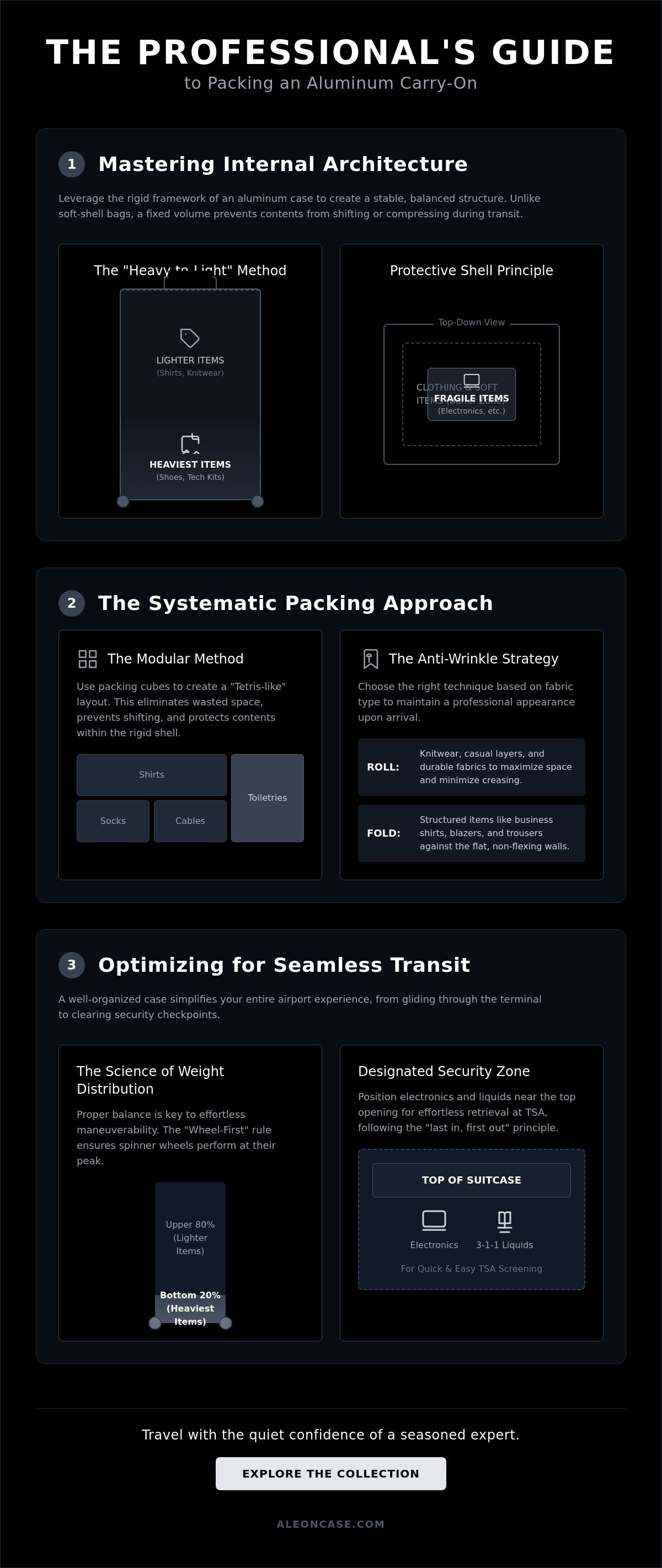
When considering the best way to organize a carry on, you must prioritize the vertical stack. Place your densest items, such as shoes and tech kits, at the base near the spinner wheels. This "Heavy-to-Light" method creates a stable foundation that prevents the bag from becoming top-heavy. Aerospace-grade aluminum reinforces this internal structure, protecting your professional gear from the external pressure of crowded overhead bins.
To visualize these structural packing principles, watch this guide on efficient techniques:
Leveraging the Rigid Shell for Protective Packing
The hard-shell perimeter of premium aluminum luggage acts as a built-in buffer zone. By placing delicate professional equipment or fragile items toward the center of the case, you use the aluminum's strength as a defensive shield. The dual-sided packing design common in these cases also allows for a logical separation of items. It's an ideal system for keeping clean business attire isolated from laundry, ensuring you maintain a polished appearance from arrival to departure.
The Science of Weight Distribution and Balance
The "Wheel-First" rule dictates that you should place your densest, heaviest items within the bottom 20% of the bag's total height. Multi-directional spinner wheels perform at their peak when the internal load is centered and kept low. This balance prevents the suitcase from tipping forward and allows it to glide effortlessly through busy terminals. When weight is distributed correctly, the best way to organize a carry on becomes a matter of physics that simplifies your entire transit experience.
The Systematic Approach to Professional Packing
The debate between rolling and folding depends entirely on the fabric. Roll your knitwear and casual layers to save space; however, always fold structured business shirts and blazers. The flat, non-flexing walls found in aluminum luggage collections provide a superior surface for pressed garments. These cases often feature integrated compression systems that lock your items in place, providing a level of stability that soft-shell bags cannot match.
Don't overlook the small voids within your case. Utilizing the interior of your shoes for socks or charging blocks is a simple yet effective way to reclaim lost space. This practice also helps shoes maintain their shape under the pressure of other packed items, serving as a secondary protective layer for smaller essentials.
Tech and Specialty Equipment Organization
For those utilizing a 17-inch aluminum business case, electronic protection is paramount. Place your heaviest devices toward the center to maintain balance. Organize your cables using the "last in, first out" principle to ensure immediate access for in-flight productivity without disturbing your main packing. Consulting a TSA travel checklist before you pack will help you designate which tech needs to be accessible for screening, ensuring a smooth transition through security.
Maintaining Professionalism: The Anti-Wrinkle Strategy
A pristine appearance is non-negotiable for business success, especially when your travel wardrobe includes high-end designer pieces from Alvin Valley. Use internal compression straps to secure your folded suits against the flat aluminum panels. These straps prevent the micro-movements that cause deep creases during transit. By leveraging the unyielding structure of the case, you create a pressurized environment where clothing remains exactly as you placed it. This methodical approach ensures you arrive at your destination with a wardrobe that is ready for the boardroom.
Optimizing for Seamless Transit and Security
The final phase of architectural packing involves preparing for the high-pressure environment of the airport terminal. To achieve the best way to organize a carry on, you must designate a "Security Zone" at the uppermost part of your suitcase. This area should house your 3-1-1 liquids and primary electronics. It's a simple step that allows you to present items for inspection so you don't disturb the structural integrity of your wardrobe. Utilizing TSA-approved locks further streamlines this process. These integrated systems provide elite security while ensuring that authorized personnel can perform necessary checks without damaging your investment.
TSA Efficiency and Checkpoint Readiness
Efficient scanning begins with how you layer your belongings. Arrange your items in clear, horizontal tiers rather than a cluttered pile. This methodical layering allows X-ray technology to produce a crisp image, which often prevents the need for a manual bag search. Reviewing official TSA travel and packing tips helps you stay updated on current screening requirements. In international hubs, the presence of aerospace-grade security features on your case acts as a silent signal of a prepared, professional traveler.
Underseat vs. Overhead Bin Logic
Strategic organization differs based on where your luggage will reside during the flight. A 16-inch underseat case, such as a pilot unit, should be organized for immediate utility. It holds the tools you need for the journey: noise-canceling headphones, travel documents, and essential chargers. Conversely, a 21-inch carry-on should be packed for your final destination. This larger unit serves as your mobile closet, housing your professional attire and grooming kits that remain untouched until you reach the hotel. By separating transit essentials from destination needs, you maintain a calm and focused travel experience.
Navigating the complexities of modern travel requires more than just a bag; it requires a precision tool. Elevate your journey with an all-aluminum carry-on designed for the modern professional who values both form and flawless function.
Master Your Journey with Precision
Mastering the best way to organize a carry on is an investment in your professional efficiency. By prioritizing internal architecture and utilizing a modular system, you protect both your time and your wardrobe from the stresses of transit. You've learned how to leverage a rigid shell for perfect balance and how to designate strategic zones for rapid security clearance. These methodical steps ensure that your arrival is as polished as your departure.
Success on the road requires equipment that matches your ambition. Our cases feature aerospace-grade aluminum construction that provides a superior shield for your professional tools. With TSA-approved dual locks and a multi-directional spinner wheel system, your movement through the terminal becomes a study in effortless precision. It's time to transition from a traveler who simply packs to one who curates a seamless, high-performance experience.
Shop the ALEON Aluminum Luggage Collection to find the architectural tool that defines your next successful journey. Travel with the quiet confidence of a visionary expert and let your luggage reflect your commitment to enduring excellence.
Frequently Asked Questions
What is the best way to pack a suit in an aluminum carry-on?
Use the flat interior panels of the aluminum shell as a natural press for your garments. Lay the suit jacket face down with sleeves folded naturally across the back, then place trousers on top. Secure the internal compression straps firmly to prevent shifting. This method leverages the unyielding structure of the suitcase to act as a portable garment bag, keeping the fabric smooth throughout your flight.
Should I roll or fold my clothes for a hard-shell suitcase?
Adopt a hybrid strategy based on fabric structure. Roll casual items like cotton t-shirts and undergarments to fill the gaps between your larger modules. Fold structured items, such as business shirts and blazers, to take advantage of the case's flat aluminum surfaces. This combined method is often the best way to organize a carry on because it maximizes density while preserving the integrity of professional attire.
How do I maximize space in a 16-inch underseat bag?
Prioritize vertical organization for immediate accessibility in a 16-inch underseat case. Place your laptop and essential documents in the front-most section for quick retrieval during boarding. Use the "Russian Doll" technique by nesting smaller electronics inside larger accessory pouches. This approach ensures that every cubic inch of the compact aluminum frame is utilized without creating a cluttered interior that hinders your workflow during the journey.
Are packing cubes necessary for aluminum luggage?
Packing cubes are highly recommended for maintaining order within a rigid aluminum frame. They act as internal drawers that prevent your belongings from tumbling when the case is opened at security or in the cabin. These cubes create a modular system that complements the fixed volume of the shell, allowing you to categorize items by utility or day of travel for a more logical and efficient experience.
How do I protect my electronics in a carry-on?
Position your most sensitive electronics in the geometric center of the suitcase. Surrounding your devices with soft clothing layers creates a natural shock absorber against the vibrations of travel. The aerospace-grade aluminum shell provides the primary defense against external impact, while internal padded sleeves offer a secondary layer of protection for screens and delicate internal components during high-speed transit.
How do I balance my carry-on so it doesn't tip over?
Concentrate the heaviest items toward the base and as close to the wheel assembly as possible. Placing weight near the bottom 20% of the bag's height lowers the center of gravity and stabilizes the multi-directional spinner wheels. This is the best way to organize a carry on to prevent tipping. Ensure that the weight is also balanced side-to-side within the aluminum shell to maintain smooth mobility through the terminal.


