


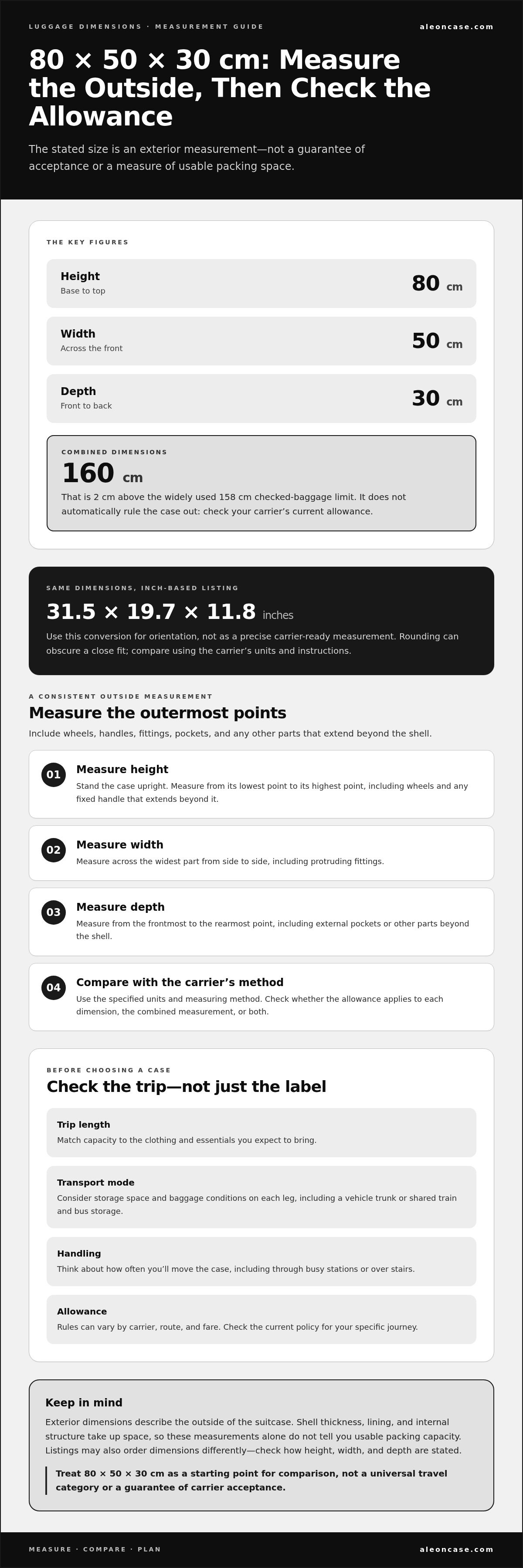
An 80×50×30 cm suitcase adds up to 160 cm across its three dimensions, just above a widely used 158 cm checked-baggage limit. That does not automatically rule it out, but it does mean you should check your carrier’s allowance before travelling.
It’s easy to mistake a case’s exterior measurements for its usable packing space, or to compare centimetres with inch-based listings and get the wrong impression. This guide explains what the dimensions mean, how to measure a suitcase consistently, including wheels and handles, and how to judge whether it suits your trip. You’ll also see how the size converts to inches and why the airline, route and fare can affect whether the case travels smoothly.
Key Takeaways
- Read each dimension as an exterior measurement, and check how the listing orders height, width and depth.
- For an 80×50×30 cm case, measure the outermost points and include wheels, handles and other protrusions.
- Compare your measurement with the carrier’s current baggage rules, which can vary by route and fare.
- Balance packing needs with trip length, transport mode and ease of handling when choosing a size.
What Does 80×50×30 cm Mean for a Suitcase?
The three figures describe a suitcase’s height, width and depth, usually in centimetres. Height runs from the base to the top, width across the front, and depth from front to back. Listings do not always present the measurements in that order, however, and a case may be measured upright or in another position. Check the stated measurement method before comparing cases.
These figures usually refer to the suitcase’s exterior, not the space available for packing. Shell thickness, lining and internal structure take up room, so exterior measurements alone cannot tell you how much the case holds. 80×50×30 cm describes a bag’s stated dimensions, not a guarantee of carrier acceptance. For background on how baggage categories and travel rules relate, see Baggage regulations and types.
Is 80×50×30 cm a standard suitcase size?
No single set of dimensions defines a universal carry-on or checked-baggage category. Carriers set their own allowances, and the rules may depend on your journey. Exterior dimensions also differ from interior packing capacity: the measurements describe the outside, while usable space depends on the case’s construction. Don’t infer a specific packing volume from these measurements alone.
Use the dimensions as a starting point for comparison, not as a travel classification. ALEON’s aluminum luggage options offer a range of case styles, but a product category does not mean a particular case measures 80×50×30 cm. To assess a specific suitcase, measure its outermost points and compare them with your carrier’s current limits.
How to Measure an 80×50×30 cm Suitcase and Check the Rules
Measure the suitcase itself rather than relying only on a product label. Wheels, handles and other protrusions can affect the result, so use the same measurement method that the carrier specifies.
- Measure the height: Stand the suitcase upright and measure from its lowest point to its highest point, including wheels and any fixed handle that extends beyond the case.
- Measure the width: Measure across the widest part from side to side, including protruding fittings.
- Measure the depth: Measure from the frontmost to the rearmost point. Include external pockets or other parts that extend beyond the shell.
- Compare the result: Use the carrier’s stated measuring method and units, and review the rules for your specific route and fare.
Compare the measured exterior with the current baggage rules for your specific carrier and route. Check whether the allowance applies to each dimension, the combined measurement, or both. Don’t assume a case is within limits just because its listed dimensions look close.
How do you compare centimetres with inch-based baggage limits?
An 80×50×30 cm case is approximately 31.5×19.7×11.8 inches. Treat this as a conversion for orientation rather than a precise carrier-ready measurement: rounding can obscure a close fit. Measure the case, then compare it using the carrier’s units and instructions. If the carrier counts protruding parts, include those outermost points.
Clear measurements help you make a practical comparison. As you weigh size against your travel needs, explore aluminum luggage options as one category to consider.
Choosing Luggage After Checking 80×50×30 cm
Let your itinerary set the priorities. A longer trip may call for more packing room, while a short stay or a journey with several transfers may be easier with a case that is simpler to manoeuvre and store. Think about where the suitcase needs to go, whether in checked baggage, a vehicle trunk, or shared train and bus storage. More capacity is not automatically more practical.
Before choosing, weigh these factors:
- Trip length: Match capacity to the clothing and essentials you expect to bring.
- Transport mode: Account for storage space and baggage conditions on each leg of the journey.
- Handling: Consider how often you’ll move the case, including through busy stations or over stairs.
- Allowance: The carrier’s current rules determine acceptance, so check the policy for your specific journey and fare.
An 80×50×30 cm case may suit one itinerary but create difficulty on another. Base your choice on the actual route, planned packing and storage needs, rather than treating the measurement as a universal category or assuming a carrier will accept it.
When might an aluminum case suit your travel needs?
Material is a separate consideration from size compliance. ALEON luggage features all-aluminum construction and weatherproof seals. The range includes different case styles, from the 16" Aluminum Vertical Under-Seat Carry-On to larger checked cases. Compare the dimensions stated for the specific model with your travel requirements in the aluminum luggage collection.
A material preference does not determine whether a case meets a carrier’s allowance. Use the case’s measured exterior and the carrier’s current rules to assess fit, then consider whether its construction and style suit the way you travel.
Choose a Case That’s Ready for Your Next Journey
Choose luggage for the way you travel, not just a number on a label. After deciding whether 80×50×30 cm works for your itinerary, look for a case with dimensions that fit your needs and materials that suit your preferences. ALEON luggage features all-aluminum construction and weatherproof seals. Its Limited 10-Year Worry-Free Warranty covers defects in materials or workmanship and must be registered on the ALEON website to be valid.
Explore the range and compare the case options for your next trip. Explore ALEON aluminum luggage and choose a case with your route, packing needs and preferred design in mind.
Frequently Asked Questions
Is 80×50×30 cm allowed as carry-on luggage?
Usually, no. At 80×50×30 cm, a case is substantially larger than the 56×35×23 cm carry-on dimensions many major airlines are moving toward enforcing. Allowances still vary by carrier, route and fare. Check the operating airline’s current cabin-bag rules before travelling, especially if your ticket has a more restrictive baggage allowance.
How do I measure a suitcase correctly?
Use a tape measure and record the suitcase in the condition you plan to travel with it. Measure its height, width and depth separately, noting the units and the points you measured from. If an expandable section or flexible pocket will be in use, measure the case in that configuration so your comparison reflects how it will be presented.
Can an 80×50×30 cm suitcase be used as checked luggage?
It may be accepted, but the dimensions alone can’t determine that. Some carriers set a combined limit for the three exterior sides, while others specify a maximum for each side. Check the rules for your operating airline, route, fare and travel class, and look for any separate instructions on oversized baggage before heading to the airport.
What is 80×50×30 cm in inches?
80×50×30 cm is approximately 31.5×19.7×11.8 inches, respectively. These figures are rounded, so use them as a convenient comparison rather than an exact measurement near a limit. If your carrier lists dimensions in inches, compare against its stated units and follow its guidance on which parts of the suitcase count.


