


That $200 polycarbonate suitcase might be the most expensive travel mistake you make this year. While the entry price feels accessible, the hidden cycle of cracked shells and broken wheels creates a recurring tax on your wallet. You've likely felt the frustration of a zipper failing right before a critical meeting or realized that worn-out gear doesn't match your professional trajectory. Investing in quality means understanding the high resale value of aluminum luggage, which transforms a simple purchase into a long-term travel asset.
We'll demonstrate why aerospace-grade aluminum is a high-yield investment by analyzing its total cost of ownership compared to disposable plastic alternatives. This guide breaks down the math behind the ten-year travel cycle, the secondary market for premium cases, and how to protect your electronics with a shell that actually holds its value over time.
Key Takeaways
- Shift from a short-term expense mindset to a strategic investment approach that bypasses the frequent replacement cycle of traditional hard-shell cases.
- Learn to calculate the true cost of ownership by factoring in the high resale value of aluminum luggage and the savings gained from extreme durability.
- Evaluate the security dividends of aerospace-grade aluminum, which offers superior protection for high-value electronics compared to flexible materials.
- Discover how specialized gear, such as the 17-inch aluminum pilot case, serves as a functional asset that reinforces professional credibility during critical trips.
The 'Disposable Luggage' Trap: Why Cheap Bags Cost More Over Time
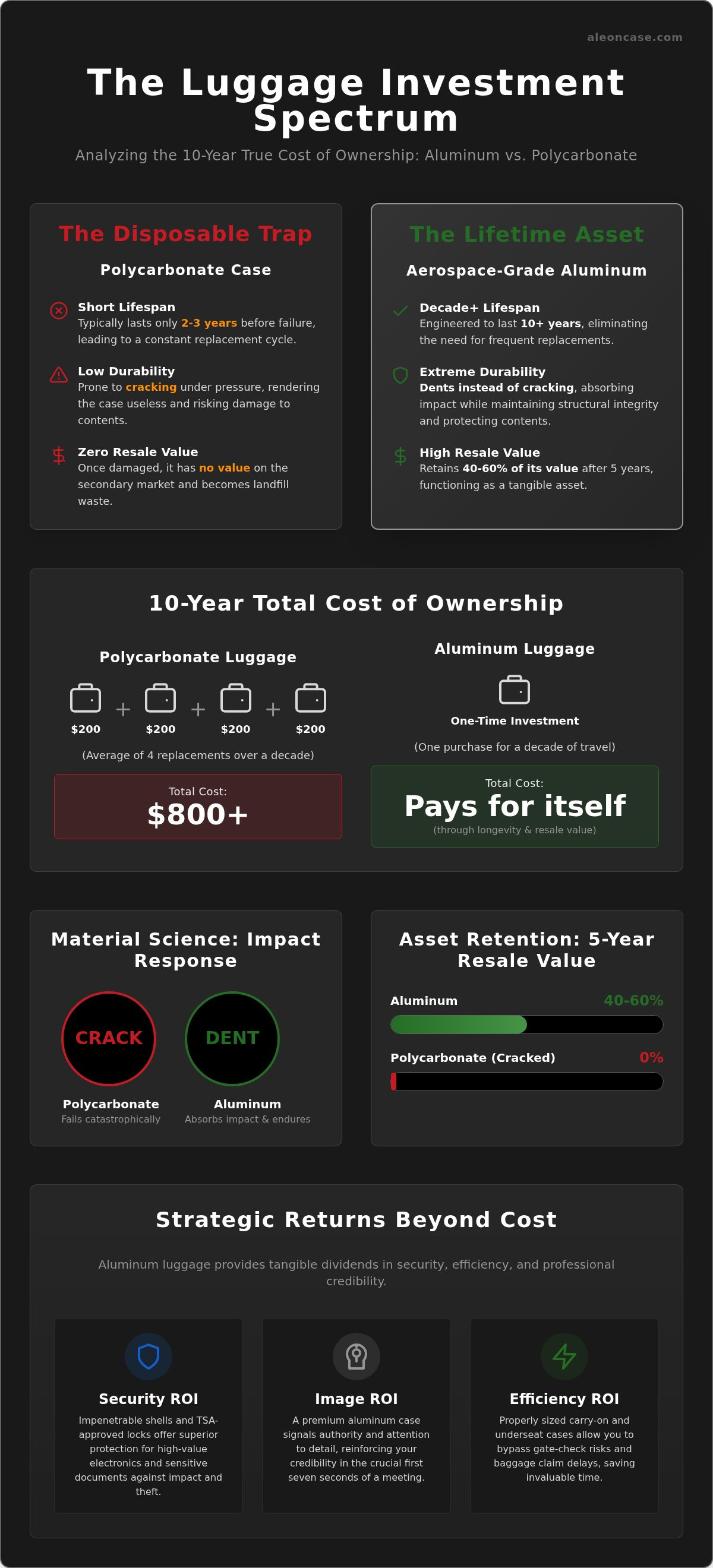
Frequent travelers often fall into the trap of buying for the next trip rather than the next decade. While a polycarbonate bag seems affordable, its typical 2 to 3 year lifecycle creates a cycle of constant replacement. This is a classic example of planned obsolescence, where products are designed with an artificially limited life. The costs aren't just financial. They include the stress of a zipper failing mid-transit and the expense of emergency airport replacements. Choosing all aluminum carry on luggage shifts your perspective from a temporary expense to a long-term investment.
The true cost of budget gear includes the risk to your professional image and your equipment. A worn-out bag suggests a lack of attention to detail. More importantly, fragile shells offer little protection for high-value electronics. When you calculate the resale value of aluminum luggage, the initial price tag begins to look like a wise allocation of capital. By choosing materials that endure, you ensure that your gear remains a liquid asset rather than a disposable burden. This logic extends to your physical workplace; to find premium preowned office solutions and workstations that hold their value, click here.
Material Science and the Durability Gap
Aluminum handles impact differently than plastic. While polycarbonate often cracks under extreme pressure, aluminum absorbs energy by denting. A dent preserves the structural integrity of the case, whereas a crack renders it useless. ALEON's construction utilizes aerospace-grade materials and reinforced multi-directional spinner wheels to eliminate common mechanical failure points. This engineering serves as a hedge against the frequent replacement cycles of budget alternatives while protecting the resale value of aluminum luggage for years to come. You aren't just buying a suitcase; you're securing a reliable travel companion that maintains its functional and aesthetic value.
The Luggage ROI Formula: Calculating Resale Value and TCO
Treating travel gear as a capital asset requires a shift in financial perspective. The standard Luggage ROI formula is simple: (Replacement Savings + Resale Value - Initial Investment) / Initial Investment. Over a decade, a $200 polycarbonate bag replaced four times costs $800, plus the hidden tax of lost time during failures. In contrast, aluminum carry-on luggage maintains its structural integrity, effectively paying for itself through longevity and performance.
Unlike plastic, which has zero value once it cracks, the resale value of aluminum luggage remains robust. Premium cases often retain a significant portion of their original price on the secondary market. This durability aligns with the principles of a circular economy, where high-quality materials are kept in use rather than entering a landfill. For those who prioritize efficiency, the time saved by avoiding mid-trip repairs adds an intangible but vital "Time Value" to the equation. If you're ready to upgrade your travel strategy, exploring an all aluminum carry on luggage solution is the first step toward better ROI.
Step-by-Step ROI Calculation for Travelers
- Step 1: Calculate your annual travel frequency and current baggage failure rate to determine your replacement cycle.
- Step 2: Estimate the cost of a mid-trip emergency replacement bag, which often exceeds $150 at airport retail locations.
- Step 3: Factor in a 40-60% resale value for a well-maintained aluminum case after five years of use.
Strategic Returns: Security, Efficiency, and Professional Image
Beyond the math of cost per trip, aluminum gear offers strategic dividends that plastic alternatives can't match. Security ROI is paramount when you're transporting high-value electronics or sensitive documents. Impenetrable aerospace-grade shells and TSA-approved locks ensure your devices remain secure against both impact and theft. Professionally, your gear acts as a vital nonverbal cue. Research suggests you have only seven seconds to make a positive first impression. A 17" aluminum pilot case signals authority and precision, reinforcing your credibility before you even speak. This enduring aesthetic contributes to the high resale value of aluminum luggage, as true craftsmanship never goes out of style.
Efficiency is another measurable return on your investment. Utilizing 16" underseat luggage allows you to bypass gate-check risks and baggage claim delays entirely. You move from the jet bridge to your destination without friction or the fear of lost items. There's also a distinct Social ROI to consider with ALEON. A portion of every sale supports solar energy initiatives in Honduras, adding a layer of global responsibility to your purchase. This commitment to sustainability adds ethical value to your asset, ensuring your travel choices align with your broader values.
The Underseat Advantage for Business Professionals
The 16" underseat case optimizes the mobile office experience by keeping your most critical tools within arm's reach. It eliminates the common anxiety of crowded overhead bins and protects your professional brand from the "worn-out" look of cheap gear. These aluminum business cases provide a seamless travel experience where gear security is guaranteed. We define Professional ROI as the measurable gain in travel seamlessness during high-stakes trips. By maintaining the resale value of aluminum luggage, you ensure that your gear remains a liquid asset that supports your professional trajectory for years.
Investing in Your Professional Journey
Travel gear shouldn't be a recurring expense that ends in a landfill. By shifting to an investment mindset, you've seen how aerospace-grade durability and high resale value retention transform a suitcase into a strategic asset. You're no longer just buying a bag; you're securing your electronics and elevating your professional credibility. The high resale value of aluminum luggage ensures that your capital remains protected even if you decide to upgrade your collection later. Your choice also supports global solar initiatives, adding a layer of social impact to every mile you fly. It's time to break the cycle of disposable gear and choose a companion built for the long haul. Invest in a lifetime of travel with ALEON aluminum luggage and experience the confidence that comes with true quality. Your next successful journey starts with the right equipment.
Frequently Asked Questions
Is the resale value of aluminum luggage higher than plastic?
Yes, aluminum retains a significant portion of its original cost while used plastic often has zero market value. This is due to the material's inherent durability and the premium status of aerospace-grade cases. Buyers on secondary markets value the structural integrity that aluminum provides over the brittle nature of polycarbonate. This performance gap is a primary driver for the resale value of aluminum luggage.
How many years should a high-quality aluminum suitcase last?
A well-constructed aluminum suitcase can easily last a decade or more with regular use. Unlike plastic bags that need replacement every two or three years, these cases are engineered for longevity. The robust frame and reinforced components like multi-directional spinner wheels ensure the case remains functional and aesthetically polished. This durability prevents the hidden costs of frequent replacements during your professional journey.
Does aluminum luggage dent, and does that affect its resale value?
Aluminum luggage does dent upon impact, but these marks are often viewed as a patina that tells a traveler's story. Unlike plastic, which cracks and loses all function, a dented aluminum case remains structurally sound. This unique characteristic helps maintain the resale value of aluminum luggage, as collectors and frequent flyers appreciate the material's proven history of protection and its distinct aesthetic.
Is aluminum luggage too heavy for international carry-on limits?
Most aluminum carry-ons are designed to meet standard weight and size regulations for major international carriers. While aluminum is heavier than fabric or thin plastic, a 21" aluminum carry-on is optimized to balance extreme protection with weight efficiency. It's best to check specific airline weight tiers before flying. These cases remain the standard equipment for global business travelers who prioritize security and reliability.
Can I use an aluminum underseat case on all major US airlines?
The 16" underseat luggage is specifically designed to fit within the dimensional requirements of major US domestic airlines. This compact size allows you to avoid gate-check risks and keep your essentials accessible throughout the flight. It's a reliable solution for maintaining professional efficiency. You'll ensure your high-value gear never leaves your sight during transit while maintaining a polished, authoritative image.
How do TSA-approved locks improve the ROI of my luggage?
TSA-approved locks protect the internal contents from theft and unauthorized access, which secures the ROI of your expensive electronics. By preventing the need for forced entry by security personnel, these locks also preserve the structural integrity of the latches. This protection ensures the case remains in top condition. It directly supports the long-term value of your investment by keeping the hardware functional.


