


Small hardware can make a lasting difference to how luggage holds together. Rivets form a joint when their shafts deform inside the holes, helping the fasteners stay seated rather than loosen as threaded fasteners can. The benefits of riveted luggage construction include durable joints, fewer routine adjustments, and a visible sign of considered assembly.
It makes sense to look beyond a suitcase’s finish: dependable construction matters when luggage is opened, closed, lifted, and carried. This article explains how rivets resist loosening, what that can mean for upkeep, and why the way they’re set reflects careful assembly. You’ll also learn where riveted joints matter most and how to assess construction alongside the rest of a case’s design.
Key Takeaways
- Assess how a suitcase’s joints are fastened, not just its exterior finish, when considering long-term durability.
- Learn why riveted joints can resist loosening with repeated handling and how that supports reliable construction.
- See how secure fastening can reduce routine maintenance while understanding why overall build quality still matters.
- Use rivet placement and finishing as clues to careful assembly, alongside the case’s intended use.
Rivet durability and resistance to loosening
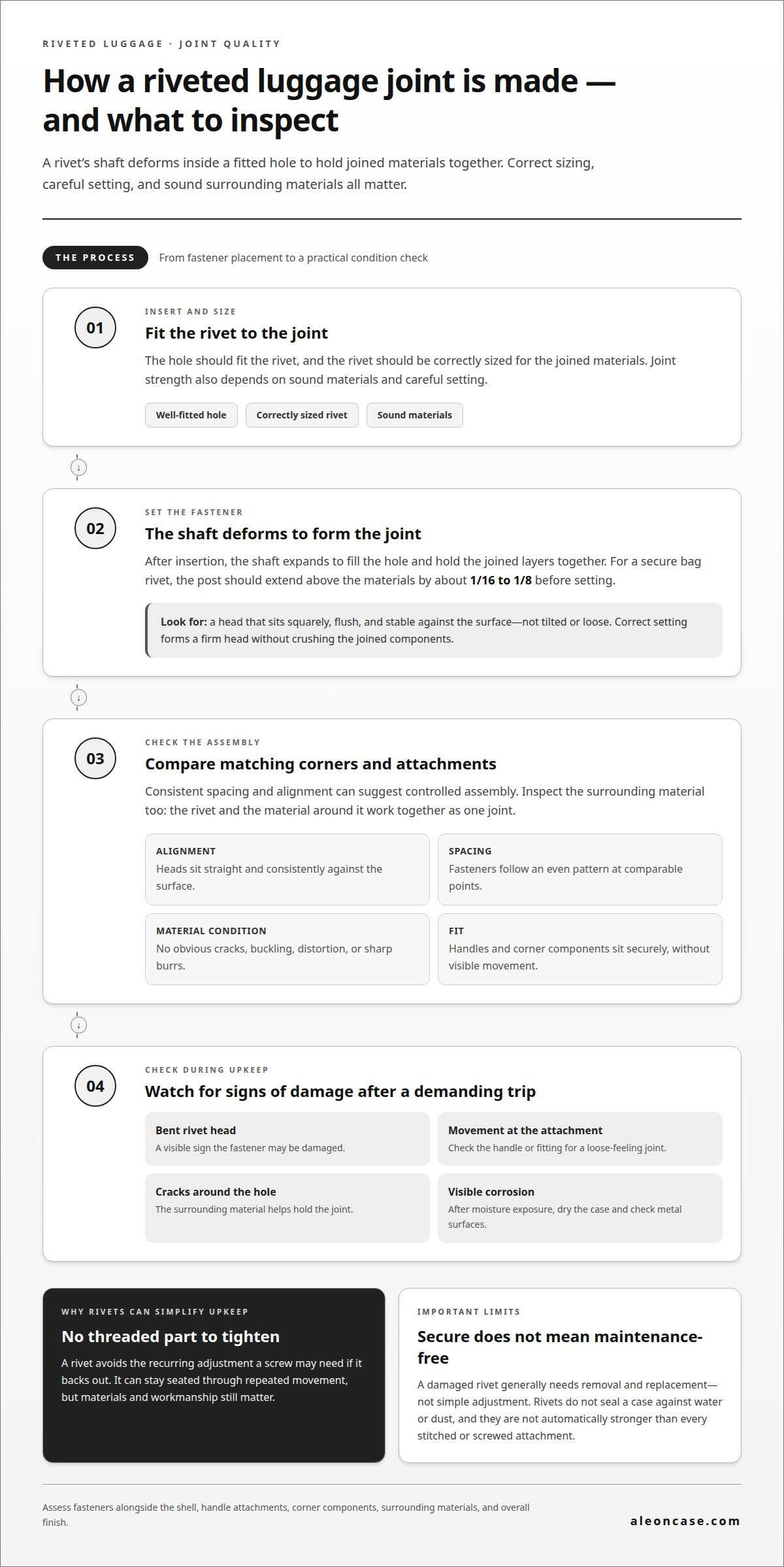
A rivet forms a joint when its shaft deforms after insertion, expanding to fill the hole and hold the joined materials together. Unlike a threaded screw, it has no thread that can gradually back out under repeated vibration. This makes rivets a durable option for luggage corners and handles, where lifting and handling repeatedly stress attachment points. Joint strength still depends on a correctly sized rivet, a well-fitted hole, sound materials, and careful setting.
At corners and handles, rivets create a mechanical connection through the joined layers. Stitching relies on thread, while screws rely on threaded engagement. A well-set rivet can stay seated through repeated movement, but that doesn’t make every riveted attachment stronger than every stitched or screwed one. Materials and workmanship matter.
Welded and molded hard-shell construction join or form materials differently, so neither method is automatically less durable than riveting. Rivets are visible, discrete fasteners; welded seams and molded shells have different joint structures. Travelers comparing construction with case material can explore aluminum luggage options without assuming that rivets alone determine durability.
In the United States, there’s no meaningful typical price for riveted luggage based on its fasteners alone. Overall cost varies with factors such as case size, shell material, hardware, and finish. Rivet construction is only one part of the design.
Rivets add hardware, which can contribute to a case’s weight; the total depends on the materials and overall design. Repairs can also be less straightforward than tightening a screw: a damaged rivet generally needs to be removed and replaced, rather than simply adjusted.
Rivets join materials, but they don’t seal a suitcase against water or dust. Protection from moisture, particles, or tampering depends on other design features, such as the case closure and locks, not the rivets alone.
Reduced maintenance
For a travel case, less maintenance means fewer fastener adjustments during ordinary use. A rivet has no threaded part to tighten, so it avoids the recurring adjustment a screw may need if it backs out. That can simplify upkeep around a handle mount or corner fitting, where movement repeatedly stresses the joint.
Rivets don’t make a suitcase maintenance-free. The shell, handle, lining, and closure still need care. After a demanding trip, look for a bent rivet head, movement at the attachment, cracks around the hole, or corrosion. These signs point to damage that cleaning alone won’t address. Keeping grit away from moving parts and drying a damp case also helps protect components beyond the riveted joint.
- At a handle: watch for a loose-feeling attachment or a changing gap around the rivet.
- At a corner: note dents or cracks that could affect the material holding the fastener.
- After exposure to moisture: dry the case and check metal surfaces for visible corrosion.
Can riveted luggage be repaired, and what does rivet replacement cost? A damaged rivet can be removed and replaced, but the repair also depends on access and the condition of the surrounding material. Cost varies with the rivet, labor, and whether the attachment area needs repair; no single price applies to every case.
In industrial production, riveting tools can set fasteners efficiently, but a durable repair still depends on correct placement and a sound joint. A replacement rivet must suit the joined materials and fit the existing hole. Poor alignment or a damaged hole can compromise the repair, even when the new fastener is sound.
In renewable energy systems, rivet durability and corrosion resistance can mean less maintenance and greater long-term reliability. Advanced materials can help rivets maintain structural integrity in applications exposed to extreme temperatures.
Craftsmanship and quality
A well-made riveted joint shows care in the details. The rivet should sit squarely, with its head flush and stable against the surface, rather than tilted or loose. For a secure bag rivet, the post should extend above the materials by about a sixteenth to an eighth before setting. This allowance lets the post form a firm head without crushing the joined components.
Consistency matters across the case. Compare rivets at matching corners or handle attachments: even spacing and similar alignment suggest controlled assembly. Inspect the surrounding material, too. A clean hole with no visible cracking or distortion helps show that the fastener was set without damaging the shell. The rivet and the material around it work together as one joint.
What should travelers look for when choosing riveted luggage? Examine the fastener heads, spacing, and nearby surfaces, especially around handles and corners. Look for evenly set rivets and intact surrounding panels.
- Alignment: rivet heads sit straight and consistently against the surface.
- Spacing: fasteners follow a deliberate, even pattern at comparable attachment points.
- Material condition: holes and edges show no obvious cracks, buckling, or sharp burrs.
- Fit: handles and corner components sit securely, without visible movement at their joints.
A polished finish is only one part of quality. Rivets may also attach leather to a bag without sewing through it, making their placement and finish especially visible. Consider the full assembly: orderly fasteners, undamaged materials, and well-fitted components offer more useful evidence of workmanship than decorative hardware alone.
In construction applications, high-quality rivets can resist corrosion and exposure to adverse weather. That performance is specific to the application, so it shouldn’t be taken as proof of how a luggage rivet will perform.
ALEON
ALEON offers aluminum luggage for travelers who value considered construction and lasting utility. Rivets are one detail to assess alongside the shell, handle attachments, corner components, and overall finish. The range includes underseat, carry-on, and check-in luggage, with options for different journeys. Fastener style is only one measure of quality.
As you compare cases, consider how size and intended use shape your priorities. Compact aluminum luggage suits a different travel role than a larger check-in case. Look for a well-finished design that aligns with how you travel and the features you value.
If you’d like to discuss your luggage needs, contact ALEON.
Choose a Case for the Journeys Ahead
Construction is one part of a thoughtful luggage choice. Match the case to how you travel, what you carry, and the handling it will encounter. The benefits of riveted luggage construction matter most when the fastening method supports your routine, rather than serving as a feature in isolation.
ALEON’s range includes 16" underseat luggage, a 17" aluminum pilot case, and a 21" aluminum carry-on. Consider which format best fits your travel needs, then weigh its materials and overall design alongside the details of its joints. A considered choice can make each departure feel more composed.
For help exploring luggage options, contact ALEON about riveted luggage. Take the next step toward a case that suits the way you travel.
Frequently Asked Questions
What are the benefits of riveted luggage construction?
The benefits of riveted luggage construction include secure fastening at joints and fewer adjustments than threaded fasteners may require. Rivets can be useful where components meet and repeated handling stresses the connection. Their presence alone doesn’t establish overall case quality, though. The shell, handle assembly, fastener placement, and finish all contribute to how luggage performs in regular use.
How do rivets improve luggage durability and structural strength?
Rivets help hold joined components together, allowing the connection to resist movement during handling. Their structural contribution depends on the joint’s design, the materials being joined, and the quality of installation. A rivet can secure a connection, but it can’t compensate for a cracked panel or poorly supported attachment. Assess the surrounding construction as well as the visible fastener.
Are riveted suitcases more resistant to impacts and rough handling?
Riveted joints don’t make a suitcase immune to impact. A rivet may keep joined parts connected, while a hard knock can still dent or damage the shell around the joint. Resistance to rough handling depends on the case’s overall design and materials, not the fastening method alone. For frequent travel, consider the shell, corners, handles, and closures together.


