


The most trusted name in soft-shell luggage might not be the smartest choice for serious travelers anymore. Briggs & Riley has built a loyal following on the strength of its lifetime guarantee and durable nylon construction, and that reputation is well-earned. But when your bag is sitting on a baggage carousel, passing through crowded terminals, or representing you in a client meeting, "durable nylon" starts to feel like a compromise rather than a credential.
You already know the frustration: a scuffed zipper that won't fully close, a fabric corner that caught on something it shouldn't have, or a bag that simply doesn't project the professional image your career demands. Those concerns are valid, and they're exactly why more discerning travelers are asking a sharper question: is heritage soft-shell engineering still the benchmark, or has aerospace-grade aluminum changed the standard entirely?
This guide gives you a clear, honest answer. We'll compare material durability, security features, and professional aesthetics across both categories so you can choose a travel companion that works as hard as you do.
Key Takeaways
- The Briggs & Riley lifetime warranty is impressive, but warranty coverage and structural protection are two different things — and understanding that distinction changes how you evaluate premium luggage.
- Aerospace-grade aluminum offers measurable advantages over ballistic nylon in impact resistance and weatherproofing, particularly for travelers carrying sensitive electronics or navigating unpredictable conditions.
- The professional aesthetic of aluminum luggage goes beyond appearance — discover how construction material directly influences security, durability, and the impression you make in high-stakes environments.
- Specialized form factors, such as the 17-inch aluminum pilot case, are engineered to function as mobile offices rather than simple carry-alls — a critical distinction for frequent business travelers.
- Brand values increasingly factor into purchasing decisions — learn how ALEON's commitment to solar energy initiatives sets it apart from traditional luggage manufacturers at a corporate level.
Briggs & Riley vs. ALEON: Heritage Utility Meets Modern Innovation
Premium luggage has always been a reflection of how professionals travel. For decades, that reflection was soft-shell: tightly woven ballistic nylon, reinforced corners, and a brand promise built on repairability. Briggs & Riley mastered that era. But eras evolve, and the materials defining executive travel today look fundamentally different from those that defined it twenty years ago.
Understanding where each brand stands requires looking beyond marketing language and examining the philosophy underneath each product. Briggs & Riley built its reputation on functional utility: bags engineered to survive real-world abuse, backed by a warranty that removes the financial risk of ownership. It's a compelling proposition, and for a specific type of traveler, it remains genuinely relevant.
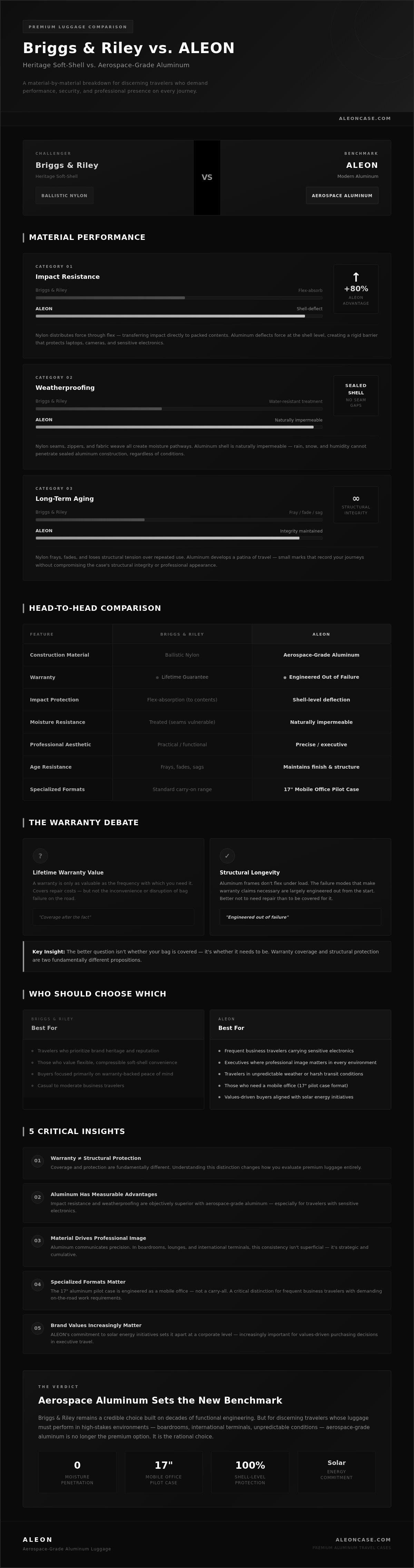
ALEON operates from a different premise entirely. Aerospace-grade aluminum isn't a cosmetic upgrade; it's a structural rethinking of what luggage can do. Where nylon absorbs stress through flexibility, aluminum deflects it through rigidity. That distinction matters the moment your bag is stacked under three others in an overhead bin, or when you're walking into a boardroom and every detail of your professional presentation is being assessed.
The Warranty Debate: Lifetime Coverage vs. Structural Longevity
A lifetime warranty is only as valuable as the frequency with which you need it. Soft-shell bags, regardless of how well they're constructed, are subject to fabric fatigue, zipper wear, and the gradual structural sag that comes from repeated compression. ALEON's aluminum frames don't flex under load the way nylon does, which means the failure modes that make warranty claims necessary are largely engineered out from the start. The better question isn't whether your bag is covered; it's whether it needs to be.
Aesthetic Appeal: Minimalist Aluminum vs. Traditional Nylon
Professional image is cumulative. A nylon bag communicates practicality. An aluminum case communicates precision. Over years of use, nylon develops micro-abrasions, color fading, and subtle deformation that signal wear. Aluminum maintains its finish with straightforward care, and its clean geometric lines don't date the way fabric textures can. For executives whose luggage appears in client meetings, airport lounges, and international terminals, that consistency isn't superficial; it's strategic.
The modern visionary isn't choosing between durable and stylish. They're choosing materials that deliver both without compromise. Explore ALEON's full range of aluminum luggage to see how that standard translates across every travel format.
Material Performance: Ballistic Nylon vs. Aerospace-Grade Aluminum
Material choice isn't a preference. It's a performance decision with real consequences across every trip you take. Briggs & Riley's ballistic nylon is genuinely impressive fabric engineering, but fabric has inherent physical limits that no amount of weaving or reinforcement can fully overcome. Aluminum doesn't share those limits.
Consider impact resistance first. When a bag is dropped, compressed, or thrown onto a conveyor belt, nylon distributes force through flex. That flex protects the fabric itself, but it transfers directly to whatever is packed inside. Aerospace-grade aluminum does the opposite: it absorbs and deflects impact at the shell level, creating a rigid protective barrier between the external force and your contents. For travelers carrying laptops, cameras, or sensitive equipment, that distinction isn't minor. It's the difference between a device that arrives intact and one that doesn't.
Weatherproofing follows the same logic. Nylon can be treated for water resistance, but seams, zippers, and fabric weave all create pathways for moisture. Aluminum is naturally impermeable. Rain, snow, and humidity don't penetrate a sealed aluminum shell the way they can compromise soft-shell construction over time.
The weight argument against aluminum is largely outdated. Modern aerospace-grade aluminum cases are engineered for a balance of structural integrity and manageable weight. The difference between a premium nylon bag and a well-constructed aluminum case is often negligible in practical terms, particularly when you factor in the added protection you're carrying.
Aging tells perhaps the clearest story. Nylon frays, fades, and loses structural tension with repeated use. Aluminum develops a patina of travel: small marks that record your journeys without compromising the case's integrity or professional appearance. One material declines; the other accumulates character.
Security Features: Beyond the TSA Lock
Zippers are the most exploited vulnerability in soft-shell luggage. A ballpoint pen can breach most zipper closures in seconds, a fact well-documented among frequent travelers and security professionals. Aluminum frames eliminate that vulnerability entirely. There's no zipper to compromise. Access is controlled entirely through integrated locking mechanisms, which means the only way in is through the lock itself.
- Aluminum frames: Integrated TSA-approved locks built directly into the case structure, with no external zipper exposure
- Soft-shell cases: TSA locks typically secure zipper pulls, but the zipper track itself remains a separate and exploitable point of entry
- External padlocks: Add weight and can be removed without opening the bag, offering security theater rather than genuine protection
The integration matters. A lock that's part of the frame is structurally different from a lock attached to fabric. One secures the case; the other secures a component of it.
Internal Organization and Capacity
Briggs & Riley's CX expansion technology is a genuine engineering achievement, allowing bags to compress after packing and expand when needed. It solves a real problem for travelers who pack variably across trips. Aluminum cases take a different approach: fixed, precisely engineered internal dimensions that reward intentional packing over reactive adjustment.
That rigidity is an advantage in specific contexts. A fixed interior creates predictable space that experienced travelers learn to use efficiently. Specialized cases like the 16-inch underseat aluminum luggage are dimensioned to maximize usable volume within airline underseat restrictions, delivering reliable access to your essentials throughout a flight without the variability that comes with expandable soft-shell construction.
The right organizational system depends on how you pack. If your volume changes significantly trip to trip, soft-shell flexibility has real value. If you travel with consistent kit and prioritize protection and access over adaptability, rigid aluminum organization is the more precise tool.
The Professional's Choice: Why ALEON is the Superior Alternative
Some luggage carries your belongings. The right luggage carries your reputation. For professionals who've outgrown the Briggs & Riley proposition, the question isn't whether to upgrade; it's knowing exactly what to upgrade to.
ALEON's answer is aluminum, engineered from the ground up for the demands of modern executive travel. That engineering extends beyond the shell itself into the brand's broader commitments, including solar energy initiatives in Honduras that reflect a corporate philosophy built on long-term thinking rather than short-term positioning. For professionals whose purchasing decisions increasingly reflect their values, that distinction carries genuine weight.
Specialty Cases for Professionals
The 17-inch aluminum pilot case is the clearest expression of what purpose-built travel equipment looks like. It's not a carry-on with a padded sleeve added as an afterthought. The internal dimensions are engineered to function as a mobile office: structured compartments for documents, devices, and accessories that remain organized and accessible regardless of how the case is handled in transit. Photographers and technical professionals will find the all-aluminum camera case equally compelling. Where soft-shell cases transfer external impact directly to sensitive equipment, a rigid aluminum shell intercepts that force at the case level. The contents don't flex because the case doesn't.
For frequent flyers choosing between ALEON's Vertical and Horizontal Business Units, the distinction is practical rather than aesthetic. The vertical configuration suits professionals who move quickly through terminals and need immediate top-access retrieval. The horizontal unit rewards those who prefer a flat, organized workspace when the case is opened, prioritizing visibility across all contents at once.
Making the Switch to Aluminum
Transitioning from soft-sided luggage to a premium aluminum carry-on is straightforward when approached methodically. Consider this checklist:
- Audit your current packing volume. Aluminum cases have fixed dimensions; identify whether your typical load fits a 16-inch underseat, 21-inch carry-on, or checked configuration before purchasing.
- Reassess your organizational system. Rigid interiors reward consistent packing habits. Invest in packing cubes or compression pouches to maximize structured space.
- Register your TSA lock combination immediately. Integrated locks are a security feature, not a formality. Set and record your combination before your first trip.
- Learn the care basics. Aluminum maintains its finish with minimal effort: a soft cloth, mild soap, and occasional polish for surface marks. Avoid abrasive cleaners. That's the entirety of the maintenance requirement.
Investment value follows directly from that simplicity. Nylon degrades through use; aluminum doesn't share that trajectory. A well-maintained aluminum case doesn't lose structural integrity, aesthetic appeal, or resale value the way soft-shell luggage does over years of travel. It's a single purchase decision made once, correctly, rather than a recurring replacement cycle.
The discerning traveler's starting point is clear: identify your primary travel format, match it to the appropriate ALEON case, and travel with the confidence that the equipment beneath your hand was built to outlast every destination on your itinerary.
Your Next Trip Deserves Better Equipment
The case against Briggs & Riley isn't about quality. It's about evolution. Ballistic nylon served a generation of professionals well, but aerospace-grade aluminum has raised the standard in ways that fabric simply can't match: rigid impact protection, integrated TSA-approved locks with no zipper vulnerabilities, and a professional finish that doesn't degrade with use.
Three things worth carrying forward from this guide. First, warranty coverage and structural protection aren't the same thing. Second, the security gap between a zipper closure and an integrated aluminum lock is real and exploitable. Third, the right case isn't just a container; it's a statement about how seriously you take your work.
ALEON's aluminum collection is built for professionals who've made that distinction. With aerospace-grade construction, TSA-approved integrated locks, and free shipping on premium business cases, the upgrade is more accessible than you might expect.
Your itinerary won't wait. Upgrade to aerospace-grade aluminum and shop the ALEON collection today.
Frequently Asked Questions
Is Briggs & Riley Better Than Aluminum Luggage for International Travel?
For most international routes, aluminum luggage holds a measurable edge. Briggs & Riley's ballistic nylon handles domestic wear reasonably well, but international travel introduces variables that soft-shell construction handles less gracefully: humidity extremes, inconsistent baggage handling, and the security demands of unfamiliar airports. Aluminum's natural impermeability and rigid frame address those variables directly, rather than working around them.
The security gap is particularly relevant internationally. Zipper-based closures are a recognized vulnerability that transcends airline or destination. Integrated aluminum locking mechanisms remove that exposure entirely, which matters more when you're navigating airports where you have less control over your surroundings and your bag's handling.
Do Aluminum Suitcases Dent More Easily Than Briggs & Riley Nylon Bags?
Aerospace-grade aluminum resists denting far better than its reputation suggests. The alloy used in purpose-built travel cases is engineered for rigidity under load, not the thin-gauge aluminum associated with consumer goods. Minor surface marks from normal handling are possible, but they don't compromise the case's structural integrity or its ability to protect contents. They're cosmetic, not structural.
Nylon, by contrast, absorbs impact through flex, which protects the fabric itself but transfers force directly to whatever's packed inside. A dent in an aluminum shell means the case did its job. A compressed nylon bag means your laptop absorbed what the shell didn't.
Why Should I Choose ALEON Over a Traditional Brand Like Briggs & Riley?
The clearest reason is structural philosophy. Briggs & Riley built its reputation on repairability, which is a response to the fact that soft-shell luggage fails over time. ALEON's aerospace-grade aluminum is engineered to eliminate the failure modes that make repairs necessary in the first place. You're not choosing between two brands; you're choosing between two different theories of what premium luggage should do.
Beyond construction, ALEON's specialized form factors, including the 17-inch aluminum pilot case and the 16-inch underseat configuration, are designed for specific professional use cases rather than general travel. That precision is difficult to match with a soft-shell product that prioritizes flexibility over exactness.
Does ALEON Luggage Feature TSA-Approved Locks for Security?
Yes. Every ALEON aluminum case includes TSA-approved integrated locks built directly into the frame structure. That integration is the critical distinction: the lock isn't attached to a zipper pull or an external hasp. It's part of the case itself, which means there's no secondary access point to exploit. TSA agents can open the case for inspection using their master key without damaging the lock or the frame.
This is a fundamentally different security model from the TSA locks found on soft-shell luggage, which secure zipper pulls while leaving the zipper track itself accessible. Integrated aluminum locking means the only way into the case is through the combination you set.
How Does the Weight of an ALEON Aluminum Carry-On Compare to a Briggs & Riley Bag?
The weight difference between a premium aluminum carry-on and a comparable Briggs & Riley soft-shell bag is narrower than most travelers expect. Modern aerospace-grade aluminum is engineered for the balance between structural integrity and practical weight, and the gap has closed considerably as manufacturing precision has improved. For most travelers, the difference isn't significant enough to influence packing capacity within standard airline carry-on allowances.
The more useful comparison is weight relative to protection delivered. An aluminum case that weighs slightly more than a nylon alternative is also providing rigid impact protection, integrated security, and weather resistance that the nylon bag doesn't offer at any weight.
What Makes the ALEON 16-Inch Underseat Luggage Unique for Business Travelers?
The 16-inch underseat case is dimensioned specifically to maximize usable volume within airline underseat restrictions, which means it fits where a standard carry-on doesn't and stays accessible throughout a flight. For business travelers who need documents, devices, or accessories during transit, that access matters. It's not a scaled-down carry-on; it's a purpose-built configuration for a specific travel scenario.
The aluminum construction adds a layer of relevance that soft-shell underseat bags can't match. Contents stored under a seat are subject to being kicked, compressed by shifting bags, and exposed to floor-level moisture. A rigid aluminum shell handles all three without any adjustment required from the traveler.


