


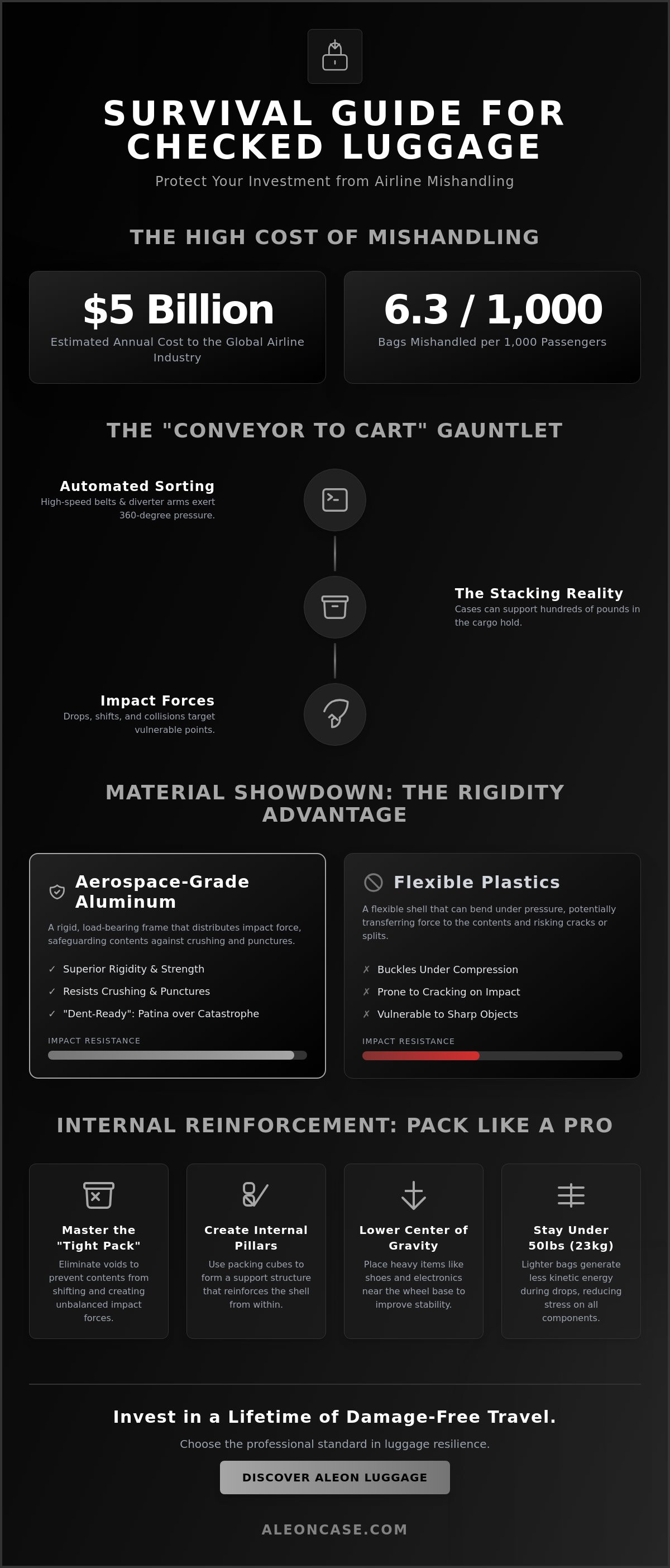
Did you know that mishandled baggage costs the global airline industry an estimated $5 billion annually? While handling rates have improved to 6.3 bags per 1,000 passengers, the personal cost of a shattered wheel or a crushed shell remains a significant frustration. Learning how to prevent luggage damage by airlines is no longer a matter of luck. It's a strategic necessity for anyone traveling with high-value items. You've likely felt that familiar pang of anxiety at the carousel, wondering if your investment survived the automated sorting systems.
We're here to replace that uncertainty with professional techniques and material standards designed to withstand the rigors of 2026 air transit. This guide outlines the essential steps to safeguard your gear, from choosing aerospace-grade materials to navigating the new Department of Transportation passenger rights rules. You'll gain the knowledge required to ensure a damage-free arrival and the confidence to choose equipment that lasts a lifetime. We'll explore the synergy of material science and strategic preparation that keeps your journey seamless.
Key Takeaways
- Master the "Tight Pack" rule to create internal structural support, preventing the shifting weight that often leads to unbalanced impacts during transit.
- Discover why aerospace-grade aluminum offers a superior "Rigidity Advantage" compared to flexible plastics, effectively safeguarding your investment against external pressure.
- Gain insight into the "Conveyor to Cart" journey to understand how automated sorting systems exert 360-degree pressure on your gear.
- Implement strategic packing techniques on how to prevent luggage damage by airlines by filling internal voids to reinforce the case's shell from within.
The Mechanics of Transit: Why Luggage Damage Occurs
Luggage damage exists on a broad spectrum. It begins with the superficial, like minor scuffs on a polycarbonate shell, and ends with catastrophic structural failure. Understanding this distinction is the first step in learning how to prevent luggage damage by airlines. Most issues arise during the "Conveyor to Cart" journey. Once your bag disappears behind the rubber flaps at check-in, it enters a complex Baggage Handling System. These automated networks use high-speed belts and diverter arms that exert 360-degree pressure on every surface of your case.
To visualize the forces your belongings face behind the scenes, watch this detailed breakdown of the baggage journey:
The "Stacking Reality" further complicates transit. In the cargo hold, checked bags aren't neatly shelved. They're stacked. A single case at the bottom of a pile might support hundreds of pounds of weight for the duration of a long-haul flight. This constant compression targets the most vulnerable points: protruding wheels, telescopic handles, and standard zippers. Learning how to prevent luggage damage by airlines requires more than just a sturdy lock; it requires an understanding of the mechanical environment your bag inhabits. Investing in aluminum luggage addresses these vulnerabilities by replacing flexible materials with a rigid, load-bearing frame.
Structural vs. Cosmetic Damage: What to Prioritise
Structural damage involves cracked shells or compromised locks that risk the security of your contents. These are failures that require immediate repair. Cosmetic damage, including scratches and small dents, is an inevitable byproduct of professional travel. For many seasoned travelers, a well-traveled aluminum case wears its marks like a badge of honor. It's a "dent-ready" mindset. You accept the surface patina because you know the internal structural integrity remains uncompromised.
The Role of Weight in Impact Force
Physics plays a decisive role in gear longevity. Heavier bags generate significantly more kinetic energy during drops or shifts in the cargo hold. When a heavy bag hits the ground, the impact force is much higher than that of a lighter one. Staying under the 50lb (23kg) threshold doesn't just save you from airline fees. It reduces the mechanical stress on wheels and handles during automated sorting. Lighter bags are easier for both machines and humans to handle, which directly lowers the risk of rough treatment.
Strategic Prevention: How to Protect Your Gear from the Inside Out
While the mechanics of transit are beyond your control, the internal architecture of your bag is not. Effective protection begins with how you organize your belongings. Mastering how to prevent luggage damage by airlines involves transforming your suitcase from a hollow container into a solid, reinforced unit. The "Tight Pack" rule is central to this strategy. When items are allowed to shift, they create unbalanced impact forces that can stress seams and corners from the inside. A densely packed interior acts as a shock absorber, distributing external pressure across the entire surface area of the bag.
For those seeking official guidance on preparation, the US Department of Transportation offers Tips on Avoiding Baggage Problems that emphasize clear identification and secure closure. However, true resilience is found in the material choice. High-quality aluminum luggage provides a rigid exterior that refuses to flex, even when subjected to the weight of other bags in the cargo hold. This rigidity is your primary defense against punctures and crushing forces.
Internal Reinforcement Techniques
Strategic packing creates a secondary support system for the shell. Use packing cubes to create vertical "pillars" of support that bridge the gap between the front and back panels. Place your heaviest items, such as shoes or technical equipment, near the wheel base. This lowers the center of gravity and prevents the bag from toppling during automated sorting. Dead space is the primary cause of shell buckling. By filling every void with soft items, you ensure the exterior shell has the internal resistance needed to maintain its shape under pressure.
External Defenses and Visibility
The exterior of your case requires its own set of precautions. Always retract telescopic handles fully before check-in. Protruding handles are easily snagged by sorting arms. Use TSA-approved locks to ensure security agents can inspect your bag without resorting to forced entry, which often results in permanent damage. While luggage covers can protect high-end aluminum from cosmetic scuffs, their primary value is visibility. Ensure you remove all old barcodes from previous flights. These stickers can confuse automated scanners, leading to unnecessary manual handling or "lost and found" delays that increase the risk of damage. If you're ready to upgrade your travel experience, consider the enduring protection of an aluminum check-in case.
Investing in Resilience: Why Aluminum is the Professional Standard
Material choice represents the final frontier in your strategy for gear longevity. While many manufacturers promote polycarbonate for its ability to flex, this flexibility is often a liability. When a plastic shell deforms under pressure, that energy is transmitted directly to your fragile contents. This is a critical consideration when deciding how to prevent luggage damage by airlines over the long term. The "Rigidity Advantage" of ALEON aluminum luggage ensures that the shell remains a fortress. It's a professional standard that refuses to yield, shielding everything from high-end electronics to bespoke tailoring. Research indicates that International Travelers Are Five Times More Likely To Have Their Luggage Mishandled, making the switch to aircraft-grade materials a logical step for the frequent flyer. Beyond the material itself, the construction method matters. Glued seams common in mass-market bags often fail after repeated cycles of pressure. Mechanical rivets provide a permanent, high-strength bond that endures the harshest environments.
The Strength of Reinforced Corners
Corners are the primary point of failure, absorbing roughly 80% of impact force during a typical transit cycle. ALEON addresses this with heavy-duty reinforced corner guards that deflect energy away from the main body of the case. This structural focus extends to the ground. Dual-wheel spinner systems distribute the weight of your 30" or 32" aluminum check-in case across eight points of contact rather than four. This reduces the stress on each individual axle, ensuring smooth movement even after years of use.
Choosing the Right Size for Minimal Exposure
The most effective way to address how to prevent luggage damage by airlines is to bypass their handling systems entirely. A 16" underseat luggage unit or a 21" aluminum carry-on allows you to maintain custody of your gear. This "Carry-On First" philosophy is essential for protecting an All Aluminum Camera Case or laptop unit. For shorter journeys, choosing a smaller profile minimizes exposure to the automated sorting belts discussed earlier. It's a proactive choice that prioritizes the safety of your most sensitive assets.
Mastering the Art of Seamless Arrival
True travel confidence is built on the foundation of superior engineering and strategic preparation. By understanding the mechanical forces within the baggage handling system and mastering internal reinforcement, you've taken the essential steps in learning how to prevent luggage damage by airlines. The transition from flexible plastics to rigid, aircraft-grade materials isn't just about aesthetics; it's about ensuring your gear survives the 360-degree pressure of modern transit. Relying on structural integrity rather than luck allows you to focus on the destination instead of the baggage carousel.
Our designs cater to those who demand reliability and enduring quality. Every case is a testament to professional craftsmanship. We utilize aerospace-grade aluminum construction, TSA-approved integrated locks, and multi-directional reinforced spinner wheels to create a fortress for your belongings. This meticulous approach ensures protection through every leg of your journey. We invite you to Explore ALEON’s Collection of Aerospace-Grade Aluminum Luggage and experience the intersection of aesthetic appeal and functional necessity. Your next adventure deserves the security of a case built for the future. Travel with the quiet confidence that only a visionary expert can provide.
Frequently Asked Questions
Does the airline have to pay for my damaged suitcase?
Airlines are legally required to compensate passengers for baggage damage that exceeds normal wear and tear. For domestic flights in the United States, the maximum liability limit is $4,700 per passenger. International travel governed by the Montreal Convention sets this limit at approximately $2,060 to $2,175. The Department of Transportation has clarified that airlines cannot exclude damage to wheels, handles, or straps from these liability claims.
Is hard-shell luggage more likely to break than soft-shell?
The risk of breakage depends entirely on the quality of the material rather than the shell type. Inexpensive plastics like ABS are brittle and prone to cracking under the heavy stacking pressure of a cargo hold. High-end aerospace-grade aluminum provides a rigid, unyielding frame that protects fragile contents from being crushed. While soft-shell bags don't crack, they offer almost no protection against the external compression forces found in modern air transit.
How do I report luggage damage to an airline correctly?
You should file a Property Irregularity Report (PIR) at the airline's baggage service office before leaving the airport. Document the damage with clear photographs and keep your original baggage claim tags. For domestic flights, you typically have 24 hours to report damage, while international rules allow up to seven days for a written complaint. As of May 26, 2026, a new DOT rule requires airlines to provide you with a summary of these rights upon request.
Will a luggage cover actually prevent dents and scratches?
Luggage covers act as a sacrificial barrier against superficial scuffs and cosmetic scratches during the automated sorting process. They are excellent for maintaining the aesthetic finish of your case but provide no real structural protection against heavy impacts. The most effective strategies for how to prevent luggage damage by airlines involve choosing a rigid exterior and ensuring the interior is packed tightly to provide internal support. Covers are a secondary defense for the style-conscious traveler.
What is the most durable luggage material for frequent flyers in 2026?
Aerospace-grade aluminum is the professional standard for durability due to its exceptional strength and resistance to puncture. This material does not flex under pressure, ensuring that the energy from an impact isn't transferred to your internal valuables. Understanding how to prevent luggage damage by airlines often leads back to this material choice. Aluminum's ability to withstand thousands of travel cycles makes it the most reliable investment for those who prioritize the safety of their gear over many years.


