


The standard fabric suitcase is no longer a sufficient shield for the high-value technology modern professionals carry across borders. You likely feel a sharp spike of anxiety when your expensive gear disappears behind the airport's rubber curtains, wondering if it will survive the journey intact. It's a valid concern. With major carriers like American and Delta raising fees to $50 for a single checked bag in 2026, the expectation for a seamless, damage-free experience has never been higher. This guide will teach you exactly how to protect electronics in checked bags by mastering the art of vibration isolation and rigid structural defense.
Securing your equipment requires more than just a layer of bubble wrap. It demands a sophisticated understanding of both physical protection and shifting aviation laws. We'll walk you through the essential 2026 TSA battery regulations, including the mandatory power-off rules for devices and the strict prohibition of spare lithium cells in the cargo hold. You'll discover how to create a professional-grade defense system that guards against rough handling and transit theft alike. From choosing the right aluminum casing to internal cushioning strategies, this overview provides the peace of mind you need for your next long-haul flight.
Key Takeaways
- Navigate 2026 aviation regulations by distinguishing between prohibited sleep modes and mandatory power-down procedures for all checked devices.
- Master the "Center-Mass" packing principle to learn exactly how to protect electronics in checked bags through strategic internal positioning.
- Implement professional vibration isolation strategies using specialized sleeves to shield delicate circuitry from transit-related shocks.
- Leverage the superior strength-to-weight ratio of all aluminum check in luggage to provide a rigid, crush-proof barrier for your high-value gear.
- Secure your journey by verifying lithium-ion battery watt-hour limits to prevent unexpected gate-side confiscations.
Understanding the Risks and Regulations of Checking Electronics
Checking high-value tech involves more than just finding space in your suitcase. It requires a strategic alignment with current aviation safety standards. As of 2026, understanding airline baggage allowance rules is the first step toward a successful transit. You must also account for the physical environment of the aircraft's belly, where your gear faces conditions far harsher than a typical cabin.
Learning how to protect electronics in checked bags starts with recognizing that your device is essentially a sensitive computer inside a pressurized, unheated metal tube. While the cabin stays comfortable, the cargo hold can experience significant temperature drops that may lead to condensation on delicate circuit boards. This thermal stress can be just as damaging as a physical impact.
To better understand the nuances of packing tech, watch this helpful video:
Lithium Battery Safety and Compliance
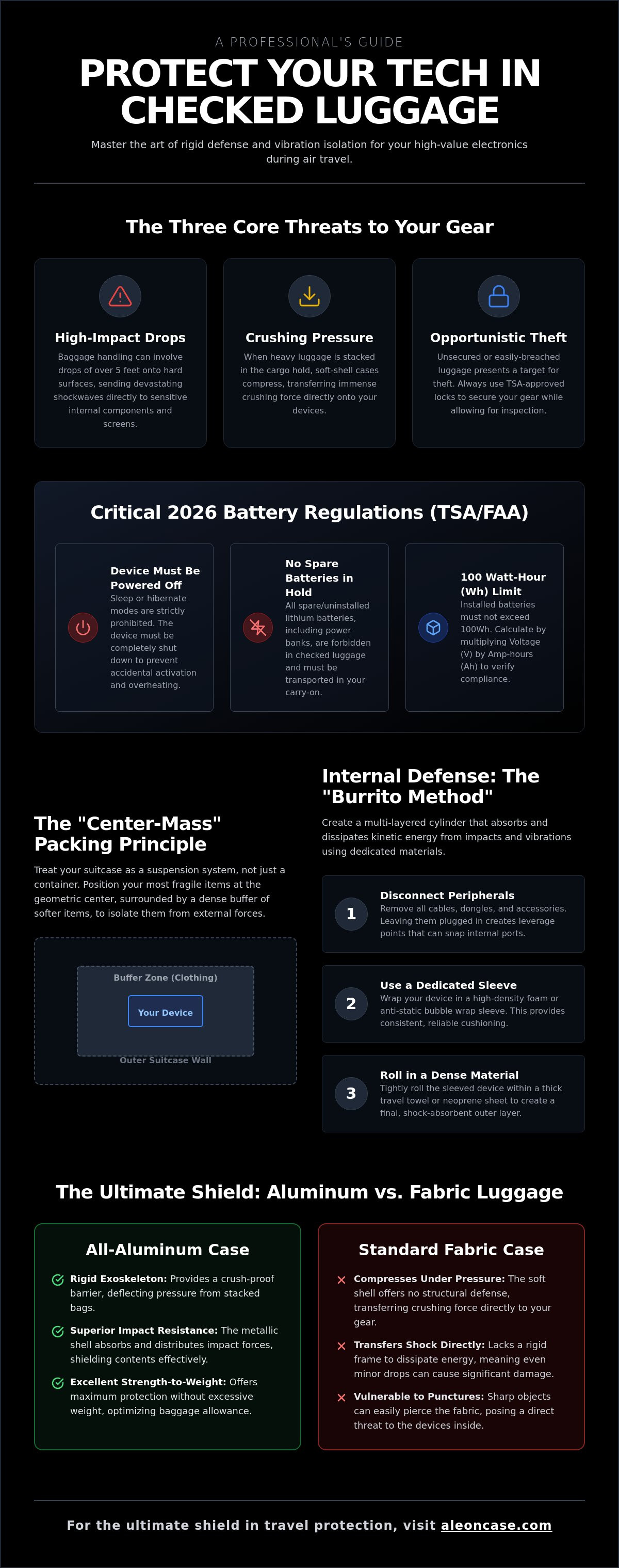
When considering how to protect electronics in checked bags, compliance with lithium battery safety is your first priority. The FAA and TSA strictly regulate these components to prevent in-flight fires. In 2026, the 100 watt-hour (Wh) limit remains the standard for installed rechargeable batteries. You can check your device's Wh rating by multiplying the voltage (V) by the ampere-hours (Ah).
- Installed Batteries: Allowed in checked bags only if the device is completely powered down.
- Spare Batteries: Prohibited. These must stay in your carry-on.
- Power Down: Never leave a laptop in sleep mode; a sudden update can cause overheating in a confined space.
The Three Main Threats: Impact, Theft, and Pressure
Baggage handlers often manage hundreds of cases per hour, meaning your luggage might endure five-foot drops onto concrete or conveyor belts. Vertical pressure is equally dangerous. When heavy bags are stacked, soft-shell luggage compresses, transferring that crushing force directly to your screen or camera lens. Choosing aluminum luggage provides a rigid exoskeleton that deflects this pressure. Opportunistic theft remains a risk, too. Always use TSA-approved locks to secure your gear while allowing for official inspections.
Essential Packing Strategies for Maximum Device Safety
Effective mechanical protection is a specific requirement often found in the fine print of airline contracts. To achieve this, you must adopt the "Center-Mass" principle. This strategy dictates that your most fragile items should reside at the exact geometric center of your luggage. Never allow a laptop or camera to rest against the suitcase walls. Even a minor tumble from a baggage cart can transmit a devastating shock through the outer shell directly into your device's screen. Learning how to protect electronics in checked bags requires thinking about the suitcase as a suspension system rather than just a container.
Professional packing also involves vibration isolation. High-density foam or anti-static bubble wrap provides a consistent barrier that clothing cannot match. Unlike fabric, which shifts and compresses during transit, dedicated equipment sleeves maintain their integrity. Before wrapping, ensure you disconnect all peripherals. Leaving a USB-C dongle or charging cable plugged in creates a lever that can snap internal ports during heavy handling. For the highest level of safety, always cross-reference your setup with FAA PackSafe regulations to ensure your packing method doesn't inadvertently violate hazardous material protocols.
Creating an Internal Buffer Zone
The "burrito method" is the gold standard for internal defense. You wrap your device in a dedicated sleeve, then roll it tightly within a high-density material like a neoprene sheet or a thick travel towel. This creates a multi-layered cylinder that absorbs kinetic energy. Use structured packing cubes to wall off these electronics. This prevents heavier items, like shoes or power bricks, from shifting and exerting concentrated pressure on sensitive components during the flight.
Maintaining this level of protection is also crucial during a residential move, where A2B Moving LLC can assist in the secure transport of your entire home office and delicate electronic systems.
Securing Your Case Against Unauthorized Access
Security is a dual-layered challenge involving both physical barriers and deterrents. While many travelers rely on external padlocks, integrated TSA-approved locks offer a more streamlined defense. A significant vulnerability in soft-shell bags is the "zipper-puncture" technique, where a simple ballpoint pen can bypass a locked zipper in seconds. A rigid frame eliminates this risk entirely by removing the zipper element. Investing in professional aluminum luggage ensures your tech remains inaccessible to anyone but you and authorized security personnel.
Why Aluminum Checked Luggage is the Ultimate Shield for Tech
Most travel guides suggest avoiding checked tech altogether, but professional requirements often make this impossible. When you must check high-value gear, the choice of suitcase material becomes a critical engineering decision. Aerospace-grade aluminum offers a superior strength-to-weight ratio that soft-shell alternatives cannot match. These rigid shells provide the definitive answer for how to protect electronics in checked bags by creating an impenetrable barrier against external force. By following IATA guidelines for electronics, you ensure your hardware meets international safety standards while benefiting from the highest level of mechanical defense.
The primary advantage of aluminum lies in its ability to maintain internal volume. While fabric bags compress under the weight of stacked luggage, a rigid case preserves the buffer zone around your devices. Reinforced corners further enhance this protection. These zones are designed to deflect the kinetic energy of a drop on the tarmac or a high-speed collision on a baggage carousel, preventing the shock from reaching internal components. It's a level of structural security that fabric simply can't provide.
The Structural Integrity of ALEON Aluminum Cases
For those transporting medium-sized tech kits, the 26" aluminum check-in case serves as a robust mobile vault. Its rivet-coordinated construction ensures that the frame remains aligned despite years of heavy use. This methodical approach to manufacturing reflects a commitment to enduring quality that goes beyond simple aesthetics. It's about creating a dependable companion for your most valuable tools. The result is a case that maintains its seal and protection level through every leg of your journey.
Specialized Protection for Photographers and Tech Pros
Professionals often require more than just a standard suitcase. The All Aluminum Camera Case is engineered specifically for sensitive optics and electronics. Its minimalist exterior is a deliberate design choice. By avoiding flashy branding, these cases hide the immense value of their contents from plain sight. You gain a sophisticated, secure solution that signals professional success without attracting unwanted attention in transit. It's the gold standard for those who refuse to compromise on the safety of their equipment.
This commitment to high-performance protection often extends to other areas of a professional's life, such as vehicle security; for instance, AL Priority USA provides the technical expertise needed to safeguard your car with advanced laser defense systems.
Mastering the Art of Secure Tech Travel
Mastering how to protect electronics in checked bags is a balance of regulatory compliance and physical defense. You've learned that a complete power-down is non-negotiable for safety; sleep mode simply isn't an option in the cargo hold. You also know that the "Center-Mass" principle provides the internal suspension your gear needs to survive the transit. These strategies ensure your equipment arrives ready for work, regardless of the distance traveled or the number of connections.
The ultimate defense remains a rigid exterior that refuses to compromise under pressure. ALEON cases provide this through aerospace-grade aluminum construction and double-reinforced corners designed for high-impact resistance. Integrated TSA-approved locking systems offer a final, sophisticated layer of security against unauthorized access while maintaining full compliance with airport security protocols. This methodical approach to design mirrors the precision of the technology you carry inside.
Upgrade to the ultimate protection with ALEON Aluminum Checked Luggage and travel with the confidence of a seasoned professional. Your next journey deserves the peace of mind that only precision engineering and enduring quality can provide. Safe travels and successful ventures await.
Frequently Asked Questions
Can I put my laptop in a checked bag if it is turned off?
Yes, you can check your laptop as long as it is completely powered off and not merely in sleep or hibernation mode. Current FAA regulations require this to prevent overheating or accidental activation while the device is in the cargo hold. For maximum safety, place the device in a padded sleeve at the center of your case to buffer against the inevitable vibrations of flight.
What happens if a lithium battery is found in my checked luggage?
If security personnel find a spare lithium battery or a power bank in your checked bag, it will be confiscated. These items represent a significant fire hazard and are strictly prohibited in the cargo hold by TSA. Unlike batteries installed within a device, spare cells must be kept in your carry-on luggage. You'll typically find a notification from TSA if an item has been removed during their inspection.
How do I protect my camera lens from cracking in a checked suitcase?
Protecting a camera lens requires detaching it from the camera body and securing it in a dedicated, hard-sided lens case. This is a critical step in how to protect electronics in checked bags, as it prevents the lens mount from snapping under pressure. Place the encased lens in the center of your suitcase, ensuring it is surrounded by firm padding to isolate it from external impacts.
Are aluminum suitcases better than plastic for protecting electronics?
Aluminum cases offer a distinct advantage over plastic because they don't flex or compress when stacked under heavy luggage. While plastic shells can bow inward and crush sensitive components, a rigid aluminum frame maintains its internal volume. This structural reliability ensures that your high-value tech remains untouched by the vertical pressure often found in modern aircraft cargo holds.


