


What if the difference between a seamless arrival and a $200 surcharge is exactly three linear inches? With major carriers like American Airlines and Delta implementing stricter fee structures as of April 2026, choosing the right size checked luggage is now a critical calculation of geometry and logistics. You likely understand the frustration of a bag that is too cumbersome to maneuver or the sting of a hidden "oversized" fee at the check-in counter. It's a common hurdle for the discerning traveler who demands both security and efficiency.
You probably agree that your equipment should empower your journey, not complicate it. This guide will teach you to master the nuances of suitcase dimensions and airline regulations to select the perfect checked bag for any destination. We'll explore the 62-linear-inch rule, break down the 2026 airline fee updates, and explain how precision engineering ensures your belongings stay protected without exceeding the limit. By the end, you'll have the technical insight to invest in a case that balances high-performance protection with effortless utility.
Key Takeaways
- Learn to calculate linear dimensions and why the 62-inch threshold remains the non-negotiable standard for global airline compliance in 2026.
- Master the strategic nuances of choosing the right size checked luggage by aligning suitcase volume with both your itinerary duration and local transit logistics.
- Compare the maneuverability of a 26-inch medium case against the expansive volume of a 32-inch macro traveler to find your ideal capacity.
- Discover how the rigid geometry of aircraft-grade aluminum eliminates the risk of case bulge, ensuring your luggage stays within regulatory limits even when fully loaded.
- Identify the specific engineering hallmarks of the ALEON collection that provide unwavering security and a permanent solution for the high-frequency traveler.
The Golden Rule of Checked Luggage: Understanding Linear Inches
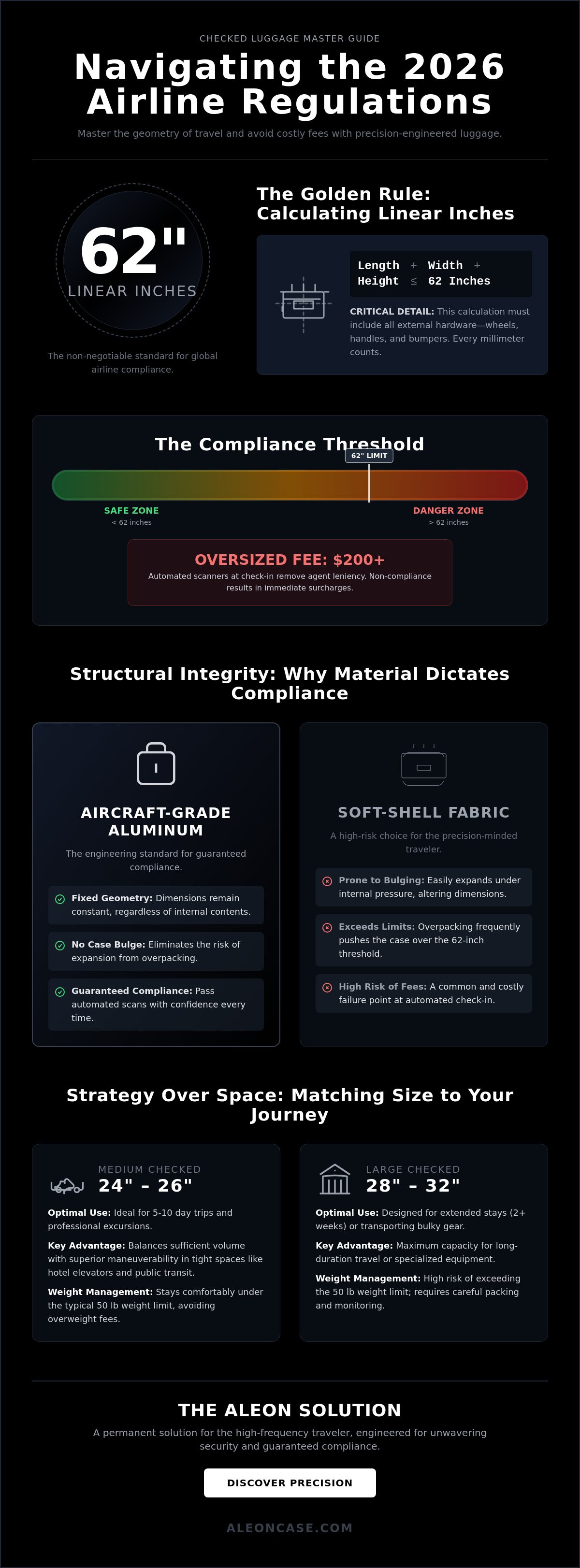
Precision is the hallmark of a seasoned traveler. When The Golden Rule of Checked Luggage is applied, it centers on a single metric: the linear inch. This calculation is the sum of the exterior length, width, and height of your case. For most global carriers in 2026, the limit is 62 linear inches. It's a non-negotiable boundary that separates standard handling from punitive oversized surcharges.
Measuring requires surgical accuracy. You must account for every protrusion, including the wheels, the retracted telescoping handle, and the structural bumpers. A 29-inch bag might seem compliant until the hardware adds another three inches, pushing you into the surcharge territory. Choosing the right size checked luggage starts with acknowledging that every millimeter of external hardware counts toward your total. If your measurement is even slightly over, you risk refusal at the gate or an immediate fee at the kiosk.
Soft-shell bags often fail this test because they lack structural permanence. They expand under internal pressure. When you overpack a nylon bag, it bulges, frequently exceeding the 62-inch threshold during the automated scanning process. When choosing the right size checked luggage, travelers must consider the rigidity of the material as much as the dimensions themselves. Selecting a case with a rigid, aircraft-grade aluminum shell ensures that your dimensions remain fixed regardless of how much you pack. The geometry is permanent; the compliance is guaranteed.
Why the 62-Inch Limit Matters
Airlines prioritize cargo efficiency to manage fuel costs and loading times. Standardizing bag sizes allows for predictable stacking in the aircraft hold. While international limits can occasionally vary, 62 inches remains the nearly universal industry ceiling for standard checked baggage. Non-compliance results in oversized fees that can reach $200 or more per segment. In 2026, automated scanners at check-in kiosks have largely replaced manual measurements, removing the possibility of agent leniency.
Common Size Benchmarks for 2026
Understanding the tiers of luggage size helps you avoid logistical friction. The 'Safe' Zone includes bags under 60 linear inches, which provides a comfortable buffer against measurement discrepancies. The 'Danger' Zone encompasses bags between 62 and 65 linear inches. These cases are high-risk and almost always trigger additional fees at the counter. The 62-inch rule is the definitive industry ceiling for standard checked baggage.
Medium vs. Large: Deciphering the Standard Sizing Tiers
Selecting a suitcase is an exercise in logistical strategy. While the 62-linear-inch rule provides the legal framework, your specific itinerary dictates the volume required. Industry bodies like IATA provide a framework for Standard Sizing Tiers, but the high-frequency traveler knows that volume must never compromise maneuverability. Choosing the right size checked luggage involves a calculated trade-off between interior capacity and the physical effort of transit.
The physical footprint of your luggage affects every stage of the journey. A case that is too large becomes a liability in narrow corridors or on public transit systems. Conversely, a bag that is too small forces compromises on your equipment or attire. Achieving the perfect equilibrium requires an understanding of how different sizing tiers perform under real-world conditions.
Medium Checked (24-26 Inches)
The 26-inch case is the tactical choice for most professional excursions. It offers sufficient volume for 5 to 10 days of attire without the inherent risk of exceeding the standard 50-pound weight limit. Its compact footprint excels in environments where space is a premium. Whether you're navigating the narrow elevators of a Parisian hotel or stowing gear in a standard car trunk, the 26-inch chassis remains agile. For those prioritizing a balance of protection and portability, the 26" Traveler provides a refined solution that fits seamlessly into the rhythm of modern travel.
Large Checked (28-30+ Inches)
Extended stays or winter expeditions require a different scale of engineering. Large checked cases, typically ranging from 28 to 30 inches, are designed for maximum capacity. These units are indispensable for journeys exceeding two weeks or when transporting bulky equipment. However, increased volume introduces the risk of overpacking. A 30-inch aluminum case can easily exceed the 50lb/23kg limit if filled with dense materials. To combat the structural stress of these larger loads, advanced models utilize dual-stiffening ribs. This reinforcement ensures the case maintains its integrity under the heavy pressure of airport sorting systems.
Maneuverability becomes paramount at this scale. A wider wheelbase and high-performance wheels are essential to prevent the case from tipping during rapid transitions. Choosing the right size checked luggage for a family or a long-term relocation might lead you toward a 32" Macro Traveler, but only if the chassis is engineered to handle the load. When the weight increases, the mechanical superiority of the closure system and the rigidity of the metal alloy become your primary defenses against equipment failure. You can explore the full range of precision-engineered aluminum travelers to find the exact specification for your next departure.
Strategy Over Space: Matching Luggage Size to Your Journey
Context dictates your equipment requirements. A business intensive in Tokyo presents a different set of logistical challenges than a week in the Swiss Alps. In urban centers, you'll encounter smooth surfaces but restricted square footage in elevators and hotel rooms. Alpine destinations demand high-volume gear and resilience against rugged terrain. Choosing the right size checked luggage involves auditing these environmental variables before the first item is packed. You aren't just selecting a container; you're selecting a partner for the "last mile" of your journey.
The "empty space" myth is a common trap for the infrequent traveler. Many believe that carrying a half-full 32" Macro Traveler provides flexibility for souvenirs. In reality, a bag that isn't packed to its intended capacity allows contents to shift violently during transit. This movement increases internal friction and can lead to damaged delicate items or unbalanced weight distribution. It's far more efficient to utilize a 26" Traveler that's filled to 90% capacity, where internal compression systems can effectively secure your belongings. If your gear doesn't fill the case, the case shouldn't be on the plane.
Professional requirements also influence your chassis selection. Business attire, particularly tailored suits and structured coats, requires a specific width to minimize aggressive folding. A narrow bag forces deeper creases that are difficult to remove upon arrival. For the modern professional, choosing the right size checked luggage means ensuring the internal dimensions respect the integrity of your wardrobe. A 30" Macro Traveler provides the necessary breadth for formal wear while maintaining the sleek profile required for executive transit.
The Environmental Factor
Consider the transition from the airport carousel to your final destination. High-friction environments like cobblestone streets or narrow train platforms test the mechanical limits of your luggage. Multi-directional spinner wheels are non-negotiable for larger checked units. They allow for vertical movement in tight spaces, reducing the physical strain on your wrist and shoulder. Aluminum shells provide a critical advantage here; they offer a rigid shield against the impacts common in high-traffic transit hubs, ensuring that external pressure never reaches your sensitive equipment.
The Weight Distribution Equation
Success in travel is measured by the ratio of gear weight to bag weight. Every pound consumed by the suitcase itself is a pound of utility lost from your packing allowance. ALEON utilizes lightweight aerospace-grade alloys to maximize this efficiency. Aluminum's strength-to-weight ratio allows for larger dimensions without sacrificing durability. By using high-performance metal alloys, you gain the security of a hard-shell case without the weight penalty often associated with inferior materials. This engineering choice ensures your luggage remains a tool of effortless utility rather than a burdensome accessory.
Structural Integrity: Why Material Choice Dictates Sizing Success
Material choice is the invisible architect of baggage compliance. While the 62-linear-inch limit provides the regulatory boundary, the material dictates whether your case actually stays within it. Choosing the right size checked luggage requires a chassis that won't deform under internal or external pressure. Soft-shell cases and low-grade plastics are prone to the "Bulge Factor." When packed to capacity, these flexible materials expand outward, often adding two to three inches to the total exterior measurement. This expansion transforms a compliant bag into an oversized liability at the automated check-in kiosk.
High-performance metal alloys provide a definitive solution through fixed geometry. An aluminum case remains dimensionally stable regardless of internal pressure. This rigidity ensures your measurements are as accurate at the check-in counter as they were in your home. Beyond compliance, larger bags demand greater wall strength. As surface area increases, the risk of structural failure from external impacts grows. A larger chassis requires the uncompromising resilience of aircraft-grade materials to prevent the structural sagging often seen in inferior materials. Precision engineering ensures that the case protects its contents while maintaining its professional silhouette.
Aluminum vs. Polycarbonate at Scale
Large-scale polycarbonate bags often crack when subjected to the crushing weight of a fully loaded cargo hold. The plastic flexes, but under extreme pressure, it reaches a physical breaking point. Aluminum provides a protective encasement that absorbs and distributes energy across the entire frame. This structural integrity is essential for maintaining 360-degree mobility. If a large bag's frame warps even slightly, the wheel alignment shifts. This misalignment turns an effortless glide into a physical struggle. Choosing the right size checked luggage means selecting a material that preserves its mechanical alignment under a 50-pound load.
Security and Closure Systems
Security requirements scale with the size of the container. Larger checked units necessitate multiple TSA-approved locks to ensure a uniform seal across the entire opening. Traditional zippers are a significant vulnerability; they can be punctured or forced open with minimal effort. Precision-engineered latches, found on high-end aluminum travelers, provide a superior mechanical closure. These systems include gasket seals to provide waterproof protection against the elements. The tactile "click" of a heavy-duty latch offers a sensory reassurance that your belongings are secured within a vault-like environment. To ensure your gear is protected by the pinnacle of luggage engineering, shop the ALEON collection of aircraft-grade aluminum travelers.
The ALEON Collection: Precision-Engineered Checked Travelers
Selecting the ideal chassis requires an appreciation for both volume and velocity. ALEON's collection is designed for the high-frequency traveler who views their equipment as a critical asset rather than a disposable accessory. Choosing the right size checked luggage becomes an intuitive process when you select from a fleet defined by structural integrity and quiet elegance. Every case in the lineup utilizes high-performance metal alloys, ensuring that your belongings are encased in a protective shell that resists the rigors of global transit.
The 26-Inch Traveler: The Professional Standard
The 26" Traveler is the quintessential choice for the modern professional. With exterior dimensions of 26.1 x 17.5 x 9.8 inches, it totals 53.4 linear inches, placing it safely within the standard 62-inch regulatory limit. This case is engineered for 7 to 10 days of travel, providing ample space for tailored attire and essential gear. Internal compression systems ensure that business suits remain crisp and secure, while the rigid aluminum body prevents the external pressure that leads to unwanted wrinkles. It's a vault for your wardrobe, offering a balance of sophisticated aesthetics and rugged utility.
Macro Travelers for Extended Journeys
For expeditions that demand maximum capacity, the 30" Macro Traveler and 32" Macro Traveler provide expansive volume without compromising on security. These units are built for the traveler who refuses to leave essential equipment behind. Reinforced corners and heavy-duty hinges provide the torsional rigidity necessary to protect high-volume loads. While these larger cases offer significant space, the mechanical superiority of the dual-latch system ensures they remain easy to operate. Internal organization is tailored for high-volume packing, featuring removable dividers that adapt to your specific logistical needs.
Precision Units for Specialized Equipment
Professional transit often involves more than just attire. Travelers transporting sensitive electronics or high-value optics require specialized protection that standard luggage cannot provide. The ALEON Camera Case and our Vertical Business Unit address the industry gap for secure, checked electronics transport. These units feature the same aircraft-grade aluminum construction as our larger travelers, providing a moisture-resistant and impact-proof environment for delicate hardware. When choosing the right size checked luggage for specialized gear, the focus shifts from simple volume to the technical specifications of the protective encasement.
Investing in Longevity
ALEON represents a deliberate move away from the "fast fashion" cycle of the luggage industry. We build our cases for a lifetime of travel, focusing on sustainability through extreme durability. Every component, from the multi-directional spinner wheels to the tactile latch closures, is designed for permanence. This philosophy ensures your equipment remains a reliable partner journey after journey, reducing the environmental impact of frequent replacements. You can Explore the ALEON Checked Collection to find the precision-engineered solution that matches your travel frequency and professional standards.
Elevate Your Travel Standards
Successful transit is a product of technical foresight. You now understand that choosing the right size checked luggage involves more than simple volume; it requires a mastery of the 62-linear-inch rule and a commitment to material rigidity. By selecting a case with a fixed geometry, you eliminate the risk of fee-triggering bulges while ensuring your belongings stay encased in a protective shield. This strategic approach transforms your suitcase from a mere accessory into an essential tool for global navigation.
ALEON provides the ultimate equipment for the discerning professional. Our travelers feature aerospace-grade aluminum construction and TSA-approved dual-locking systems for unwavering security. We offer global shipping to support your journeys, and a portion of every sale contributes to solar energy initiatives. It's an investment in enduring longevity and quiet excellence. Discover the perfect size in the ALEON Aluminum Collection and prepare for your next departure with the confidence that only precision engineering can provide.
Frequently Asked Questions
What is the most common size for checked luggage?
The 62-linear-inch standard is the most common size for checked luggage across global airlines in 2026. This measurement represents the sum of the exterior length, width, and height. Most travelers opt for a 26-inch or 27-inch vertical case to remain safely within this threshold. Choosing the right size checked luggage ensures you maximize your packing volume without triggering the oversized baggage fees now strictly enforced by carriers like Delta and United.
Does the 62-linear-inch rule include the wheels and handles?
Yes, the 62-linear-inch rule includes the wheels, retracted handles, and all external hardware. Airlines utilize automated scanning systems to measure the total displacement of the object. When calculating your dimensions, you must measure from the floor to the top of the handle. Choosing a case with recessed wheels or a flush-mounted handle can provide a critical advantage in remaining compliant with these rigid standards.
Is a 28-inch suitcase considered oversized for most airlines?
A 28-inch suitcase is typically not considered oversized, provided its width and depth don't push the total sum beyond 62 linear inches. Most 28-inch cases are designed to meet this industry ceiling exactly. However, if the bag is a "wide-body" or "expandable" model, it can easily exceed the limit when full. Choosing the right size checked luggage requires verifying the specific exterior dimensions including all protrusions before your departure.
How do I avoid overweight fees with a large checked bag?
You can avoid overweight fees by utilizing a digital luggage scale and selecting a chassis with a high strength-to-weight ratio. The 50-pound limit is strictly enforced in 2026, and even a few ounces over can lead to significant surcharges. Aerospace-grade aluminum travelers provide the necessary structural integrity while remaining surprisingly light. This engineering allows you to allocate more of your weight allowance to your gear rather than the suitcase itself.
Are aluminum suitcases heavier than plastic ones when empty?
Aluminum suitcases are often slightly heavier than low-grade plastic ones, but they offer vastly superior protection and longevity. While a polycarbonate shell might save a pound of empty weight, it lacks the permanent geometry and impact resistance of a metal alloy. The mechanical superiority of aluminum ensures that your case won't bulge or warp, which is a common cause of unexpected size violations at the airport kiosk.
What size checked bag is best for a two-week international trip?
A 28-inch or 30-inch traveler is the optimal choice for a two-week international journey. This size provides sufficient volume for multiple changes of attire and specialized equipment without becoming unmanageable in transit. For these longer durations, internal organization and compression systems are essential. They keep your belongings secure and prevent shifting, which is critical when your luggage is handled across multiple international connecting flights.
Can I check a 32-inch suitcase on a domestic flight?
You can check a 32-inch suitcase on a domestic flight, but it is highly likely to incur an oversized baggage fee. Most 32-inch cases exceed the 62-linear-inch limit once wheels and handles are included. While the 32" Macro Traveler offers maximum capacity for relocation or heavy gear, you should prepare for the additional costs associated with large-format luggage. Always verify the specific carrier's current fee schedule before arriving at the terminal.
Do airlines check the dimensions of every checked bag?
Airlines are increasingly using automated 3D scanners at check-in kiosks to verify the dimensions of every checked bag. In 2026, the era of agent discretion has largely ended. These systems provide a precise reading of the bag's total linear inches in seconds. If the scanner detects a violation, the system automatically applies the relevant surcharge to your boarding pass, making dimensional compliance more important than ever for the frequent traveler.


