


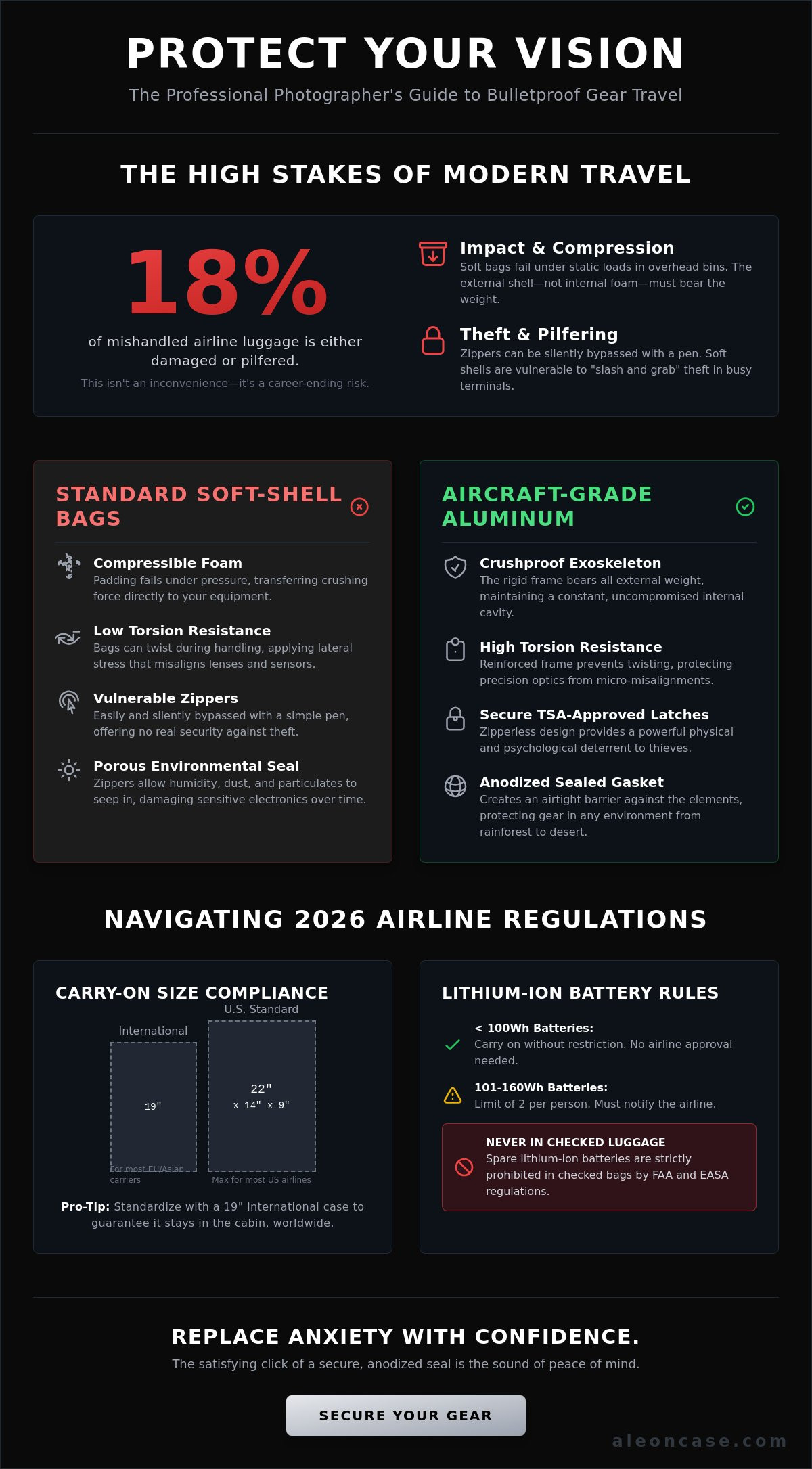
Did you know that 18% of all mishandled airline luggage is either damaged or pilfered before it ever reaches the carousel? For a professional photographer, this isn't just a statistic. It's a potential career-ending catastrophe. Finding the best way to travel with camera gear requires moving beyond soft-shell convenience toward a philosophy of aircraft-grade engineering. You've likely felt that sharp sting of anxiety as your gear disappears behind the check-in curtain or sits in a crowded overhead bin. You deserve a setup that's as resilient as your vision.
Security is not an amenity; it's a requirement. This guide will show you how to build a bulletproof mobile studio using reinforced aluminum protection, master the 2026 lithium battery regulations, and navigate airport security with absolute confidence. Whether you're providing professional services like Aflalo Communications Inc. or shooting a solo documentary, the right hardside case provides a seamless transition from the terminal to the field. It's time to replace travel anxiety with the satisfying click of a secure, anodized seal. You'll gain a streamlined workflow that protects your equipment from baggage handlers and transit theft alike.
Key Takeaways
- Learn why aircraft-grade aluminum provides the best way to travel with camera gear by offering torsion resistance and crushproof protection that soft-shell bags lack.
- Navigate 2026 airline regulations with precision by mastering the latest IATA carry-on dimensions and optimizing your equipment's weight-to-protection ratio.
- Discover how to implement the "Heavy-to-Light" packing rule and professional internal architectures to eliminate gear movement during transit and turbulence.
- Understand the technical advantages of zipperless, hardside closures and thermal stability for protecting sensitive sensors and lenses in unpredictable environments.
Understanding the Risks: Why Standard Bags Fail Your Equipment
Standard photography bags prioritize weight over welfare. They rely on high-density foam and ballistic nylon, materials that excel at absorbing minor bumps but fail entirely when subjected to static loads. In the high-pressure environment of modern aviation, your equipment faces more than just the occasional jolt. It faces compression. When a heavy suitcase is jammed against your soft-sided bag in a crowded overhead bin, that "protective" padding compresses to a fraction of its thickness. The best way to travel with camera gear is to ensure that the external shell, not the internal foam, bears the weight of the world.
The Physics of Gear Damage
Understanding the physics of impact reveals why hardside protection is the best way to travel with camera gear for the serious professional. Torsion is the silent killer of precision optics. During severe turbulence or improper handling, a soft bag can twist, applying lateral pressure to lens barrels and camera mounts. This stress can cause micro-misalignments in lens elements or hairline fractures in CMOS sensor brackets. A reinforced, torsion-resistant frame acts as an exoskeleton. It maintains a constant internal geometry regardless of external forces. Structural integrity in the context of aircraft-grade aluminum is the calibrated resistance of the alloy to deformation under extreme pressure, ensuring the internal cavity remains uncompromised.
Security Vulnerabilities in Modern Travel
Professional gear is a high-value target. Most travelers don't realize that a simple ballpoint pen can bypass almost any zipper in seconds, leaving no trace of entry. Soft-shell bags are also susceptible to "slash and grab" thefts in busy terminals where a sharp blade can expose your entire kit instantly. Following standard airline carry-on regulations isn't enough if your bag invites intrusion. A locked, metallic case provides a psychological and physical deterrent. The sight of reinforced aluminum and TSA-recognized locks signals to a thief that your equipment is inaccessible. It's a statement of permanence in a world of fleeting security.
Beyond physical impact, environmental variables like humidity and fine dust pose a constant threat. Zippered closures are porous; they allow moisture and particulates to seep into your delicate electronics. Anodized aluminum shells, paired with a precision-engineered seal, create a barrier against the elements. Whether you're shooting in a humid tropical rainforest or a dusty desert landscape, the "click" of a hardside case provides the ultimate reassurance. Your mobile studio remains pristine, shielded by a shell that's as uncompromising as your standards.
The Carry-On Strategy: Navigating Airline Regulations in 2026
Aviation logistics have reached a tipping point in 2026. Many major carriers now utilize automated gate scanners that flag oversized luggage with surgical precision, eliminating the era of "squeezing" a soft bag into the sizer. The standard U.S. carry-on limit remains 22 x 14 x 9 inches, but international professionals face stricter constraints. For those moving between continents, the best way to travel with camera gear is to standardize around a 19" International Carry-On. This compact footprint satisfies the most demanding European and Asian carrier requirements, ensuring your equipment stays in the cabin where it belongs.
Managing the weight-to-protection ratio is a delicate balance. While budget carriers like Frontier or Spirit enforce personal item limits of 18 x 14 x 8 inches, a professional kit usually requires more volume. To circumvent weight-based gate checks, many pros use the "Personal Item Hack." By placing heavy prime lenses in a dedicated photography vest or a small under-seat bag, you can reduce the primary case's weight while keeping the most valuable glass within reach. This strategy keeps your primary kit light enough to pass visual inspections without sacrificing the protection of an aircraft-grade aluminum shell.
Mastering the TSA Checkpoint
Speed is a security asset. Organizing your kit for rapid extraction prevents bottlenecks and reduces the time your gear spends exposed on a conveyor belt. Current 2026 FAA and EASA regulations strictly prohibit spare lithium-ion batteries in checked baggage. You must carry them on. Batteries under 100Wh require no approval, while those between 101 and 160Wh are limited to two per person and require airline notification. Using a case with click-and-seal latches allows you to open and secure your kit in seconds, avoiding the clumsy struggle of zippers that often draws unwanted attention during the screening process.
Weight Management for Strict Carriers
The tare weight of your luggage is the foundation of your travel workflow. High-end aluminum cases offer a superior strength-to-weight ratio compared to thick-walled plastic alternatives. While a plastic hard case might seem lighter, it often requires more bulk to achieve the same torsion resistance. To mitigate the physical toll of a heavy kit, prioritize cases with multi-directional spinner wheels. These allow for effortless navigation through terminals, letting the floor bear the weight of your gear rather than your shoulders. When every gram counts, the efficiency of an anodized aluminum frame provides the security you need without the unnecessary mass of lesser materials.
Hardware vs. Software: The Case for Aircraft-Grade Aluminum Protection
The best way to travel with camera gear involves a fundamental shift from soft fabrics to rigid engineering. While many photographers rely on ballistic nylon "software," professional security requires the uncompromising strength of aircraft-grade aluminum. Specifically utilizing 6061 or 7075 alloys, these cases provide a level of structural permanence that fabric and plastic simply cannot match. Aluminum isn't just about impact resistance; it offers superior thermal stability. Unlike plastic shells that can warp or trap heat, an aluminum exterior reflects radiant energy and helps regulate internal temperatures. This protection is vital for preserving the integrity of CMOS sensors and preventing the premature degradation of high-capacity lithium-ion batteries during long layovers in harsh climates.
Sustainability in 2026 has moved away from disposable culture toward a "buy it for life" philosophy. An anodized finish doesn't just look sophisticated; it creates a surface harder than the metal itself, resisting the scuffs and fraying that plague soft bags. While a fabric bag may last a few years of heavy travel, an aluminum case is a generational investment. Choosing a durable, recyclable metallic shell is the ethical choice for the modern professional who values both gear safety and environmental responsibility. By eliminating zippers, you also remove the most common point of mechanical failure, ensuring your case remains functional for decades.
Torsion Resistance and Seal Integrity
Aleon’s reinforced corners are the foundation of its protective capabilities. These corners prevent the frame from warping when subjected to the uneven pressure of stacked luggage or overhead bin compression. This torsion resistance ensures the gasket remains perfectly aligned, creating a consistent barrier against fine dust and moisture. The tactile click of the dual-action latches provides an immediate, sensory confirmation that the airtight seal is fully engaged and your kit is secure. This zipperless system is the definitive solution to the security gaps found in traditional luggage.
The Professional Aesthetic and Status
A photographer's kit is a reflection of their professional brand. The minimalist, sophisticated lines of an aluminum case suggest a level of expertise and attention to detail that tattered backpacks fail to communicate. This is understated luxury; it provides security through high-end engineering rather than flashy, target-drawing logos. Beyond the immediate aesthetic, hardshell protection maintains the resale value of your equipment. By preventing the "brassing" of camera bodies and protecting lens mounts from micro-stresses, you ensure your gear remains in mint condition, directly translating to a higher return when it's time to upgrade your studio.
Strategic Packing: Maximizing Space and Internal Security
Precision inside the case must match the engineering of the shell. The best way to travel with camera gear involves more than just a sturdy exterior; it requires a calculated internal architecture. High-performance kits, particularly the "Holy Trinity" of lenses—the 14-24mm, 24-70mm, and 70-200mm f/2.8—demand absolute stability to prevent internal glass elements from shifting. While generic guides suggest wrapping lenses in clothing, a professional workflow relies on dedicated padded dividers or rigid Trekpak systems. These tools ensure that your optics remain isolated from vibration and impact, maintaining the calibration of your most expensive assets.
Gravity is a constant factor in transit logistics. Always follow the "Heavy-to-Light" rule by placing your heaviest glass and primary camera bodies at the bottom of the case, nearest to the wheels. This lowers the center of gravity, which prevents the case from tipping and reduces the strain on the telescopic handle during high-speed terminal transits. Small essentials like ND filters, memory card wallets, and tethering cables shouldn't be loose. Secure these in the lid or in specialized pouches to prevent them from becoming projectiles inside the case during turbulence.
Customizing Your Internal Layout
Building a secure internal layout is a three step process that prioritizes stability over aesthetic. First, lay out your primary camera body with your most frequently used lens attached to serve as the central anchor of the kit. Second, create "snug" fit zones using reinforced dividers to eliminate all lateral movement. Even a millimeter of play can lead to impact damage over multiple long-haul flights. Finally, utilize the lid or upper mesh compartments for flat accessories and cables, ensuring they don't interfere with the pressure-sealed closure of the aircraft-grade aluminum shell.
Redundancy and Tracking
Modern security isn't just about physical locks; it's about digital visibility. Integrating a GPS tracker like an AirTag or Tile within the internal lining of your case provides real-time peace of mind. While the reinforced aluminum shell is formidable, placement near the gasket seal is optimal to ensure signal strength isn't dampened by the metallic exterior. For your non-gear essentials, utilizing Aleon Packing Cubes ensures that your personal items remain as organized and secure as your professional optics. This layered approach to packing creates a seamless transition from the aircraft cabin to the production set.
Invest in a system that protects your livelihood with the precision it deserves. Explore our range of aircraft-grade aluminum cases to find the perfect foundation for your mobile studio.
Elevating Your Workflow: Specialized Cases for the Modern Photographer
The best way to travel with camera gear is to treat your luggage as an active extension of your studio rather than a passive storage container. For the high-frequency professional, the transition from the airport terminal to a remote set must be instantaneous and organized. Aleon’s specialized collection is engineered to bridge this gap, offering purpose-built solutions that prioritize both rapid access and uncompromising defense. By selecting a case designed for your specific production rhythm, you ensure that your equipment remains ready for the first shutter click the moment you arrive on location.
The Pilot Case as a Workstation
Modern location shoots demand mobility without the loss of a centralized hub. The Aleon Pilot Case serves as a definitive "Mobile Studio" for professional crews. Its aircraft-grade aluminum shell features a perfectly flat, reinforced top surface that functions as a stable mobile laptop stand for tethered shooting. Unlike traditional bags that open horizontally and occupy a large footprint, the Pilot Case utilizes vertical openings. This allows for quick lens changes and body swaps in tight spaces without exposing your entire kit to the elements. It’s a sophisticated tool for those who value surgical precision in their workflow.
The 21" Classic: A Cross-Functional Solution
For short assignments or editorial work, the 21" Classic Carry-On offers a hybrid packing solution. This case allows you to split the internal volume, dedicating half to your primary gear kit and the other half to a streamlined wardrobe. The multi-directional spinner wheels are engineered with reinforced housings, providing smooth navigation across rugged terrain and uneven city streets. This versatility ensures you don't need to sacrifice protection for convenience when traveling light. The anodized finish maintains its timeless aesthetic even after years of rigorous use, reflecting a professional identity that values substance over fleeting trends.
Choosing Aleon is also a commitment to a more sustainable future in production. The brand’s manufacturing heritage is deeply rooted in engineering excellence that supports global solar initiatives, moving away from the "fast fashion" cycle of disposable luggage. Every case is built for a lifetime of service, reducing waste through permanent, recyclable materials. When you invest in an aluminum shell, you're choosing a tool that protects your livelihood while respecting the environments you photograph. It’s the ultimate synergy of luxury, security, and ethical responsibility.
Ready to secure your next assignment? Explore the Aleon Camera Collection and discover the pinnacle of professional gear protection.
Secure Your Vision for the Long Haul
Protecting a professional kit requires more than just padding; it demands an uncompromising commitment to structural permanence. You've learned that the best way to travel with camera gear involves a fundamental shift from vulnerable fabrics to the rigid security of a hardside shell. By mastering 2026 airline regulations and implementing a strategic, heavy-to-light internal architecture, you eliminate the variables that lead to gear failure. Your equipment is an investment in your craft. It deserves a sanctuary that's as resilient as the stories you tell.
Every Aleon case is built with high-performance aerospace-grade aluminum and features TSA-recognized locking systems for global peace of mind. We believe in protection that serves a higher purpose. A portion of every sale supports solar energy initiatives, ensuring your travel footprint contributes to a cleaner future. It's time to trade transit anxiety for the quiet confidence of a precision-engineered seal. Travel with the certainty that your mobile studio is encased in the pinnacle of protection. Your next assignment is waiting. Step into the terminal with the unwavering confidence that only a reinforced aluminum shell can provide.
Secure your gear with Aleon’s Aircraft-Grade Aluminum Camera Cases
Frequently Asked Questions
Is aluminum luggage too heavy for camera gear carry-on?
Aluminum luggage is engineered for an optimal strength-to-weight ratio that prioritizes equipment safety. While it feels substantial, aircraft-grade aluminum provides far more protection per pound than thick-walled plastic alternatives. This efficiency makes it the best way to travel with camera gear without exceeding carry-on weight limits. The rigid frame ensures the floor bears the weight through multi-directional wheels, reducing the physical burden on the traveler during long transits.
Can I check my camera gear in an aluminum case if the flight is full?
You can check your camera gear with confidence if overhead space is unavailable. The reinforced, aircraft-grade aluminum shell is designed to withstand the compression and impact of a cargo hold. Unlike soft-shell bags that collapse under pressure, these cases maintain their structural integrity and protect delicate internal alignments. Just ensure all lithium-ion batteries are removed and kept in your personal item, as per 2026 aviation safety regulations.
Are Aleon cases waterproof for outdoor photography travel?
Aleon cases feature a high-performance rubber gasket seal that provides exceptional resistance to rain, dust, and moisture. This seal is engaged by the compression of the zipperless latches, creating a barrier against the elements during outdoor assignments. While they aren't designed for submersibility, they offer the necessary protection for desert sands or tropical humidity. The anodized finish further prevents corrosion in salty coastal environments or humid climates.
How do I pack lithium-ion camera batteries for air travel in 2026?
Spare lithium-ion batteries must be packed in your carry-on luggage and are strictly prohibited in checked baggage. As of 2026, batteries under 100Wh don't require airline approval, while those between 101 and 160Wh are limited to two per person. You should tape over the terminals or use original packaging to prevent short-circuits. Keeping them in an Aleon 19" International Carry-On ensures they stay within reach and comply with current safety standards.
Do aluminum camera cases attract more attention from thieves?
Aluminum cases serve as a psychological and physical deterrent rather than an easy target. Professional thieves look for vulnerable access points like zippers or soft fabrics that they can slash in seconds. A locked, metallic case communicates that the contents are inaccessible and time-consuming to breach. This sophisticated aesthetic signals that the owner is a professional who prioritizes high-level security and equipment maintenance over convenience.
What is the best size Aleon case for a standard DSLR or Mirrorless kit?
The 19" International Carry-On is the ideal choice for a standard mirrorless or DSLR kit. It provides ample volume for two bodies and the "Holy Trinity" of lenses while adhering to strict global airline dimensions. For those requiring a dedicated mobile studio, the Camera Case or Pilot Case offers specialized internal architectures. These sizes represent the best way to travel with camera gear while maintaining a seamless workflow between assignments.
How do TSA-approved locks work on zipperless aluminum cases?
TSA-recognized locks are integrated directly into the heavy-duty latches of the zipperless system. These locks allow security agents to inspect your kit using a master key without damaging the case or the locking mechanism. The dual-action mechanism provides a secure, mechanical seal that is far more reliable than traditional padlocks or flimsy zipper pulls. You'll hear a distinct, satisfying click once the latches are fully engaged and the internal gasket is compressed.
Can I use Aleon cases for drone transportation?
Aleon cases are an excellent solution for transporting professional drones and sensitive gimbals. The torsion-resistant shell prevents the frame from warping, which is critical for maintaining the calibration of drone sensors and optics. By using adjustable padded dividers, you can create a custom, snug fit for the aircraft, controllers, and spare propellers. The thermal stability of the aluminum shell also helps protect drone batteries from extreme temperature fluctuations during transit.


