


A single hairline fracture in a lens element can end a professional commission before it even begins. While many photographers rely on standard hard-shell plastic, true gear security requires a more resilient foundation. Traveling with an aluminum camera case is no longer just a choice for the aesthetic elite; it's a structural necessity for those who view their equipment as a mission-critical investment. Protection shouldn't be a gamble. You know the familiar knot of anxiety that forms when your gear disappears behind the airport check-in counter, leaving your livelihood in the hands of strangers.
We understand that your equipment is an extension of your vision. This guide will help you master the logistics of air travel with high-value photography gear while leveraging the superior security of aerospace-grade aluminum. You'll learn how to handle TSA regulations for lithium batteries with ease and move through security checkpoints with efficient confidence. We'll provide a clear roadmap for achieving total peace of mind during transit, ensuring your tools remain protected within a case built to last for decades.
Key Takeaways
- Understand why aerospace-grade aluminum provides superior crush resistance compared to traditional polymers, maintaining the structural integrity of your optics.
- Master the logistics of airport security and battery compliance while traveling with an aluminum camera case to ensure a seamless transit.
- Discover the importance of reinforced corners in preventing lens misalignment caused by the vibrations and impacts of frequent air travel.
- Learn how to select the right specialized setup, from carry-on solutions for international flights to rugged backpacks for on-location shoots.
The Engineering of Security: Why Aluminum is the Standard for Camera Protection
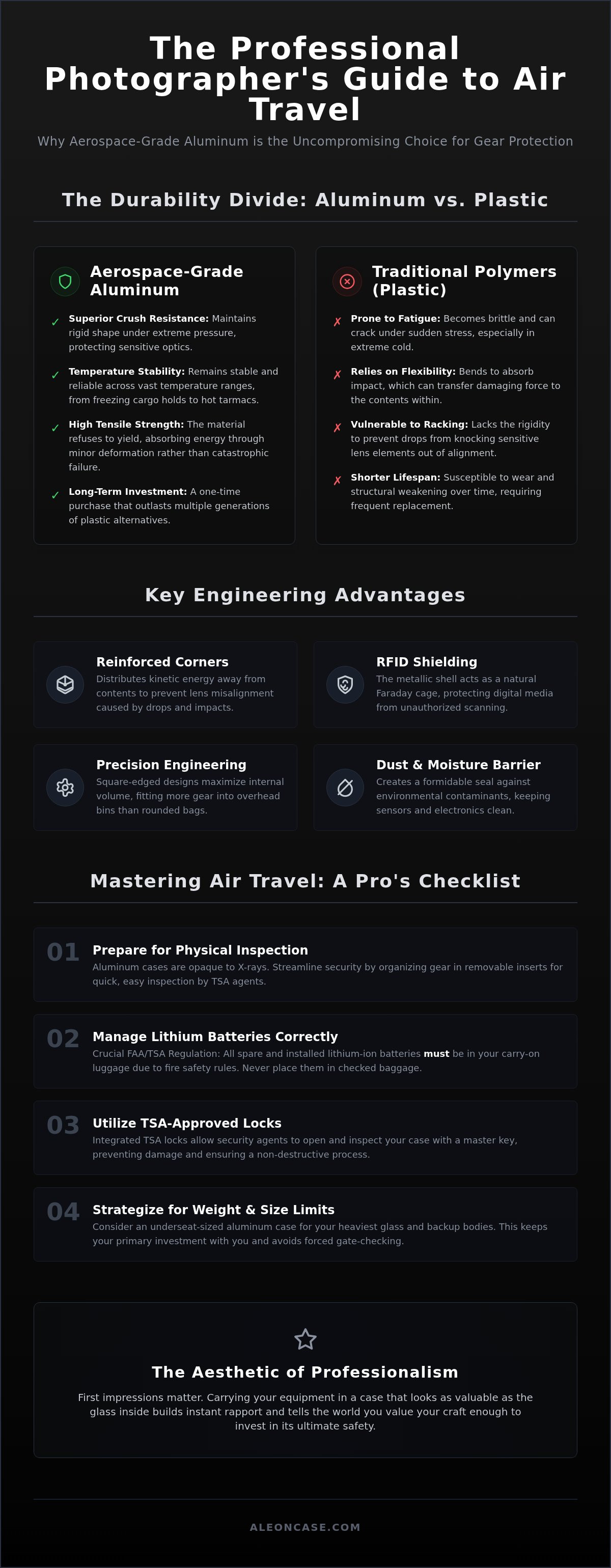
Precision optics require more than just a padded bag. They demand a rigid fortress. Aerospace-grade aluminum provides a structural integrity that polymer cases simply cannot replicate. While plastic shells rely on thickness and flexibility to survive impacts, aluminum offers high tensile strength and rigidity. This material doesn't just bounce back; it refuses to yield. When you're traveling with an aluminum camera case, you're utilizing a shell that maintains its shape even under the crushing weight of stacked luggage in a cargo hold. This rigidity is often measured against the ATA Specification 300, a standard that defines the durability required for high-frequency flight transit.
Corner reinforcement is another critical engineering detail. Most lens damage occurs not from a direct hit, but from the "racking" effect of a drop that knocks internal elements out of alignment. Aluminum cases feature reinforced corners that distribute kinetic energy away from the contents. This ensures that your most delicate glass remains perfectly calibrated. Additionally, the metallic shell acts as a natural RFID shield. This protects your digital storage media and personal information from unauthorized scanning in crowded terminals. Unlike soft-sided bags, an aluminum case creates a formidable barrier against fine dust and moisture, keeping your sensors clean in the most demanding environments.
Aluminum vs. Plastic: The Durability Divide
Plastic cases are prone to fatigue. In extreme cold, polymers can become brittle and crack under sudden stress. Aluminum remains stable across a vast temperature range. It absorbs energy through minor, localized deformation rather than catastrophic failure. Choosing a high-quality aluminum suitcase for your gear is a definitive career move. It's a one-time investment that outlasts multiple generations of plastic alternatives. It doesn't just protect your gear; it preserves your ability to work.
The Aesthetic of Professionalism
First impressions matter in high-stakes photography. The minimalist ALEON design signals a level of professional intent that clients immediately recognize. Carrying your equipment in a case that looks as valuable as the glass inside builds instant rapport and trust. It tells the world you value your craft enough to invest in its safety. This psychological edge is invaluable when arriving at a luxury venue or a high-profile corporate shoot.
Navigating Air Travel: TSA Compliance and In-Flight Logistics
Efficiency at the airport is a hallmark of the seasoned professional. When you are traveling with an aluminum camera case, the security process requires a specific approach. Because metal shells are opaque to X-ray machines, security agents will often require a physical inspection of your gear. This is a standard procedure. You can streamline this by ensuring your equipment is neatly organized within your removable photography inserts. Referencing the official TSA guidelines for camera equipment can help you prepare for these interactions with confidence. It's also vital to remember that lithium-ion batteries must remain in your carry-on; never place them in checked baggage due to fire safety regulations. For powering peripheral gear like flashes, utilizing high-performance rechargeable cells from Horizon Battery can help keep your kit compact and travel-compliant.
Mastering the TSA Checkpoint
Integrated TSA-approved locks are essential for a smooth journey. These allow agents to open and inspect your case using a master key, preventing the need to cut locks or damage the shell. If an agent needs to verify the contents, the process is quick and non-destructive. Pro-tip: you should never check a camera case unless it is aerospace-grade and securely locked, as the mechanical stress of automated sorting systems can easily misalign precision optics in lesser containers.
Weight management is the next hurdle, especially as international carriers move toward stricter 2026 compliance standards. While aluminum is heavier than fabric, its protection density is far higher. To stay within limits, consider using a 16" underseat aluminum luggage unit for your heaviest glass and backup bodies. This keeps your primary investment within reach and ensures you aren't forced to gate-check your most valuable tools if overhead bins fill up. You might find that specialized aluminum luggage offers the perfect balance of volume and structural security for these tight requirements.
Maximizing Overhead Bin Efficiency
The geometric precision of an aluminum case provides a distinct advantage in the cabin. Square-edged designs maximize internal volume, allowing you to fit more gear into standard overhead bins than rounded, soft-sided bags. Once you land, multi-directional spinner wheels allow you to navigate tight airplane aisles and crowded terminals with minimal effort. This mobility ensures that even a fully loaded kit remains easy to manage during long layovers or quick gate changes.
Choosing Your Ideal Setup: ALEON’s Specialized Photography Solutions
Selecting the right configuration depends entirely on your assignment's geography and technical demands. For international creators, the 21" Aluminum Camera Carry-On is the definitive choice. It balances internal volume with strict airline dimensions, ensuring your primary kit never leaves your sight. When your work moves into more rugged, on-location environments, the 16" Aluminum Photography Backpack offers a unique combination of mobility and rigid protection. It allows for hands-free navigation through difficult terrain without sacrificing the structural benefits of a hard shell. This minimalist, industrial aesthetic also provides a level of "stealth luxury." It signals professional utility rather than consumer wealth, which is a subtle but effective strategy for protecting your gear in high-traffic areas.
Larger productions often require more than a single body and lens. The 26" and 30" Aluminum Check-In Cases are engineered to house complex lighting kits and heavy-duty tripods. These larger units provide the same aerospace-grade security for your support gear that your carry-on provides for your glass. You can easily customize the internal layout using high-density foam or adjustable dividers to fit specific lens configurations. This level of organization is essential when you visit Bald Mountain Air Service for a bear photo safari, as it prevents internal movement during the heavy vibrations of takeoff and landing in remote environments.
Modular Internals for Dynamic Kits
Efficiency is paramount for a working professional. ALEON's removable photography inserts allow you to transition from travel mode to active shooting in seconds. These inserts do more than just organize; they provide a critical layer of secondary shock absorption. By nesting your equipment within a padded insert inside an aluminum shell, you create a dual-barrier system. This isolates sensitive electronics from external impacts and the high-frequency vibrations common in air travel.
Long-Term Reliability and Maintenance
An investment in specialized aluminum luggage is intended to span a career. Maintaining the integrity of your case is straightforward. After an international trip, wipe the exterior with a soft cloth and check the rubber seals for debris. This ensures the moisture and dust barrier remains intact for your next mission. Traveling with an aluminum camera case becomes a seamless part of your professional identity. The material develops a unique patina over time, reflecting a history of successful assignments. ALEON cases are built to endure, ensuring your protection setup evolves alongside your camera systems.
Secure Your Vision for the Journey Ahead
Your equipment is more than a collection of tools; it's the foundation of your professional legacy. By choosing aerospace-grade aluminum, you ensure that your precision optics remain calibrated regardless of the turbulence or handling they encounter. We've explored how the structural rigidity of these cases provides a level of security that polymer shells simply cannot match. You now have the knowledge to navigate TSA checkpoints with ease and select a modular setup that fits your specific creative workflow. Traveling with an aluminum camera case isn't just a logistical decision. It's a commitment to the longevity of your craft and the reliability of your results.
Trusted by professional photographers worldwide, ALEON designs are built to withstand the rigors of the road while maintaining a sophisticated, minimalist aesthetic. With integrated TSA-approved locks and customizable inserts, your gear remains accessible to you and protected from everything else. It's time to trade travel anxiety for total peace of mind. Explore the ALEON Photography Collection for Unrivaled Gear Protection and prepare for your next assignment with the confidence of a seasoned traveler. Your best work is waiting at the end of the flight.
Frequently Asked Questions
Do aluminum camera cases get dented easily during air travel?
Aerospace-grade aluminum is highly resilient but can develop minor surface indentations over years of rigorous use. These dents are actually a sign of the material doing its job. Aluminum absorbs kinetic energy through localized deformation, which prevents that same force from reaching your delicate lens elements. Unlike plastic cases that may crack or shatter under extreme pressure, an aluminum shell remains structurally sound and continues to provide a secure, weather-resistant seal.
Are aluminum cases too heavy for international carry-on restrictions in 2026?
Aluminum is naturally heavier than fabric, but ALEON cases are engineered to meet the evolving weight requirements of major airlines for 2026. The 21-inch carry-on models are specifically designed to maximize protection while staying within portable limits. You can successfully manage the weight-to-protection ratio by utilizing removable photography inserts and placing your heaviest glass in underseat luggage if necessary. Traveling with an aluminum camera case ensures you don't have to sacrifice security for mobility.
Can TSA open my aluminum camera case if it is locked?
Security agents can inspect your equipment without causing damage as long as your case features integrated TSA-approved locks. These specialized latches allow agents to use a universal master key to open the case for a physical search. This is a critical feature because the density of a metal shell often requires a manual inspection during the security process. Having these locks ensures your gear remains protected and your case stays intact throughout the journey.
Does an aluminum case protect my camera gear from extreme temperatures?
Aluminum provides a stable thermal barrier that outperforms most polymer alternatives in harsh environments. It doesn't become brittle in sub-zero temperatures or warp under intense desert heat, which helps maintain the alignment of your camera's mechanical components. When you're traveling with an aluminum camera case, the high-density internal padding also acts as an insulator. This slows the rate of temperature change and helps prevent internal condensation from forming on your sensors and glass.


