


The most efficient mobile office on the market isn't a backpack or a messenger bag; it's a piece of equipment born in the clouds. You've likely felt the frustration of fumbling with a side-opening bag in a cramped boardroom or felt that pang of anxiety when a soft-shell case gets squeezed in an overhead bin. It's natural to wonder, what is a pilot case used for in a modern professional setting? While these cases began as cockpit essentials, they've become the definitive tool for anyone requiring vertical accessibility and high-stakes protection.
In this guide, you'll discover why the pilot case has evolved into the ultimate mobile office for high-stakes professionals. We'll explore how aerospace-grade aluminum and top-loading designs provide the security your gear deserves while signaling a refined, authoritative aesthetic. From protecting sensitive electronics to organizing critical files, learn how this specialized luggage transforms your daily workflow.
Key Takeaways
- Learn why the vertical, top-loading design offers superior accessibility in cramped spaces compared to traditional side-opening luggage.
- Discover what is a pilot case used for in modern professional contexts, ranging from heavy litigation file transport to securing sensitive field equipment.
- Understand the protective advantages of aerospace-grade aluminum construction for safeguarding high-value electronics and critical documents.
- Identify the key features that define a premium mobile office, including multi-directional spinner wheels and integrated security systems.
What is a Pilot Case? Definition and Core Purpose
A pilot case is a specialized, hard-sided business case designed for maximum accessibility and protection. Originally, these cases served flight crews, allowing them to retrieve navigation charts within narrow cockpits. Unlike a standard Flight Bag, which is often soft-sided, the pilot case uses a rigid structure to safeguard contents. It serves as the structural foundation of a professional mobile office.
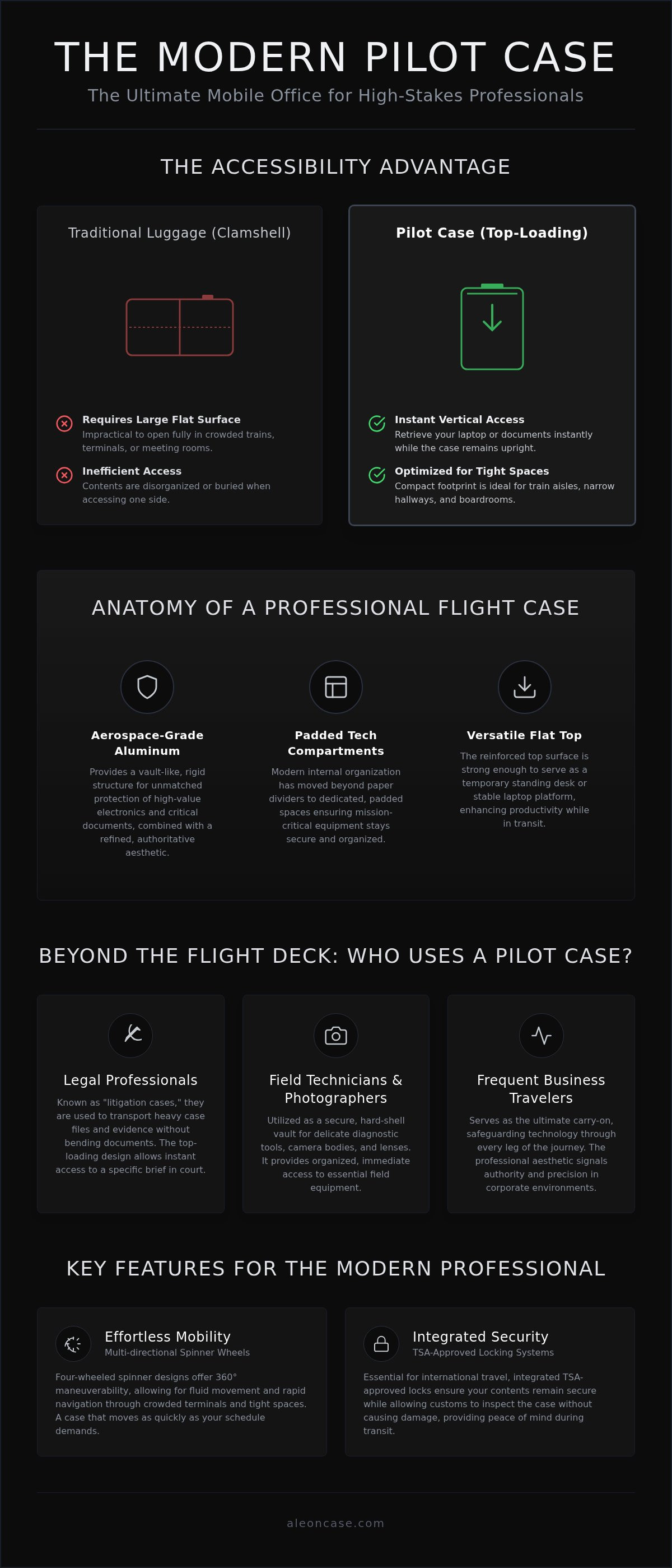
When asking what is a pilot case used for today, the answer lies in its unique architecture. Traditional luggage typically employs a clamshell design. This requires you to lay the bag flat to reach your belongings, which is impractical in a crowded train or terminal. In contrast, a pilot case utilizes a vertical, top-loading orientation. It allows you to reach your laptop or critical documents instantly while the case remains upright. It's built for those who value time and order.
The Essential Anatomy of a Professional Flight Case
The hallmark of a premium case is its structural integrity. Aerospace-grade aluminum is the industry standard, providing a vault-like environment for mission-critical tools like an Electronic Flight Bag (EFB). For those seeking this level of protection, aluminum luggage offers an unmatched combination of durability and style. The vertical orientation offers a significant ergonomic advantage; you don't need to crouch to access files. Modern internal organization has transitioned from paper dividers to padded tech compartments. These dedicated spaces ensure high-value equipment stays secure, reflecting why the question of what is a pilot case used for now extends to every high-stakes career.
Who Uses a Pilot Case? Beyond the Flight Deck
While its name suggests a cockpit origin, the answer to what is a pilot case used for today spans multiple high-stakes industries. Legal professionals often refer to these as litigation cases. They rely on the rigid structure to transport heavy case files and evidence without the risk of documents bending or the bag tipping over in a courtroom. The top-loading design ensures they can pull a specific brief in seconds without disrupting their workflow.
Field technicians and photographers utilize the case as a secure, hard-shell vault. Just as aviators must organize essential items in a flight bag, these experts require immediate access to delicate diagnostic tools or camera bodies. For the frequent business traveler, it serves as the ultimate carry-on. It offers a level of durability that safeguards your technology through every leg of the journey.
The Pilot Case as a High-Stakes Mobile Office
Efficiency is paramount in narrow spaces. The compact footprint excels in train aisles, narrow hallways, and crowded conference rooms where a traditional suitcase would be an obstacle. A minimalist aluminum aesthetic reinforces your professional presence, signaling authority and precision in corporate environments. It's a visual cue of your commitment to quality.
The reinforced flat top surface even serves as a temporary standing desk or laptop platform during transit. It's a versatile solution for those who value both form and function. If you're ready to upgrade your professional toolkit, exploring a high-quality aluminum pilot case can redefine how you manage your mobile office. It's a choice that combines reliability with a sophisticated edge.
Choosing the Right Aluminum Pilot Case for Your Career
Selecting the right equipment depends on understanding the specific rigors of your profession. Aerospace-grade aluminum provides a level of security and durability that plastic or nylon simply can't match. This is particularly vital for professionals protecting sensitive data or high-value tech. Modern security requires more than just a sturdy shell. Integrated TSA-approved locks are essential for international travel; they ensure your contents remain secure while allowing customs officials to inspect the case without causing damage. It's about peace of mind during transit.
Mobility is another critical factor in your selection. While some prefer traditional two-wheeled steerable cases for stability, four-wheeled multi-directional spinner wheels offer effortless navigation through crowded terminals. This design evolution mirrors the shift in aviation from heavy paper charts to the modern Electronic Flight Bag (EFB). When considering what is a pilot case used for in a modern context, the focus is on fluid movement and rapid access. You need a case that moves as quickly as your schedule demands.
The ALEON Standard: Engineering for Longevity
ALEON's 17" Aluminum Pilot Case represents a career-long investment, built to withstand decades of heavy use. For those who prioritize maximum portability without sacrificing protection, the 16" underseat luggage option provides a compact, high-performance alternative. Choosing from ALEON’s aluminum luggage collection ensures you have a reliable companion for every high-stakes journey. It's the logical choice for professionals who understand what is a pilot case used for: total reliability and an uncompromising aesthetic that signals established authority.
Elevate Your Professional Journey with Precision
The modern professional landscape demands tools that offer both unyielding protection and effortless access. Understanding what is a pilot case used for reveals its true value; it's a mobile vault that keeps your critical documents and technology within reach at all times. By choosing aerospace-grade aluminum construction and integrated TSA-approved security, you aren't just buying luggage; you're securing your career's most important assets. These cases are trusted by aviation and business leaders alike for their ability to signal authority while delivering seamless functionality in any environment.
Explore the ALEON Pilot Case Collection to find the structural foundation for your next high-stakes project. Invest in equipment that works as hard as you do and enjoy the confidence of a perfectly organized journey.
Frequently Asked Questions
Can I use a pilot case as a standard carry-on for all airlines?
Most modern pilot cases meet the standard carry-on requirements for major carriers. While regulations vary, the common limit of 22 x 14 x 9 inches accommodates these compact cases with ease. They are engineered to navigate narrow aisles and fit securely in overhead compartments. You should always verify dimensions with your specific airline, as budget carriers often enforce stricter size or weight limits for cabin luggage.
Why do professional pilots prefer aluminum cases over leather?
Professional pilots prioritize aluminum because it provides a rigid, crush-proof environment for high-value equipment. Unlike leather, which can scuff, tear, or lose its structural integrity over time, aerospace-grade aluminum maintains its shape and professional appearance for decades. It offers superior protection against impacts and moisture. This ensures that critical devices and documents remain safe in the demanding environment of a modern flight deck.
Will a 17-inch pilot case fit in the overhead bin of a regional jet?
A 17-inch pilot case is ideal for regional jets where overhead space is notoriously limited. Its compact dimensions allow it to slide into smaller bins that often reject standard carry-on luggage. This portability is a key part of what is a pilot case used for by travelers who transition between international flights and smaller domestic connections. It ensures your gear stays with you instead of being gate-checked.
What is the difference between a flight bag and a pilot case?
The distinction lies primarily in construction and accessibility. A flight bag is typically a soft-sided bag made of nylon or canvas, offering flexibility but minimal protection. A pilot case is a hard-sided, reinforced container featuring a top-loading lid. This design allows for immediate access to contents in tight spaces. Understanding these differences helps clarify what is a pilot case used for when high-stakes equipment protection is the priority.


