


The most eco-friendly suitcase isn't necessarily the one made from recycled plastic bottles. It's the one you only have to buy once. As we enter the UN Decade of Sustainable Transport in 2026, the search for authentic sustainable luggage brands has moved beyond simple recycled fabrics toward a deeper commitment to longevity and circularity. You've likely felt the frustration of a cracked plastic shell or a broken wheel after just a few international flights. It's a wasteful cycle that many modern travelers are eager to break.
We understand that choosing the right gear is often complicated by greenwashing and vague marketing claims. This guide simplifies your decision by showing you exactly how to identify travel gear that respects both the planet and your professional standards. You'll discover why high grade aluminum is the definitive material for a circular travel economy and which brands are leading the way with social responsibility initiatives. We've curated a selection of premium options that offer a minimalist look and a lifetime of reliability, ensuring your next investment is your last.
Key Takeaways
- Learn why true sustainability is defined by a product's end-of-life recyclability rather than just its initial recycled content.
- Master a practical framework to evaluate sustainable luggage brands using the three pillars of materials, manufacturing, and mission.
- Discover the engineering benefits of aerospace-grade aluminum and how it supports a circular economy for conscious travelers.
- See how choosing durable gear can directly fund social responsibility projects, such as providing solar power to remote regions.
- Find out how to transition to a minimalist, carry-on-only lifestyle without compromising on professional style or long-term security.
What Defines Sustainable Luggage in 2026?
Sustainability in the travel industry has evolved beyond basic recycled materials. In 2026, the benchmark for sustainable tourism involves examining the entire lifecycle of a product. Truly sustainable luggage brands focus on three core areas: ethical manufacturing, extreme longevity, and end-of-life recyclability. It's no longer enough to use "green" materials if the final product ends up in a landfill within three years.
To better understand how specific construction choices impact the travel experience, watch this helpful video:
The traditional travel model often relies on a "Disposable Luggage Cycle." This occurs when travelers purchase inexpensive, plastic-based bags that break after a few trips. Each replacement carry-on or check-in case adds to a significant carbon footprint through manufacturing and international shipping. A circular economy approach seeks to eliminate this waste by prioritizing materials that can be repaired or fully recycled without losing quality.
The Longevity Factor: Why Durability is the Ultimate Green Metric
Durability is the most effective way to reduce environmental impact. A single high-quality suitcase that serves a traveler for twenty years is vastly superior to four recycled plastic cases that fail every five years. Every time a bag is replaced, the energy required for production and logistics is spent again. By investing in enduring quality, you reduce the demand for raw material extraction and lower your personal travel emissions. Reliability is the foundation of conscious travel.
Material Science: Aluminum vs. Recycled Plastics
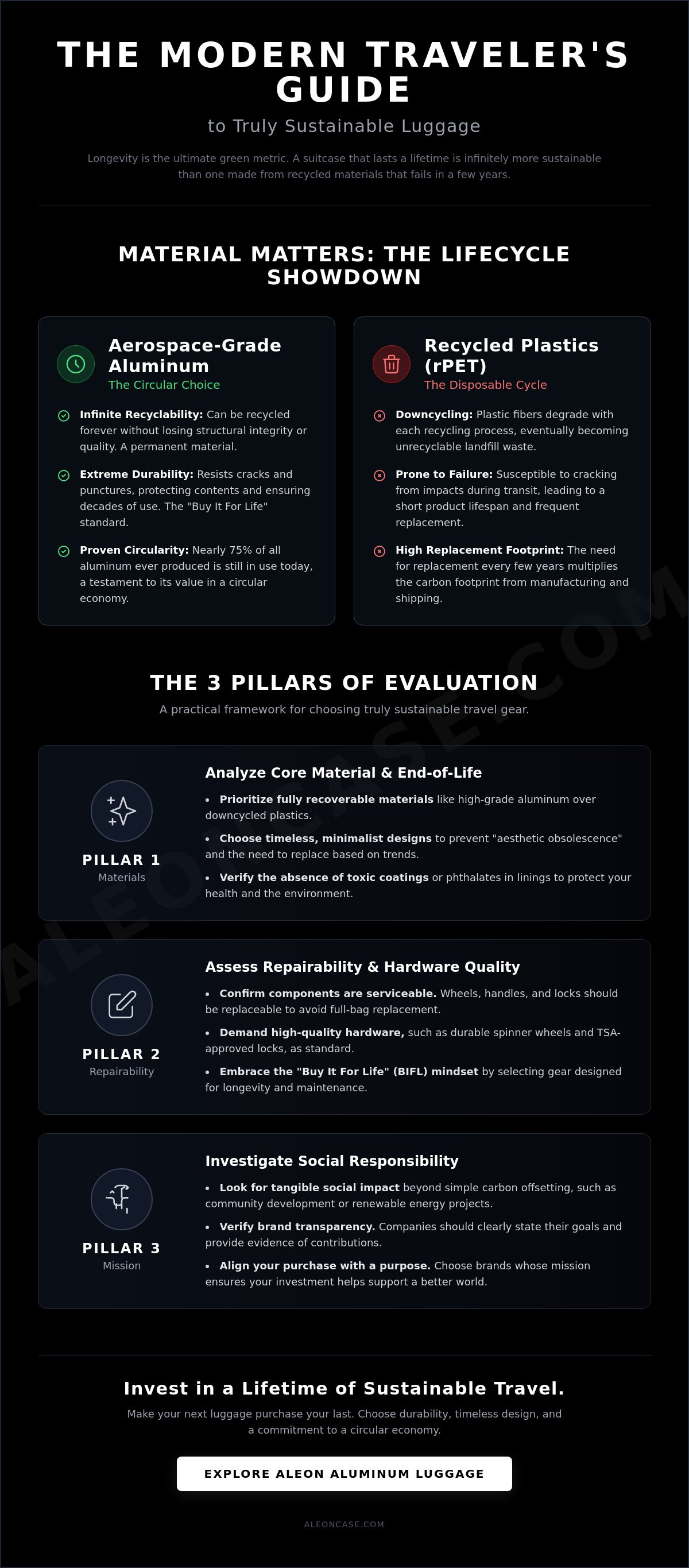
While many sustainable luggage brands promote recycled plastic (rPET), these materials are often subject to "downcycling." Plastic fibers degrade each time they are processed, eventually becoming unrecyclable. In contrast, aerospace-grade aluminum offers infinite recyclability. According to industry data, nearly 75% of all aluminum ever produced is still in use today. This metal maintains its structural integrity forever, making aluminum luggage a permanent investment in a circular future.
How to Evaluate Sustainable Luggage Brands
Evaluating sustainable luggage brands requires a systematic approach that looks past marketing buzzwords. While many companies highlight a single eco-friendly feature, a truly conscious choice is based on the "Three Pillars of Sustainable Travel Gear": Materials, Manufacturing, and Mission. This framework ensures your investment supports environmental health while providing the professional, minimalist aesthetic required for modern travel. It's about finding a balance between what's good for the planet and what performs reliably on the road.
Step 1: Analyze the Core Material and Recyclability
Start with the shell. Look for materials that resist aesthetic obsolescence. A timeless, minimalist design ensures your gear remains professional and relevant for decades, preventing the need for a replacement based on shifting trends. Prioritize high-grade metals or advanced polymers that can be fully recovered at the end of their lifecycle. It is also vital to check for the absence of toxic coatings or phthalates in the interior linings. These choices ensure your gear doesn't leach chemicals into the environment or your personal belongings.
Step 2: Assess Repairability and Hardware Quality
Sustainability and repairability are inseparable. A common failure point in travel gear is the hardware. High-quality multi-directional spinner wheels and TSA-approved locks should be standard; however, they must also be serviceable. Determine if components like handles and wheels can be serviced rather than requiring a full bag replacement. This "Buy It For Life" (BIFL) approach is the most effective way to judge sustainable luggage brands and ensure your gear stays out of the landfill.
Step 3: Investigate Social Responsibility and Give-Back Programs
The final pillar is the brand's mission. Genuine impact goes beyond simple carbon offsets. Look for tangible social impact, such as support for renewable energy or community development in the regions where the brand operates. Transparency is key. A brand should clearly state its goals and provide evidence of its contributions. This level of accountability ensures your purchase supports a better world, providing a sense of purpose to your travels.
ALEON: Leading the Shift Toward Durable, Ethical Travel
ALEON represents the intersection of high-performance engineering and conscious travel. While many sustainable luggage brands focus on temporary solutions, ALEON builds for the long term. By prioritizing aerospace-grade aluminum, the brand provides a solution that is both high-end and deeply responsible. This choice reflects a commitment to the circular economy, ensuring that every piece of gear is a permanent addition to your travel kit rather than a temporary convenience. From the compact 16" underseat luggage to the expansive 32" aluminum check-in case, every unit is designed with professional-grade longevity in mind.
Aerospace-Grade Aluminum: The Sustainable Advantage
Aluminum offers a level of protection that plastic simply cannot match. It serves as a rigid shield for sensitive electronics and professional photography equipment. The weight-to-strength ratio is exceptional. It ensures a lifetime of use without structural failure, even under the rigors of frequent international transit. This inherent durability is the core of why ALEON is a standout among sustainable luggage brands. Every case is backed by a 10-year limited worry-free warranty, reinforcing the promise of reliability and enduring quality.
A Mission Beyond Luggage: Solar Energy Initiatives
Social responsibility should extend beyond the factory floor. ALEON partners with the Abundant Life Foundation to create tangible change in developing regions. For every case sold, the brand makes a donation to provide solar-powered lights to communities in Roatán, Honduras. This initiative connects the brand’s expertise in durable materials with a broader advocacy for renewable resources. It's a logical extension of a brand that values efficiency and foresight. We invite you to explore the ALEON collection and invest in travel gear that honors both your journey and the planet.
Elevate Your Travel Standards for a Circular Future
The landscape of travel gear in 2026 has shifted toward a more logical and enduring philosophy. The most responsible choice is no longer just about recycled content; it's about the product that never enters a landfill. By prioritizing infinite recyclability and precision engineering, you move beyond the limitations of disposable plastic. True leaders among sustainable luggage brands are those that offer a seamless blend of professional aesthetics and ethical accountability. You now have the framework to evaluate gear based on its material integrity and the tangible social impact of the brand.
Choosing your next travel companion is an opportunity to align your professional success with your environmental values. ALEON provides the security and durability required for a life in motion. From aerospace-grade aluminum construction to TSA-approved security features, every detail is refined for the modern explorer. For those looking to maximize their packing space sustainably, jellypenny.com offers high-quality compression sets that complement a minimalist travel setup. It's a commitment to quality that simplifies your journey while supporting global community development through vital clean energy projects.
Invest in a Lifetime of Sustainable Travel with ALEON Aluminum Luggage and support solar energy initiatives in Honduras with every journey you take. Your commitment to quality today ensures a more resilient world tomorrow.
Frequently Asked Questions
Is aluminum luggage more eco-friendly than recycled plastic?
Yes, aluminum is often more eco-friendly because it offers infinite recyclability and superior durability. Recycled plastic eventually degrades and ends up in a landfill, but aluminum retains its structural integrity forever. This longevity breaks the cycle of replacing cheap bags every few years. By choosing a metal case, you significantly reduce the long-term carbon footprint associated with manufacturing and shipping multiple replacement suitcases.
How does ALEON support solar energy initiatives?
ALEON supports clean energy through a dedicated partnership with the Abundant Life Foundation. For every case sold, a donation is made to provide solar-powered lights to communities in Roatán, Honduras. This initiative brings renewable energy to families who lack reliable power. It demonstrates how sustainable luggage brands can create measurable social impact while providing professional-grade travel solutions to their customers.
Can aluminum suitcases be recycled at the end of their life?
Aluminum suitcases are completely recyclable and can be repurposed indefinitely without any loss in material quality. Unlike plastics that downcycle into lower-grade products, aluminum is a permanent resource. Statistics show that 75% of all aluminum ever produced is still in active use today. This makes it a foundational material for a circular economy, ensuring your travel gear never contributes to global waste.
What makes a luggage brand truly "sustainable"?
True sustainability is defined by a brand's commitment to product longevity and ethical social initiatives. A brand shouldn't just use recycled materials; it should design gear that never needs to be replaced. High-quality sustainable luggage brands provide repairable parts and long-term warranties to ensure their products last for decades. They also maintain transparency regarding their manufacturing processes and their contributions to global community development.


