


Your briefcase is not just a container for your tools; it's the primary engine of your professional output. With global business travel spending projected to reach $1.7 trillion in 2026, the margin for error during high-stakes transit has vanished. Mastering the art of organizing a business briefcase is no longer about simple neatness. It's a matter of engineering a high-performance environment that protects your 15 inch laptop and sensitive data behind aircraft-grade aluminum and TSA-recognized locks.
You've likely felt the frustration of digging for a charger while a client waits, or the anxiety of a cluttered bag that feels like a bottomless pit. It's time to demand more from your gear. We'll show you how to transform your mobile office into a secure, sophisticated command center that projects confidence and permanence. This guide breaks down the spatial architecture and technical protocols needed to ensure every "click" of your case signals total control over your professional world. You'll learn to optimize internal layouts, leverage RFID-blocking technology, and maintain a seamless appearance that commands respect in any boardroom.
Key Takeaways
- Define the modern mobile office as a precision-engineered hub designed for asset protection and instant accessibility.
- Implement the Three-Tier Asset Framework to separate high-frequency essentials from your high-value digital core.
- Understand how rigid aircraft-grade aluminum maintains a fixed internal geometry, ensuring your layout remains identical every time you open the case.
- Master a five-step engineering protocol for organizing a business briefcase to eliminate clutter and enhance workflow efficiency.
- Experience the security of a zipperless closure system that provides a water-resistant seal and reinforced protection for your professional gear.
What is an Organized Business Briefcase in 2026?
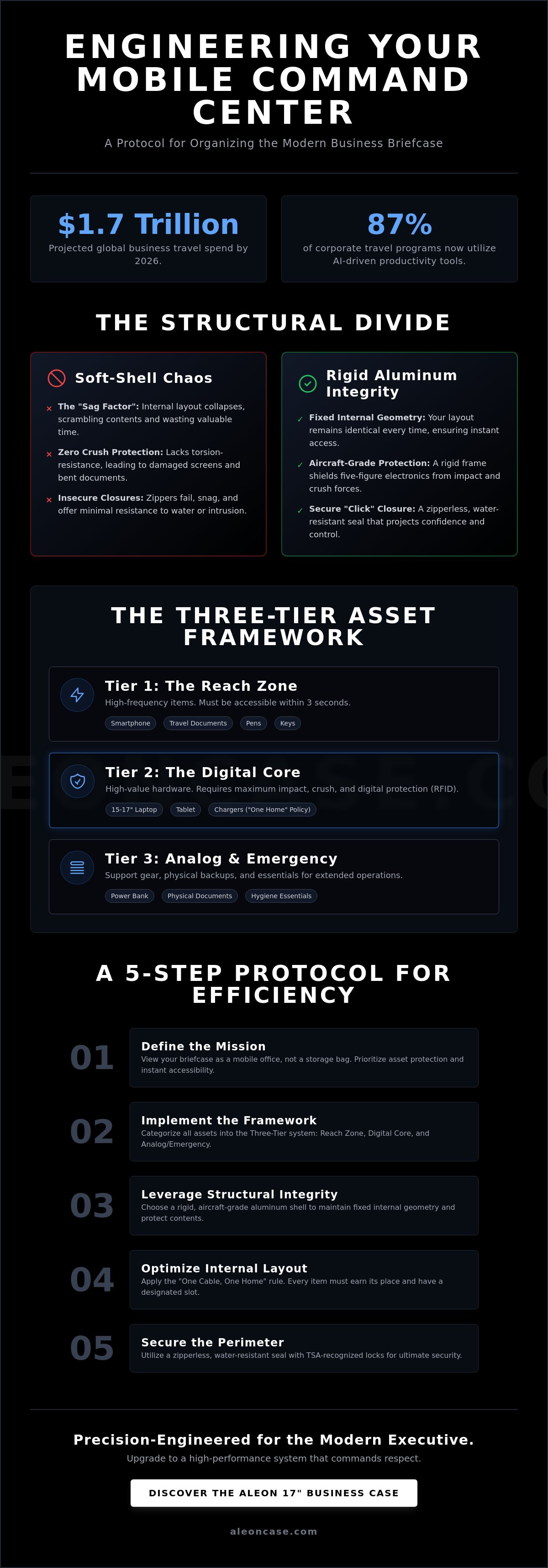
The 2026 professional environment demands more than a mere container for documents. An organized briefcase is now defined as a precision-laid mobile office that prioritizes asset protection and instant accessibility. While the history of the business briefcase traces back to simple leather satchels, the modern executive requires a structural foundation that mirrors their digital workflow. With 87% of corporate travel programs now utilizing AI-driven productivity tools, your physical gear must match that level of surgical precision. Efficiency is the new return on investment.
Organizing a business briefcase begins with understanding that your bag is a high-performance environment. The shift from paper-heavy workflows to tech-centric operations means your case must safeguard five-figure electronics rather than just shielding files. Structural rigidity is the prerequisite for this system. Without a fixed frame, internal organization is an illusion that disappears the moment you lift the handle. The psychological impact of a "clean click" closure provides a sense of unwavering confidence; fumbling with a zipper suggests a lack of control before the meeting even begins. A secure, hardside seal communicates that you are prepared for the pressure of global commerce.
The Briefcase Paradox: Capacity vs. Efficiency
Many professionals mistakenly believe that an abundance of pockets leads to better order. In reality, excessive compartments often create a "bottomless pit" effect where small items vanish into fabric folds. True efficiency relies on a "Buy It For Life" philosophy. You must invest in a structural foundation that dictates where items belong. The Mobile Command Center is a tool for high-stakes performance that eliminates the need to hunt for gear. A refined, minimalist interior allows for faster recognition of missing items, ensuring you never leave a critical charger behind in a London boardroom.
Why Soft-Shell Bags Fail the Organization Test
Soft-shell bags suffer from what engineers call the "Sag Factor." When a fabric bag is set down, its walls collapse and scramble your internal layout, forcing you to dig for essentials. This lack of torsion-resistance frequently leads to damaged laptop screens or bent documents. Transitioning to a hard-shell mindset provides permanent order. Aircraft-grade aluminum cases maintain their geometry regardless of how they are handled, keeping your pens, tablets, and passports in the exact coordinates you assigned them. A rigid shell ensures your mobile office remains a reliable asset rather than a chaotic liability.
The Three-Tier Asset Framework for Professional Organization
Successful spatial management within a mobile office is not a matter of luck. It is a result of rigorous engineering. Organizing a business briefcase requires a systematic approach that we call the Three-Tier Asset Framework. This methodology categorizes your belongings based on their frequency of use and their inherent vulnerability. By assigning specific zones to these assets, you eliminate the cognitive load of searching for tools during critical moments. Every second spent digging for a passport or a pen is a second of lost professional authority.
The framework operates on three distinct levels. Tier 1 is the Reach Zone, reserved for high-frequency items like your smartphone, travel documents, and primary writing instruments. These must be accessible within three seconds. Tier 2 is the Digital Core, housing your laptop and tablet. This zone requires the highest level of impact protection. Tier 3 is the Analog and Emergency tier, containing physical documents, backup power banks, and hygiene essentials. To maintain this system, you must apply the "Earn the Right" rule. Every item in your case must justify its weight and volume. If an object hasn't served a function in your last three trips, it is dead weight that compromises your mobility.
Protecting the Digital Core
In 2026, your hardware is your most valuable asset. While many rely on soft padded sleeves, these offer zero protection against crush forces or torsion. True security comes from an aircraft-grade aluminum shell that creates a rigid perimeter around your 15 inch laptop. You should also adopt a "one cable, one home" policy to prevent the typical tangle of wires that plagues lesser bags. For those handling sensitive corporate data, the 17" Business Case integrates RFID shielding to neutralize the threat of digital skimming in crowded transit hubs.
The Analog Essentials
Despite the digital revolution, physical artifacts remain essential for high-level networking. Carrying business cards in a soft-shell bag often leads to "corner curl," which immediately undermines your professional image. A rigid internal structure ensures that every document and card remains pristine and crisp. Your stationery kit should be minimalist; one high-quality pen is superior to a dozen plastic alternatives. This focus on quality over quantity reflects a sophisticated "buy it for life" philosophy that values permanence. When you open a reinforced case, the contents should appear as a curated set of tools, not a collection of clutter.
Structural Integrity: Why Rigid Aluminum Beats Soft-Shell Chaos
The foundation of a high-performance mobile office is the material that encases it. While competitors often prioritize the suppleness of leather or the flexibility of nylon, these materials fail the most basic requirement of organizing a business briefcase: maintaining a fixed internal geometry. A soft-shell bag is a shifting environment. When the exterior deforms, the interior layout collapses, rendering your organization system useless. Aircraft-grade aluminum provides a permanent, reinforced perimeter that ensures your tools remain exactly where you placed them, trip after trip.
Security is not just about locks; it's about the physical defense of your assets. High-frequency travelers often carry five-figure investments in hardware and proprietary data. A rigid aluminum shell offers superior impact resistance that fabric cannot match. The tactile experience of a latch-based system further reinforces this sense of security. Unlike traditional zippers that can snag, tear, or be easily compromised, the "click" and "seal" of a zipperless closure provides immediate confirmation that your belongings are protected. This is a "buy it for life" philosophy translated into engineering, where aluminum maintains its professional edge for decades while leather scuffs and fabric inevitably frays.
The Physics of Protection
In the compressed environment of a crowded overhead bin, torsion-resistance is your primary defense against equipment failure. A reinforced aluminum case prevents the twisting forces that crack laptop screens and damage internal circuitry. The integrated rubber seal creates a seamless barrier, protecting your Digital Core from moisture, dust, and debris. The anodized aluminum surface provides a high-strength, scratch-resistant finish that preserves the case's sophisticated appearance through years of rigorous use. This technical superiority ensures that your mobile command center remains operational in any climate or condition.
Aesthetic Cohesion
Professionalism is projected through precision. A structured bag communicates an unwavering confidence that resonates in high-stakes meetings. This is the essence of "Quiet Luxury," where quality is felt through substance rather than shouted through logos. Maintaining an aluminum case requires minimal effort compared to the constant conditioning needed for high-end leather. A simple wipe preserves the anodized finish, keeping your presentation sharp and your focus on the deal at hand. Organizing a business briefcase within a rigid frame ensures you never appear flustered, providing a seamless transition from the airport lounge to the executive boardroom.
Engineering Your Layout: A Five-Step Protocol for Efficiency
Constructing a mobile command center requires a disciplined approach to spatial management. Organizing a business briefcase is not a one-time event; it's a repeatable engineering protocol that ensures peak performance. By following a structured sequence, you eliminate the randomness that leads to fumbled meetings and damaged gear. This five-step process transforms a simple container into a precision tool designed for the high-frequency professional.
- Step 1: The Total Purge. Begin by emptying the case entirely. This allows you to evaluate the structural starting point and inspect the reinforced corners for any debris. A clean, anodized interior is the only acceptable foundation for a professional layout.
- Step 2: Zone Mapping. Assign your high-value real estate based on the Tier 1 assets identified earlier. Passports, credentials, and primary communication devices must occupy the most intuitive "reach" zones.
- Step 3: Tech Anchoring. Secure your 15 inch laptop and tablet within the central reinforced compartments. This anchoring prevents internal shifting and ensures that impact protection is maximized during turbulent transit.
- Step 4: Cable Management. Utilize specialized pouches to neutralize the "tangle trap." Every power cord and adapter must have a dedicated home, preventing the visual and functional chaos of loose wires.
- Step 5: The Seal Test. Close the case and listen for the definitive "click" of the latches. A seamless seal should occur without internal pressure. If the case requires force to close, the internal geometry is compromised and must be recalibrated.
For those who demand this level of precision in their daily workflow, the Aleon 17" Business Case offers the exact structural rigidity required to maintain this five-step system indefinitely.
The Airport Security Sprint
In 2026, U.S. domestic business travel is forecast to grow 0.7%, reaching $319 billion. This volume necessitates extreme efficiency at security checkpoints. Your layout strategy should allow you to access tech and liquids in seconds, minimizing friction. TSA-recognized locks are essential for seamless inspections, allowing authorities to verify contents without damaging your investment. For professionals navigating expansive international terminals, a rolling 17" Business Case provides a tactical advantage, reducing physical fatigue while maintaining a sophisticated appearance.
The 'Clean Desk' Briefcase Policy
Maintaining order requires a daily maintenance ritual. Implement a 60-second end-of-day reset to ensure every asset is returned to its assigned coordinate. You must prevent "trash creep" by treating your briefcase as a professional tool, not a wastebin for receipts or wrappers. Adopting a "one-in, one-out" rule for supplies ensures that your case never exceeds its designed capacity. This disciplined approach preserves the "buy it for life" value of your gear and ensures you are always prepared for the next high-stakes engagement.
The Aleon 17" Business Case: Precision-Engineered for the Executive
The Aleon 17" Business Case is the definitive tool for the modern executive. It marries sophisticated design with rugged engineering, providing a permanent home for your mobile command center. As of May 2026, this case remains the benchmark for professionals who view their gear as an investment rather than a temporary accessory. It's designed to accommodate a 15 inch laptop within a frame of aircraft-grade aluminum, ensuring that organizing a business briefcase becomes a seamless, intuitive process. Weighing just 6 lbs, it offers a lightweight yet torsion-resistant solution for the high-frequency traveler.
The "Click-and-Seal" latch system replaces vulnerable zippers with a high-strength closure that guarantees water resistance. Multi-directional spinner wheels allow for effortless navigation through terminals. Double-reinforced corners provide a physical safeguard against the rigors of high-frequency travel. Internally, the architecture features removable organizers. These are specifically crafted to support the Three-Tier Asset Framework, allowing you to customize your layout for maximum efficiency. The Aleon Promise includes a commitment to sustainable durability, utilizing materials that are built to last decades rather than seasons.
Vertical vs. Horizontal: Choosing Your Form Factor
Choosing the correct form factor depends on your specific transit profile. The Vertical Business Unit is optimized for tight urban commutes and narrow aircraft aisles, providing a slim profile without sacrificing internal volume. The Horizontal Business Unit serves as the ultimate mobile desk for long-haul travel, offering a wider base for stability and easier access to documents while seated. Both units utilize the same high-standard manufacturing to ensure your professional appearance remains untarnished. It's a choice between agility and expansive utility.
Security and Peace of Mind
Security is a primary hallmark of the Aleon identity. The 17" Business Case features two TSA-approved key locks, providing security that doesn't sacrifice speed during inspections. The shell is constructed from 6061-T6 aircraft-grade aluminum, a material heritage that ensures torsion-resistance and long-term durability. Measuring 16.5 x 13 x 4.5 inches, it fits comfortably in most overhead compartments or under seats. This is not a product subject to the whims of fast fashion; it's a "buy it for life" asset that maintains its sophisticated edge. Discover the Aleon Business Collection to secure your professional future.
Command Your Professional Environment
Mastering the art of organizing a business briefcase is the final step in refining your mobile workflow. By adopting the Three-Tier Asset Framework and a rigid structural foundation, you ensure that every tool is protected and every second is maximized. Efficiency is an engineering challenge. It requires the right materials and a disciplined protocol to succeed in a $1.7 trillion global travel market. You now have the blueprint to transform your bag from a simple container into a high-performance command center that projects unwavering confidence.
Aleon cases provide the permanent solution for the discerning executive. Each unit is constructed from aerospace-grade 6061-T6 aluminum and secured by a sophisticated, TSA-recognized locking system. Your investment does more than protect your hardware; it supports global sustainability through our dedicated solar energy initiatives. It's time to replace the chaos of soft-shell bags with the permanent security of a precision-engineered shell. Upgrade to an Aleon Business Case and experience the tactile superiority of a zipperless seal. Your mobile office is ready for the high-stakes demands of the future.
Frequently Asked Questions
How do I stop my business cards from getting bent in my briefcase?
Preventing damage to business cards requires a rigid internal environment that eliminates the "corner curl" common in soft-shell bags. You should store cards in a dedicated hard-walled compartment or a reinforced card case. An aircraft-grade aluminum shell provides the necessary wall tension to ensure your cards remain pristine and professional for high-stakes networking.
What are the essential items every professional should have in their briefcase?
A modern professional toolkit must include a 15 inch laptop, a high-quality writing instrument, a backup power bank, and noise-canceling earbuds. In 2026, 87% of corporate travel programs also emphasize the use of RFID-blocking technology to protect digital assets. Maintaining a minimalist kit of high-value essentials ensures you don't compromise your mobility with unnecessary weight.
Is a hard-shell briefcase better than a soft-shell for organization?
Hard-shell cases are significantly superior for organizing a business briefcase because they maintain a fixed internal geometry. Unlike fabric bags that collapse and scramble their contents, a rigid aluminum shell keeps every item in its assigned coordinate. This permanent structure provides the "buy it for life" reliability that high-frequency travelers demand for their mobile office.
How can I keep my laptop charger and cables organized in a briefcase?
Implement a "one cable, one home" policy by utilizing removable organizers or dedicated internal pouches. This method prevents the "tangle trap" and ensures your charging hardware is accessible within seconds. A structured layout within a hardside case avoids the visual clutter that often undermines an executive's professional presentation during a meeting.
What is the best way to clean the interior of an aluminum briefcase?
Clean the anodized interior using a soft, lint-free cloth dampened with a mild soap solution. You must avoid abrasive chemicals that could compromise the scratch-resistant finish of the reinforced shell. A 60-second end-of-day reset prevents "trash creep" and maintains the surgical precision of your internal environment for years of service.
How do I secure my briefcase while traveling for business?
Utilize integrated TSA-approved dual key locks and a zipperless closure system to provide the highest level of security. These features offer a sensory "click" that confirms a seamless seal against unauthorized access. For the 2026 professional, a reinforced aluminum shell offers the best physical defense for sensitive corporate data and high-value electronics.
Can a 17-inch business case fit in an airplane's overhead bin?
Yes, the Aleon 17" Business Case is engineered to fit within the overhead compartments of most international and domestic aircraft. With verified dimensions of 16.5 x 13 x 4.5 inches, it meets standard carry-on requirements. This ensures your mobile command center remains protected and within reach throughout the duration of your flight.
What is the benefit of a rolling briefcase for professional organization?
A rolling briefcase reduces physical fatigue during the long transits typical of 2026 business travel, where domestic spending is forecast to reach $319 billion. Multi-directional spinner wheels provide the agility needed for crowded terminals while maintaining a sophisticated appearance. This form factor is a tactical choice for organizing a business briefcase while preserving your energy for high-stakes engagements.


