


What if the first dent in your aerospace-grade suitcase isn't a sign of failure, but the beginning of a lifelong journey? Most travelers feel a sharp pang of anxiety when they see their premium investment sliding down the baggage carousel with a fresh ding. It's frustrating to watch airline handlers treat your 30" Aluminum check-in case with anything less than the respect its craftsmanship deserves. You're likely searching for how to prevent dents in aluminum luggage because you value both the aesthetic of your gear and the longevity of your investment. We agree that while a suitcase should look well-traveled, it must always remain professional and functional.
This guide will help you master the art of maintaining your aluminum suitcase, from preventing transit dings to restoring shells for a lifetime of travel. We'll explore the difference between structural damage and cosmetic patina, provide step by step instructions for replacing hardware like wheels or locks, and explain exactly when a repair requires a professional touch. You'll gain the confidence to handle minor maintenance yourself while ensuring your luggage remains a dependable companion for every journey. By the end of this article, you'll know how to keep your gear in peak condition regardless of the miles you cover.
Key Takeaways
- Differentiate between cosmetic patina and structural frame damage to ensure your suitcase remains secure and functional throughout its lifespan.
- Implement proactive handling strategies and protective measures that demonstrate how to prevent dents in aluminum luggage during rigorous transit.
- Master the use of specialized tools, such as rubber mallets and microfiber cloths, to safely massage out minor indentations at home.
- Identify the critical threshold when DIY efforts should be set aside in favor of professional restoration to preserve the integrity of aerospace-grade shells.
Assessing Damage: How to Prevent Dents in Aluminum Luggage from Becoming Permanent
Aluminum possesses a unique physical memory. Unlike plastic cases that may crack or shatter under pressure, the inherent properties of aluminum allow it to deform and absorb impact energy. This ductility is why your 26" aluminum check-in case might return from a flight with a shallow depression instead of a catastrophic failure. Understanding this material behavior is the first step in learning how to prevent dents in aluminum luggage from compromising your travel experience. It's a matter of managing the metal's reaction to stress.
To better understand the nuances of maintaining high-end travel gear, watch this helpful video:
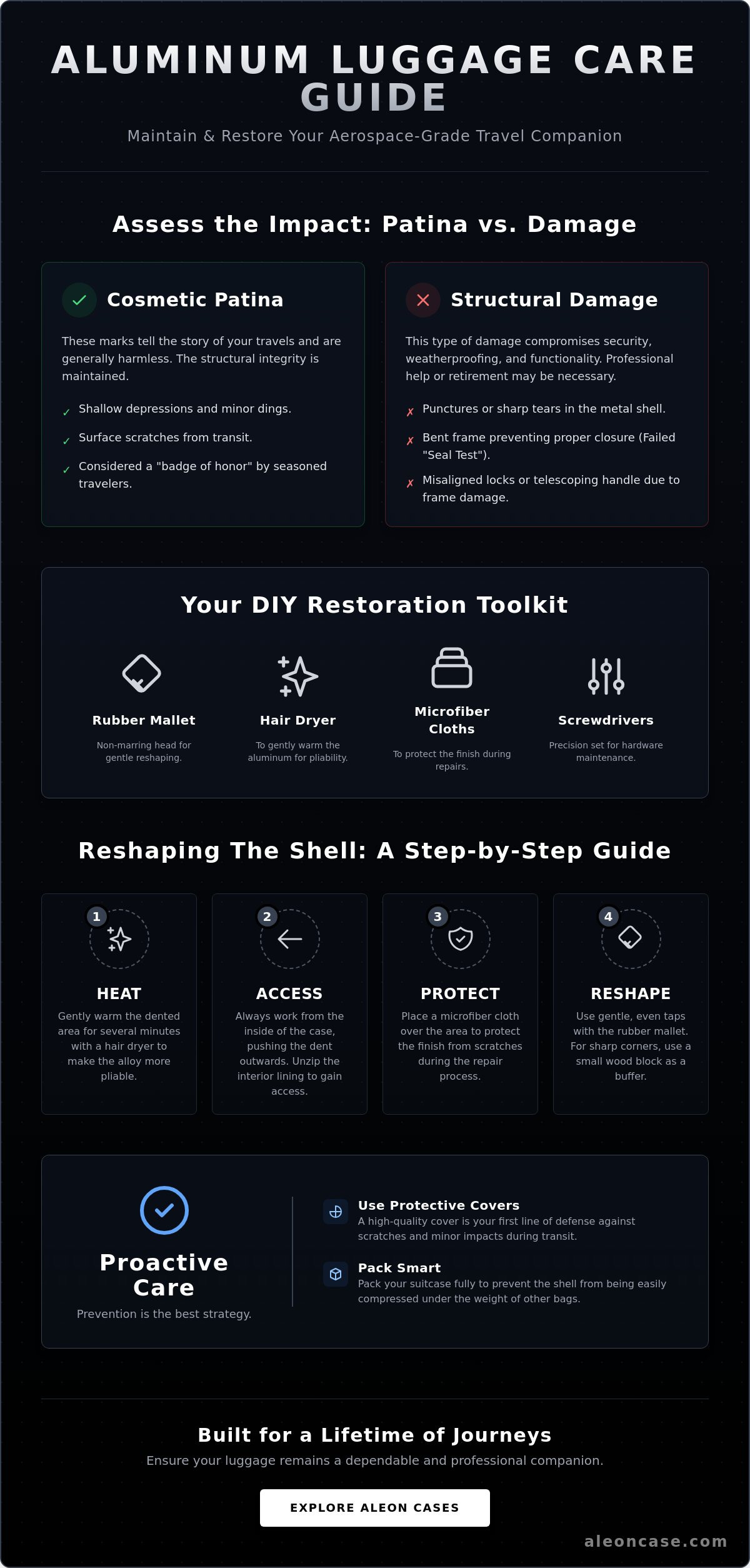
Not all dings are equal. A minor indentation on the face of an all aluminum carry on luggage piece is usually harmless. However, damage near the rim requires a "Seal Test." Close your suitcase and check if the rubber gasket meets the opposite side perfectly. If you see light through the gap, the water-resistant closure is compromised. You should also inspect the mechanical components. Ensure that TSA locks align without force and that the telescoping handle retracts smoothly. Mechanical failures often stem from frame misalignment rather than the parts themselves.
The Philosophy of the Patina
Seasoned travelers often view surface irregularities as a badge of honor. Aerospace-grade aluminum maintains its structural integrity even when its surface is no longer pristine. These minor marks don't weaken the shell; they simply record your transit history. Luggage patina is the visual history of a traveler's journey.
When to Retire a Case
Precision is paramount for high-end travel gear. While you can learn how to prevent dents in aluminum luggage through careful packing and protective covers, deep punctures or sharp tears in the metal are irreparable. If the main frame is bent beyond the point of closing, the security of your locks and the weatherproofing of the seal are lost. At this point, the metal has reached its fatigue limit and can no longer guarantee the safety of your contents. A compromised frame is the primary indicator that a case has fulfilled its service life.
How to Repair Aluminum Luggage at Home: A DIY Guide
While mastering how to prevent dents in aluminum luggage is the first line of defense, high-frequency travel eventually leaves its mark. The good news is that aluminum's malleability makes it uniquely repairable compared to plastic alternatives. To begin, gather a professional toolkit: a non-marring rubber mallet, several microfiber cloths, and a set of precision screwdrivers. These tools allow you to address both the aesthetic shell and the mechanical components without causing further damage.
Reshaping the Shell: The Rubber Mallet Technique
Success in metal restoration depends on patience and precision. Before attempting to reshape the metal, use a hair dryer on a high setting to warm the dented area for several minutes. This gentle heat makes the alloy slightly more pliable, mirroring professional aluminum repair techniques used in industrial settings. Always work from the inside of the case to push the dent outward. Place a microfiber cloth over the area to protect the finish, and use a small wood block as a buffer when addressing sharp corner impacts. This distributes the force of your mallet strikes evenly, preventing localized bulging.
Hardware Maintenance: Wheels and Handles
Mechanical reliability is just as vital as a smooth exterior. If your multi-directional spinner wheels feel sluggish, it's often due to accumulated debris in the bearings. Access the internal housing by unzipping the interior lining, then use your precision screwdrivers to remove the wheel unit for a thorough cleaning. Similarly, a wobbling telescoping handle is usually the result of loosened internal mounting screws. If your TSA-approved locks become stiff, a full replacement of the lock cylinder can be performed through these same internal access points. For those seeking a suitcase built for longevity, explore our aluminum luggage collection for cases designed with replaceable parts.
Maintaining your gear ensures it remains a dependable companion. If you've recently upgraded to an all aluminum laptop case or a 21" aluminum carry-on, performing these minor adjustments every few trips will preserve its professional appearance for years.
Proactive Care: Professional Restoration and Preventive Strategies
While DIY techniques handle minor dings, certain impacts require the precision of a professional metalworker or a dedicated manufacturer service center. If a 30" Aluminum check-in case suffers a warped frame that prevents the gaskets from sealing, hydraulic alignment is necessary. The mechanical properties of aluminum alloys allow these aerospace-grade materials to be reshaped without sacrificing tensile strength. Choosing a professional restoration over replacement is a sustainable choice that honors the longevity of your investment. It transforms a damaged shell back into a reliable travel companion.
Effective prevention is the best strategy for maintaining a pristine finish. Knowing how to prevent dents in aluminum luggage often starts with physical barriers. High-quality neoprene or clear PVC covers provide a sacrificial layer that absorbs the friction of automated baggage carousels and prevents deep scuffs. With the global rate of mishandled baggage reaching 6.3 bags per 1,000 passengers in 2024, these protective measures are essential for any checked luggage. Routine maintenance also plays a role. Apply a dry silicone lubricant to the hinges annually and clean the exterior with a pH-neutral aluminum polish to maintain that iconic jet-age aesthetic.
Manufacturer Support and Warranties
A premium suitcase is a lifetime commitment. ALEON’s minimalist design philosophy simplifies the repair process by ensuring that every component is accessible and replaceable. Unlike mass-market brands that favor glued assemblies, these cases are engineered for modularity. This approach allows owners to easily swap out handles or locks, ensuring the bag evolves with their travel needs. Investing in a brand that provides long-term parts support is the most effective way to ensure your gear remains functional for decades.
Long-Term Protection Strategies
Proper storage is as critical as transit care. Store your aluminum cases in a temperate, dry environment to prevent the rubber seals from experiencing dry-rot or losing their elasticity. Avoid damp basements where oxidation could dull the finish over time. For those who prioritize resilience, browse durable hard shell luggage built for high-frequency travel. Maintaining the structural integrity of your case ensures that it continues to protect your belongings with the same quiet confidence it possessed on its first journey.
Elevate Your Travel with Lasting Durability
Your suitcase is more than a simple container; it's a testament to your global exploration and professional standards. By mastering how to prevent dents in aluminum luggage through the use of protective covers and methodical maintenance, you preserve the polished image required for modern success. You now understand that while a surface patina tells a compelling story, the structural integrity of your gear remains the ultimate priority. Aerospace-grade aluminum construction ensures that even when the road gets rough, your essential belongings stay secure and organized.
True reliability comes from a design that values repairability over disposal. High-performance hardware that's easily replaceable and TSA-approved security features are the hallmarks of a case built for the long haul. You don't need to settle for fleeting luxury when you can choose enduring craftsmanship. Invest in a Suitcase Built for a Lifetime-Shop ALEON Aluminum Luggage. Embrace every upcoming mile with the quiet confidence that your gear is as resilient as your ambition. Safe travels await those who prepare for the journey with foresight and care.
Frequently Asked Questions
Can you fix a hole in an aluminum suitcase?
You cannot safely repair a through-hole or puncture in an aluminum shell while maintaining its original weatherproofing and security. A puncture indicates that the metal has reached its stress limit and the structural integrity is compromised. While minor surface dings are manageable; a hole usually necessitates replacing the case to protect your belongings from moisture and theft.
Will hammering out a dent weaken the aluminum frame?
Hammering out a dent can lead to work hardening, which makes the metal more brittle and prone to cracking in the future. It's essential to use a rubber mallet and apply gentle, consistent pressure rather than sharp strikes. Understanding how to prevent dents in aluminum luggage through careful handling is always preferable to repeated reshaping, as each repair slightly alters the metal's internal grain structure.
How do I remove deep scratches from my aluminum luggage?
Deep scratches in raw aluminum are permanent because the metal itself has been gouged. You can improve the appearance of surface scuffs by using a fine-grit abrasive pad or a specialized aluminum polish to blend the mark into the surrounding finish. Avoid using heavy power tools. These can remove too much material and create thin spots in your 21" aluminum carry-on or check-in cases.
What tools do I need to replace a broken spinner wheel?
Replacing a broken spinner wheel typically requires a Phillips head screwdriver and a set of needle-nose pliers. Most premium aluminum cases feature an internal access zipper that allows you to reach the mounting screws from inside the bag. Simply unscrew the damaged housing and bolt the new wheel unit into place. This modularity is a primary benefit of high-quality aluminum luggage construction.
Is it better to repair or replace a damaged aluminum suitcase?
Repair is the superior option for cosmetic dings, broken wheels, or stiff handles. These components are designed for easy replacement to extend the life of your investment. However; you should replace the suitcase if the main frame is warped or if there are cracks in the shell. A suitcase that no longer closes securely cannot fulfill its primary purpose of protecting your valuables during transit.
Does repairing my own luggage void the manufacturer warranty?
Performing basic hardware maintenance like replacing wheels or handles generally does not void warranties from brands that provide official replacement parts. However; attempting to hammer out structural dents or modifying the shell can void certain manufacturer protections. You should always review your specific warranty terms regarding how to prevent dents in aluminum luggage and what DIY repairs are permitted before beginning work on the shell.


