


Your flight case is far more than a simple container. It's the structural foundation of your mobile office. Many pilots learn the hard way that prioritizing pocket count over build quality leads to broken zippers and crushed electronics in crowded overhead bins. If you've ever struggled to pull a bulky bag through a narrow cockpit aisle, you know that precision engineering matters just as much on the ground as it does in the air. Learning how to choose a pilot flight case requires a shift in perspective. You aren't just buying luggage. You're investing in a piece of equipment that must withstand decades of professional use while protecting the mission-critical tools inside.
We understand that reliability isn't a luxury; it's a requirement for those who spend their lives at 35,000 feet. This guide will help you discover how to select a pilot case that balances aerospace-grade protection with the specific dimensions required by major airlines, such as the standard 22 by 14 by 9 inch limit. We'll examine why structural integrity is the most critical factor for safeguarding your EFB and how a professional aesthetic reinforces your presence on the flight deck. By focusing on enduring materials and logical organization, you can find a companion that remains functional and refined from your first solo to your retirement flight. For those just starting their professional journey, visit Aero Global Aviation Academy to explore career-oriented training programs.
Key Takeaways
- Prioritize structural rigidity over soft-shell alternatives to ensure your headsets and EFBs remain protected in high-vibration environments.
- Learn how to choose a pilot flight case by evaluating the specific aisle widths and storage constraints of your primary airframe.
- Decide between vertical and horizontal orientations to find the optimal footprint for your cockpit's unique spatial configuration.
- Look for multi-directional spinner wheels and integrated TSA-approved locks to reduce physical strain and streamline security checkpoints during international transits.
Prioritizing Protection: Why Material Choice Defines a Pilot Case
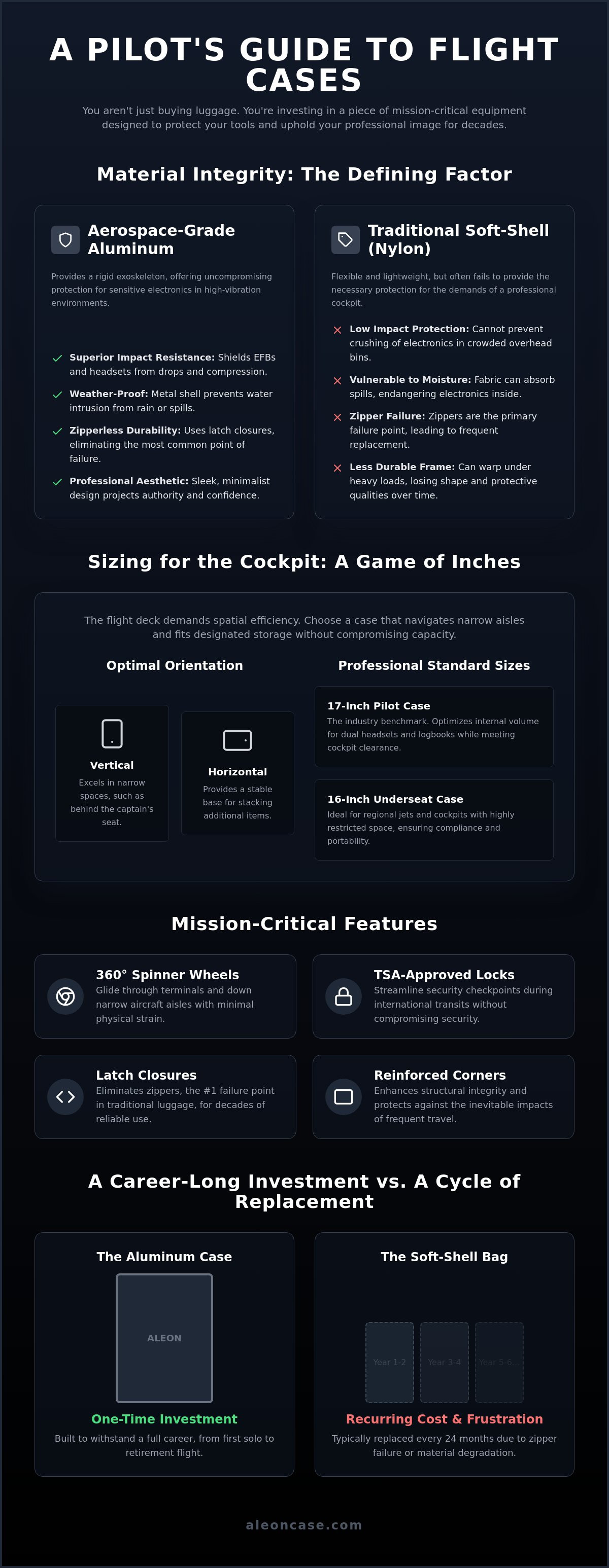
A flight bag or pilot case is a specialized, reinforced container engineered to organize documents, headsets, and Electronic Flight Bags (EFBs) while adhering to strict cockpit dimensions. It's the nerve center of your professional operations. Learning how to choose a pilot flight case starts with understanding the environment. High-vibration cockpits and turbulent transitions demand more than just a fabric pouch. While many guides suggest nylon, these soft-shell options often fail to protect the sensitive avionics that modern pilots rely on daily.
To better understand this concept, watch this helpful video:
Aluminum vs. Soft-Shell Materials
Impact resistance is non-negotiable for professional aircrews. Aluminum provides a structural rigidity that nylon cannot match, shielding tablets and expensive headsets from terminal mishaps or sudden shifts in the flight deck. It's also naturally weather-resistant. Spilled coffee or driving rain on the tarmac won't seep through a metal shell like it would through treated fabric, keeping your tech dry and functional regardless of the weather outside the canopy.
The Durability of Hard-Shell Construction
Moving parts are the primary failure point in traditional luggage. By eliminating zippers in favor of latch-based closures and reinforced corners, you remove the most common reason for gear replacement. Aerospace-grade aluminum serves as a rigid exoskeleton that prevents frame warping under heavy loads, ensuring the case remains perfectly aligned throughout years of service. It's a design philosophy built for the long haul.
Consider the cost-per-flight rather than the initial price tag. Replacing a nylon bag every 24 months is a cycle of frustration and waste. A high-quality aluminum case represents a one-time investment that can last an entire career. Beyond the economics, the minimalist aesthetic matters. A sleek metal exterior projects a level of professional authority that matches the uniform and inspires confidence in crew and passengers alike. When you understand how to choose a pilot flight case, you prioritize a professional image that is as enduring as the aircraft you fly.
Sizing for the Cockpit: Balancing Capacity with Portability
The flight deck is a masterclass in spatial efficiency. Every inch counts. When researching how to choose a pilot flight case, the most common frustration among crew members is a bag that's too wide for the aisle or too tall for the designated storage bin. Narrow-body aircraft and regional jets leave little room for error. You need a case that navigates these tight corridors without scuffing the interior or slowing your progress during a quick turn. Precision in dimensions is just as vital as the gear you carry inside.
Choosing between a vertical or horizontal orientation depends on your primary airframe storage. Vertical units often excel in the narrow spaces behind the captain's seat, while horizontal designs provide a stable base for stacking additional flight bags. Weight is a factor, but it shouldn't compromise protection. Premium aluminum offers a reassuring heft, which is easily managed with high-quality 360-degree spinner wheels. This mobility ensures you can glide through terminals and down narrow aisles with minimal wrist and shoulder strain.
Your professional equipment should also serve your personal travel needs. A case that meets strict cockpit dimensions often doubles as a compliant aluminum carry-on for deadheading or vacation. This versatility eliminates the need for multiple bags, streamlining your lifestyle on and off the clock.
The 17-Inch Aluminum Pilot Case
The 17-inch form factor is a professional standard for a reason. It optimizes internal volume, providing ample space for dual headsets, logbooks, and personal electronics without exceeding standard cockpit clearance. This size allows for a logical interior layout where every item has a dedicated place. It reduces the time spent searching for gear during high-workload flight phases, keeping your focus where it belongs.
The 16-Inch Underseat Option
For regional pilots, space is even more restricted. A 16-inch underseat luggage piece is often the ideal solution for these environments. Its compact height allows it to slide into restricted spaces that larger cases simply can't reach. Accessibility is the primary benefit here. You can retrieve essential tools while seated, ensuring that your EFB or backup charts are always within arm's reach. If you're looking for a case that fits the tightest flight decks, consider exploring our precision-engineered business units designed for maximum utility in minimal space.
Professional Features: Mobility, Security, and Longevity
Beyond the cockpit, your case must perform in the high-traffic environments of international terminals. Mobility is often overlooked when researching how to choose a pilot flight case, yet it significantly impacts your physical well-being. Multi-directional spinner wheels allow the case to glide alongside you, drastically reducing the repetitive strain on your wrist and shoulder during long terminal transits. This effortless movement is a stark contrast to the fatigue caused by heavy shoulder straps or traditional two-wheeled bags that require constant tilting and pulling.
Security is another pillar of professional travel. Integrated, TSA-approved locks are essential for pilots who move through customs and security checkpoints multiple times a week. These locks provide a necessary layer of protection during hotel stays or when your case is temporarily out of sight in a crew room. Inside, the focus shifts to logical customization. Removable dividers allow you to organize your "mobile office" to suit your specific mission, ensuring that everything from bulky headsets to spare batteries has a secure, designated home.
Investing in an aluminum case is also a commitment to sustainability. Unlike nylon bags that typically require replacement every 24 months due to fraying or mechanical failure, a high-quality metal case is designed for longevity and repairability. It's a one-time purchase that supports long-term professional goals while reducing the environmental impact of disposable luggage.
Securing Your Digital Flight Bag
Modern aviation is digital. Your Electronic Flight Bag (EFB) requires a dedicated, padded compartment that isolates it from heavier gear like flashlights or thermal bottles. A robust latch system provides a tamper-resistant seal that eliminates the mechanical vulnerabilities of a standard zipper while ensuring your gear remains inaccessible to unauthorized hands. This level of protection is vital for maintaining the integrity of your flight data and expensive personal devices.
The ALEON Advantage in Aviation
Choosing ALEON means selecting equipment that mirrors the precision engineering of the aircraft you fly. Our cases utilize aerospace-grade materials to provide a level of durability that stands up to the rigors of a 1,000-hour flying year. We understand that a pilot's gear is an extension of their professional identity. You deserve a brand that offers both sophisticated style and dependable support throughout your career. Explore the ALEON aluminum luggage collection to find your next cockpit companion.
Elevate Your Professional Standard
Selecting the right equipment is a declaration of intent. When you understand how to choose a pilot flight case, you move beyond the cycle of disposable nylon and fragile zippers. You prioritize the structural integrity of aerospace-grade aluminum and the precision of a case designed specifically for the flight deck. A truly professional case doesn't just store your gear. It protects your mission-critical electronics and streamlines your transitions through every terminal and security checkpoint.
The right choice balances the necessity of a "flight deck fit" with the reliability of a long-term investment. Features like high-density multi-directional spinner wheels and TSA-approved dual-locking systems aren't just conveniences. They're essential tools that reduce physical strain and safeguard your career's most important assets. It's time to carry a companion that reflects the quality of the aircraft you command.
Upgrade Your Cockpit Gear with an ALEON Aluminum Pilot Case
Your journey deserves gear that can keep pace with your ambitions. Step into the cockpit with the confidence that only precision engineering can provide.
Frequently Asked Questions
Do airline pilots need a specific type of luggage?
Professional pilots require specialized cases that meet both airline uniform standards and the unique storage constraints of the flight deck. Unlike standard passenger luggage, these units must navigate narrow aisles and fit into specific cockpit compartments. They often feature vertical or horizontal orientations designed to sit securely behind or beside the seat during all phases of flight, ensuring that mission-critical tools remain within reach without obstructing controls.
What is the difference between a flight bag and a pilot case?
A flight bag is typically a soft-sided container used for carrying general gear, while a pilot case is a reinforced, structured unit designed for maximum protection and organization. When learning how to choose a pilot flight case, professionals often find that the hard-shell case offers superior protection for sensitive Electronic Flight Bags and headsets. The rigid structure prevents delicate gear from being crushed in high-vibration environments or crowded crew rooms.
Will a 17-inch pilot case fit in the overhead bin of a regional jet?
Most 17-inch pilot cases are specifically engineered to fit within the restricted overhead bins of regional jets or under the seat in narrow-body aircraft. Since major U.S. airlines typically enforce a 22 by 14 by 9 inch carry-on limit, the 17-inch form factor provides a comfortable margin for clearance. This compact size ensures your essential tools remain accessible while complying with FAA-approved storage regulations across various airframes.
Why do many professional pilots prefer aluminum cases over leather or nylon?
Aluminum cases provide unmatched structural integrity and longevity compared to leather or nylon alternatives. Professional pilots value the way aerospace-grade materials resist moisture, spills, and impact while maintaining a polished aesthetic that matches their uniform. Fabric bags often fray or suffer zipper failure after 24 months of heavy use. In contrast, a metal case is a career-long investment that offers superior protection for expensive digital flight tools.


