


What if the chaos of the terminal was merely a variable you hadn't yet engineered out of your itinerary? You likely recognize the rising friction of modern transit, where avoiding travel stress and anxiety feels like a constant battle against logistical entropy. With the February 1, 2026, TSA ConfirmID fee set at $45 for alternative verification and Southwest Airlines now charging $45 for a first checked bag as of April 9, 2026, the cost of a disorganized journey is both financial and mental. You deserve a predictable experience where your mobile office remains secure and your focus stays sharp.
Mastering high-precision travel requires more than just patience; it demands a tactical shift toward elite gear and total environmental control. By leveraging aircraft-grade aluminum protection and refining your transit habits, you can transform a frantic commute into a seamless transition. This specialist's guide explores how to eliminate the variables that trigger sensory overload. You'll learn to secure your belongings with the definitive seal of aircraft-grade aluminum while utilizing grounding strategies that keep you calm under pressure.
Key Takeaways
- Understand the biological triggers of transit stress to reclaim cognitive control over unpredictable airport environments.
- Implement a "T-Minus" protocol and the "Digital Double" strategy to engineer out the variables of lost documentation and scheduling delays.
- Master the art of avoiding travel stress and anxiety by utilizing the tactile security and "click-and-seal" reassurance of aircraft-grade aluminum luggage.
- Deploy tactical mindfulness and sensory grounding techniques to maintain a calm, professional state during gate changes or security bottlenecks.
- Adopt the 15-minute post-arrival reset to efficiently close the stress loop and transition into your destination with surgical precision.
The Anatomy of Travel Anxiety: Why Our Brains Resist the Terminal
The modern terminal is a landscape of high-stakes variables. For many, travel isn't merely a transition but a physiological challenge where the brain interprets logistical shifts as security threats. Your amygdala, the brain's primary radar for danger, remains on high alert as you move through crowded corridors or wait for luggage at the carousel. This hyper-vigilance is the root cause of why avoiding travel stress and anxiety feels like an uphill battle. When the environment is unpredictable, the mind defaults to a state of defensive arousal. The amygdala doesn't distinguish between a physical predator and a misplaced laptop. It simply reacts. This biological response is why even seasoned travelers feel a subtle hum of dread before they even reach the gate.
The Biological Trigger: Novelty vs. Threat
Airports are sensory engines designed for efficiency, yet they often stimulate dormant neurons in ways that mimic genuine peril. In the 2026 travel landscape, where a simple ID oversight can lead to a $45 TSA ConfirmID fee, the line between excitement and apprehension has blurred. This heightened state of cortisol production can escalate into Hodophobia, an irrational fear of travel that stems from a perceived loss of control. Travel anxiety is a manageable byproduct of logistical uncertainty. By introducing "Predictable Hardware," such as an aircraft-grade aluminum 21" Classic Carry-On, you provide your brain with a consistent, tactile variable that signals safety. Reliability is the antidote to biological friction. Using gear with a "buy it for life" philosophy creates a sense of permanence that quietens the brain's threat assessment.
Decision Fatigue and the 'What If' Loop
Cognitive resources are finite. Every micro-decision, from identifying the correct gate to calculating baggage weight to avoid the $65 gate-check penalty, depletes your mental reserves. This process, known as decision fatigue, leaves you vulnerable to the "What If" loop. Professionals are especially susceptible to this crossover because the high-stakes nature of their work mirrors the high-precision requirements of transit. When your gear is unreliable, your brain must constantly re-evaluate the status of your belongings. Avoiding travel stress and anxiety becomes significantly easier when your hardware is a constant. A reinforced, torsion-resistant shell doesn't just protect your electronics; it anchors your mental state. If you don't have to worry about the "click" and "seal" of your case, your mind is free to focus on the journey ahead. This mental clarity is the foundation of high-precision travel, leading directly into the necessity of a rigorous pre-trip engineering protocol.
Pre-Trip Engineering: A 5-Step Protocol for Logistical Calm
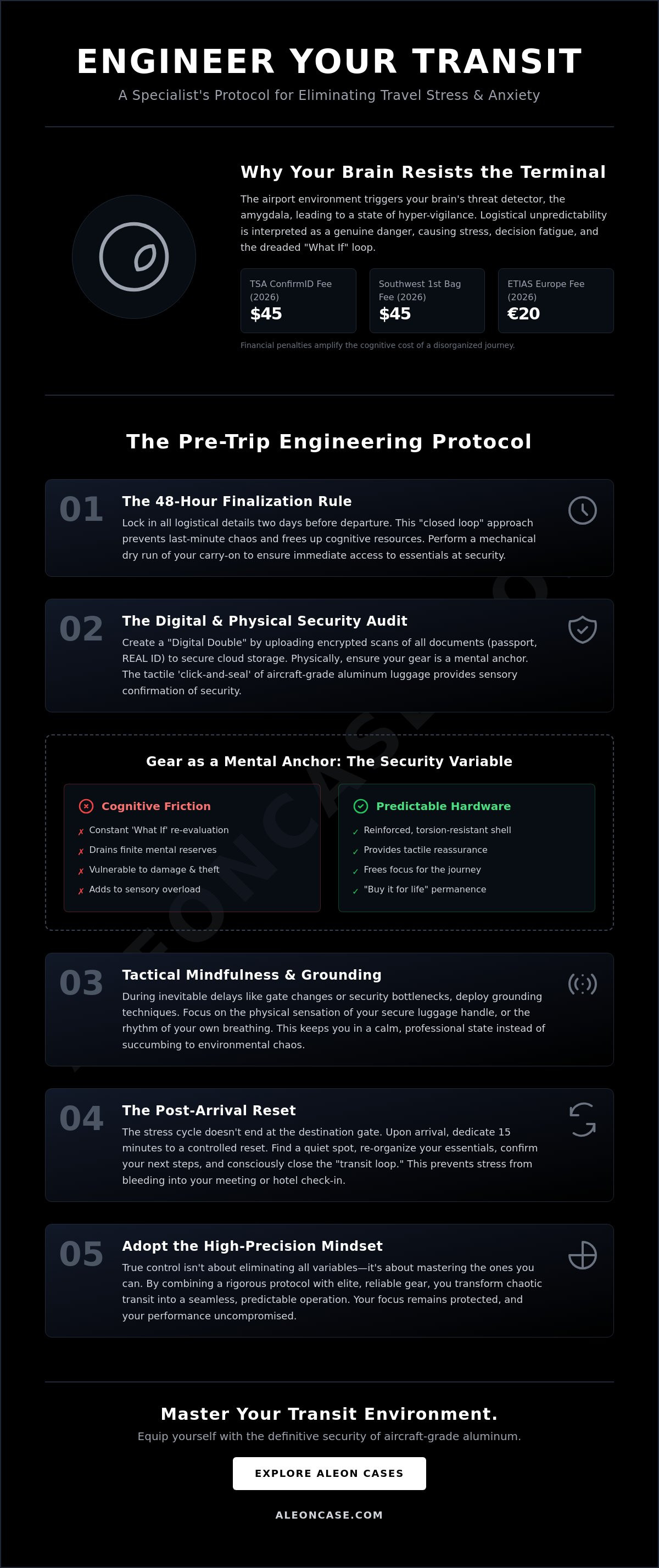
Precision in the terminal begins 48 hours before the cabin door closes. While many travelers focus on destination planning, the specialist focuses on the transit itself. This protocol is designed to eliminate the variables that lead to cognitive friction. By standardizing your preparation, you ensure that avoiding travel stress and anxiety becomes a byproduct of your system rather than a feat of willpower. Control is not a reaction; it is a pre-departure configuration.
The 48-Hour Finalization Rule
Chaos thrives on last-minute adjustments. Finalize every logistical detail two days prior to your departure to prevent the brain from entering the "What If" cycle. This "closed loop" approach provides the mental breathing room needed for high-stakes transit. Perform a mechanical dry run of your carry-on organization. Ensure your laptop and essential documents are positioned for immediate access at security checkpoints. This rehearsal reduces the time spent at the x-ray belt, where sensory overload is at its peak. When every item has a dedicated, reinforced place, you move through the terminal with the quiet confidence of an expert.
The Digital and Physical Security Audit
Your security hardware must be as reliable as your itinerary. In May 2026, with the TSA REAL ID requirements strictly enforced and the ETIAS authorization fee of €20 mandatory for European travel, document management is a critical vulnerability. Create a "Digital Double" by uploading encrypted scans of your credentials to a secure cloud. Physically, your gear must meet the standard of aircraft-grade reliability. Check that your TSA-recognized locks engage with a distinct, audible click. This provides sensory confirmation that your mobile office is sealed and secure.
To maintain visual order inside your case, use packing cubes to categorize and compress essentials. This creates a predictable internal environment that mirrors the clean lines of your luggage shell. Beyond the gear, engineer 30-minute "white space" intervals into your schedule. This buffer absorbs the impact of the February 1, 2026, identity verification delays or unexpected gate changes. If you are seeking a tool that matches this level of discipline, the Vertical Business Unit offers the torsion-resistant performance required for seamless professional transit. Inspect your wheels and handles for smooth operation; in a world of rising fees and stricter enforcement, your hardware should never be the source of friction.
Gear as a Mental Anchor: Reducing Friction with Aircraft-Grade Security
Physical security is the foundation of psychological peace. In a travel environment defined by unpredictability, your luggage serves as the primary barrier between your essential tools and the chaos of the terminal. Many travelers overlook the "Security Paradox," which is the neurological relief that occurs when you stop subconsciously monitoring your belongings for damage or theft. When you trust your hardware, your brain reallocates that cognitive energy toward avoiding travel stress and anxiety. Reliability isn't just a mechanical attribute; it's a mental anchor that allows you to remain present and composed during high-pressure transitions.
The Psychological Power of the Aluminum Shell
The choice of material dictates your baseline stress level. While polycarbonate or fabric may suffice for the casual tourist, the professional traveler requires the "Vault Effect" provided by aircraft-grade aluminum. This material is the pinnacle of protection, offering a rigid, anodized defense against the torsion and impact of modern transit. Reinforced frames ensure that your high-value electronics remain encased in a stable environment, regardless of how aggressively the bag is handled by third-party staff. This permanent, hardside construction eliminates the background dread of a cracked shell or a sliced zipper. It transforms your luggage from a mere container into a portable safe-haven that protects your professional output with surgical precision.
Eliminating the 'Lost Bag' Anxiety
The fear of the baggage carousel is a significant driver of transit-related dread. With major carriers like Delta and Southwest increasing first-bag fees to $45 as of April 2026, the financial and logistical cost of checking a bag has never been higher. Investing in a 21-inch Classic Carry-On allows you to bypass the checked-bag lottery entirely. By keeping your "mobile office" within arm's reach, you eliminate the possibility of a lost or delayed suitcase disrupting your itinerary. The minimalist, high-visibility aesthetic of an aluminum case also ensures your gear is easily identifiable in crowded spaces, reducing the risk of accidental pickup by another passenger.
Tactile feedback provides instant reassurance. The zipperless, hardside closure system of an ALEON case replaces the vulnerability of teeth and fabric with the definitive "click" and "seal" of TSA-recognized locks. This sensory confirmation tells your brain that the task of securing your property is complete. The physical strain of navigating a terminal can often masquerade as mental fatigue. High-performance, multi-directional spinner wheels reduce the effort required to move through the concourse. This prevents the physical exhaustion that often triggers anxiety. When your gear moves with seamless fluidity, your mind follows suit. You aren't just moving luggage; you're maintaining a controlled environment that travels with you.
Tactical Mindfulness: Grounding Techniques for the Terminal
The airport concourse is a study in high-frequency chaos. Success in avoiding travel stress and anxiety depends on your ability to reclaim your sensory perimeter. While your hardware provides the physical vault, tactical mindfulness provides the mental insulation. It's about engineering a private, calm environment within a public space of high entropy. By shifting your focus from the crowd to your immediate tools, you create a stable micro-environment that moves with you through the terminal.
The Sensory Grounding Technique
When the brain enters a state of hyper-arousal, tactile feedback is the most efficient way to interrupt a panic response. The "tactile reset" occurs when you place your hand on the cool, anodized surface of an aluminum shell. The temperature differential and solid texture provide an immediate anchor for your focus. This physical contact signals to the parasympathetic nervous system that your immediate environment is stable and controlled. The clean lines and minimalist aesthetic of your gear reinforce this sense of professional order. By focusing on the material reality of your luggage, you pull your attention away from the chaotic movement of the crowd and back to the present moment.
Managing Terminal Overload
High-pressure transit situations, such as sudden gate changes or the February 2026 identity verification queues, require active breath management. The "Box Breathing" method is a standard for professionals under duress: inhale for four seconds, hold for four, exhale for four, and hold for four. This rhythmic pattern regulates heart rate and prevents the "What If" loop from escalating. Combine this with noise-canceling technology to engineer a silent sanctuary. This allows you to follow the "One Task" rule, where your only objective is the immediate next step, such as reaching the lounge, rather than worrying about the entire journey.
Physiological stress often masquerades as mental anxiety. Dehydration and fluctuating blood sugar levels can trigger the same cortisol spikes as a logistical delay. Maintain a strict hydration protocol and utilize Specialty Cases to ensure your nutritional supplements and electronics are organized and accessible. When your gear is categorized with surgical precision, you eliminate the frantic search for essentials that often precedes a meltdown. If you are ready to upgrade your transit experience, explore the ALEON collection to find the hardware that supports your mental grounding. By controlling your internal state and your external tools, you transform the terminal from a source of friction into a space of quiet, professional transition.
The Post-Arrival Reset: Closing the Stress Loop
The journey concludes not at the hotel lobby, but when the traveler successfully transitions back into the professional. This final phase, the post-arrival reset, is the definitive step in avoiding travel stress and anxiety. By establishing a rigid protocol for the first 15 minutes after arrival, you signal to your brain that the state of transit has ended. This "closing the loop" prevents the lingering fatigue of the terminal from bleeding into your business objectives. It's about reclaiming your environment with surgical precision and moving from a state of movement to a state of performance.
Restoring Order in a New Environment
Immediate unpacking is the cornerstone of a seamless reset. When you utilize organized packing cubes, the transition from case to closet takes less than 15 minutes. This efficiency restores a sense of order in an unfamiliar hotel or office space. A hardside aluminum case doesn't just transport gear; its reinforced, flat surface often serves as a secondary equipment station or a temporary desk. The "Buy it for Life" philosophy inherent in aircraft-grade aluminum means you aren't just managing one trip. You're investing in a permanent solution that eliminates the long-term stress of gear failure or replacement. The tactile reassurance of the case's "click" and "seal" provides a final sensory confirmation that your belongings have arrived in the same condition they departed. This permanence is a luxury that soft-shell alternatives simply cannot provide.
Engineering the Next Journey
Every trip provides data for the next. Perform an "After-Action Review" to identify specific friction points encountered during the journey. Perhaps the February 1, 2026, identity verification process took longer than expected, or the new €32 Louvre entrance fee required an unexpected logistical pivot. Document these variables to engineer them out of your next itinerary. Your travel identity is built on this foundation of continuous improvement and authoritative gear. High-quality luggage acts as a constant in an evolving landscape of rising fees and stricter airline enforcement.
As airlines like Southwest and Delta move toward $45 fees for first checked bags in April 2026, the value of a reliable carry-on only grows. You don't just need a bag; you need a tool that maintains its integrity under the pressure of global transit. To anchor your next journey with the pinnacle of protection, explore ALEON’s collection of secure aluminum luggage. This commitment to reliability ensures that while the world of travel changes, your standard of transit remains uncompromisingly high. By controlling the hardware and the habit, you turn every journey into a masterpiece of logistical calm.
Mastering the Art of High-Precision Transit
Mastering transit requires a shift from reactive habits to proactive engineering. By standardizing your gear and refining your itinerary, you eliminate the cognitive friction that triggers a defensive response. You've learned that avoiding travel stress and anxiety is a matter of controlling logistical variables and grounding your mental state through tactile reliability. Whether you're deploying tactical mindfulness in a crowded terminal or executing a 15-minute post-arrival reset, the objective remains the same: total environmental control.
A seamless journey begins with the definitive security of your hardware. ALEON provides the foundation for this elite experience through aerospace-grade aluminum construction and integrated TSA-recognized security locks. Every case is backed by a 10-year limited warranty, ensuring a lifetime of reliability that moves beyond the cycle of fast fashion. Your gear should be a tool of empowerment, not a source of worry. Secure your peace of mind with ALEON’s aircraft-grade aluminum luggage. You have the strategy and the standards; now, take the first step toward a journey defined by quiet confidence and surgical precision.
Frequently Asked Questions
Is travel anxiety a clinical condition or just common stress?
Travel anxiety exists on a spectrum ranging from situational stress to the clinical condition known as Hodophobia. While many travelers experience temporary unease due to logistical shifts, a persistent and irrational fear of travel affects a specific percentage of the population. Understanding this distinction is vital for avoiding travel stress and anxiety through targeted behavioral and hardware interventions. Recognizing the biological triggers, such as the amygdala's response to terminal novelty, allows you to move from a state of reaction to one of engineered control.
Can high-quality luggage actually reduce my travel anxiety?
Yes, high-quality luggage functions as a mental anchor by eliminating the variables of mechanical failure and physical vulnerability. When you utilize aircraft-grade aluminum, you remove the background worry of hardside cracking or fabric tearing during transit. This "Security Paradox" suggests that as your trust in your hardware increases, your brain's threat assessment decreases. Reliable gear provides a predictable constant in an environment defined by high entropy, allowing you to focus on your professional objectives rather than your belongings.
How do TSA-approved locks help with airport stress?
TSA-recognized security locks provide a definitive seal that prevents unauthorized access while ensuring authorized inspections occur without damage. The audible "click" of these locks offers sensory confirmation that your mobile office is secure. This feature eliminates the dread of arriving at your destination to find a broken zipper or compromised contents. By using integrated security systems, you bypass the friction of third-party lock failures and move through security checkpoints with unwavering confidence.
What are the best grounding techniques for a crowded airport?
Sensory grounding and rhythmic breathing are the most effective tools for maintaining composure in high-density terminals. Placing your hand on the cool, anodized surface of your luggage provides a "tactile reset" that interrupts the brain's panic response. Combine this with the Box Breathing method to regulate your heart rate during delays or gate changes. These techniques allow you to engineer a private, calm environment even when international visitor numbers exceed the 68 million seen in 2025.
Should I use medication for my travel anxiety?
Consult with a medical professional for advice on pharmacological interventions, as medication is a personal health decision. However, many specialists recommend starting with behavioral strategies and logistical engineering to build a baseline of calm. Standardizing your "Pre-Trip Engineering" protocol and relying on high-precision gear can significantly reduce the environmental triggers that necessitate medication. Focusing on what you can control, such as your hardware and itinerary, provides a non-invasive foundation for a seamless journey.
How can I stop worrying about my luggage being lost or stolen?
Adopting a carry-on only strategy with secure, hardside protection is the most effective way to eliminate loss-related dread. Utilizing a 21" Classic Carry-On ensures that your essential tools remain within your immediate sphere of influence. This approach bypasses the baggage carousel entirely, where many thefts and logistical errors occur. The permanent, torsion-resistant shell of an aluminum case also acts as a visual and physical deterrent, signaling that your property is encased in the pinnacle of protection.
What is the 'Decision Fatigue' mentioned in travel planning?
Decision fatigue is the depletion of cognitive resources caused by the accumulation of small, logistical choices throughout a journey. From navigating gate changes to managing baggage fees, these micro-decisions lead to mental exhaustion and heightened stress levels. You can mitigate this by standardizing your packing list and using consistent gear. When every item has a reinforced, dedicated place, you eliminate the need for constant re-evaluation, preserving your mental energy for high-stakes professional tasks.
Why is aluminum better than soft-shell luggage for anxious travelers?
Aluminum offers a level of structural permanence and security that soft-shell alternatives cannot match. Fabric cases are vulnerable to slicing, tearing, and environmental damage, which creates a constant state of low-level worry for the traveler. In contrast, the "vault effect" of an aircraft-grade aluminum shell provides an uncompromising barrier against impact and intrusion. This "buy it for life" philosophy ensures that your hardware is a reliable tool of your trade, providing a sense of security that is both tactile and timeless.


