


Could a 30 l suitcase be a compact weekend companion or an awkward fit for your flight? The answer depends on more than the number on the label. Thirty liters describes packing capacity, not the bag’s height, width, or depth, so two bags with the same volume may fit and carry very differently.
It’s easy to assume a liter rating tells you whether a suitcase will suit your trip or pass an airline’s size check. It doesn’t. A 30-liter bag can typically hold essentials for a two-to-four-day trip, but your packing style and the bag’s external dimensions matter. This guide explains what 30 liters can hold, how capacity differs from measurements in inches, and what to check against your airline’s carry-on limits. You’ll have a practical way to compare sizes and choose a format that fits your plans.
Key Takeaways
- Assess whether a 30 l suitcase suits your packing style by accounting for clothing bulk, footwear, and how lightly you travel.
- Compare external measurements, empty weight, compartments, and luggage format to find a bag that works for your plans.
- Use a simple selection order: estimate what you’ll pack, confirm the bag’s dimensions, check your airline’s rules, then compare construction.
- If a rigid shell is a priority, consider aluminum luggage as an option, while checking the specifications of each individual case.
What Does a 30 L Suitcase Hold? Understand Capacity Before You Shop
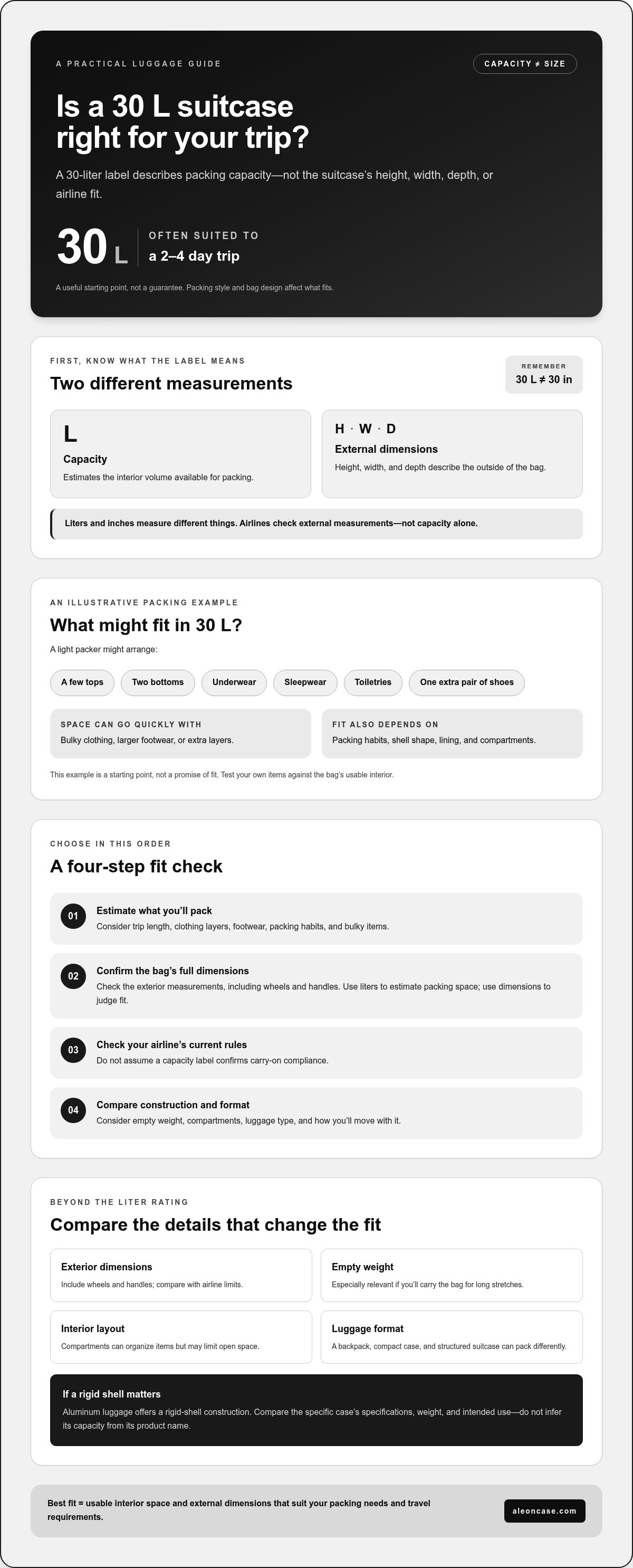
A 30 l suitcase is described by its capacity, an estimate of the interior volume available for packing. It isn’t a measurement of the case’s height. A 30-liter bag is often suited to a weekend trip of two to four days, but what fits depends on your packing habits and the bag’s design.
Capacity describes interior volume; external measurements describe a bag’s height, width, and depth. Liters and inches measure different things, so 30 L cannot be converted directly to 30 inches. Shell shape, lining, and compartments also affect how much of the stated volume is practical to use. A deep, open interior may pack differently from a case divided into several smaller sections.
For a visual example of how a traveler approaches packing a 30-liter bag, watch this review. It features a backpack, so use it as a packing example rather than a guide to suitcase dimensions:
Is a 30 L suitcase the same as a 30-inch suitcase?
No. Liters indicate volume, while inches usually indicate an external dimension. A 30-inch case is not a 30-liter case. Its overall size and packing space depend on all three exterior measurements and the construction inside. For carry-on context, see this overview of standard carry-on luggage. Airlines set size rules using external measurements, not capacity alone.
Illustrative packing example: A light packer might arrange a few tops, two bottoms, underwear, sleepwear, toiletries, and one extra pair of shoes in 30 liters. Bulky clothing, larger footwear, or structured compartments may change the fit. To test a particular bag, set out the items you expect to bring and compare them with its interior layout. Treat the example as a starting point, not a guarantee: check the specific bag’s capacity and dimensions before choosing.
How to Decide Whether a 30 L Suitcase Fits Your Trip
Start with the trip, not the label. A short getaway may fit in 30 liters if you pack lightly, repeat outfits, and need little footwear. Extra layers, bulky clothes, or multiple pairs of shoes can use that space quickly. For a longer trip, consider whether you can do laundry and keep your packing list compact. If you need to bring specialized equipment, check its dimensions and shape against the bag’s usable interior before relying on the capacity figure.
Also consider the type of luggage. A backpack, compact case, and structured suitcase can have different layouts even at a similar stated capacity. Compartments can help organize essentials, but may reduce open packing space or limit how larger items fit. Compare empty weight as well as capacity, especially if you’ll carry the bag for long stretches. Think through how you’ll move with it, too: a bag carried on your back has different practical considerations from a wheeled case.
What should you compare beyond a suitcase’s liter capacity?
Check the full external dimensions, including wheels and handles, against your airline’s current carry-on rules. For a practical measuring method, see how to measure your luggage. Don’t assume equal liters mean equal usable space: shell shape, lining, and internal organization all affect how belongings fit. If the product listing provides both capacity and dimensions, use each for its own purpose: capacity to estimate packing space, and exterior measurements to assess fit for travel requirements.
Quick checklist: Match trip length, clothing bulk, footwear, packing habits, external dimensions, empty weight, compartments, and luggage format to your needs.
Material is another consideration. Aluminum luggage offers a rigid-shell construction for travelers who prioritize a structured case; compare its weight and intended use with your packing routine. ALEON offers 16" underseat luggage and other aluminum luggage formats, but don’t infer a case’s capacity from its product name. Check each case’s specifications rather than assuming it has a 30-liter capacity. A 30 l suitcase is the right fit only when both its usable space and outer dimensions suit your journey.
Choose Your Suitcase Size With Confidence: A Practical Buying Checklist
Make the choice in a clear order. A 30 l suitcase may suit your packing needs, but capacity alone can’t confirm that a bag fits your travel plans or an airline’s rules.
- Estimate your packing needs: Account for trip length, clothing layers, footwear, and whether you’re comfortable packing light. Set out the items you plan to bring to see where bulky pieces may take up space.
- Confirm the bag’s dimensions: Check its full exterior measurements, including wheels and handles. Compare interior organization with the shape and size of your belongings.
- Check your airline’s current rules: Carry-on limits vary, so verify the requirements for your specific airline and itinerary rather than relying on a universal size.
- Compare construction: Consider shell material, empty weight, organization, and how you’ll use the luggage.
This sequence helps separate two questions: will your belongings fit, and will the bag meet your travel requirements? Confirm both before deciding. A capacity label can help narrow your search, but the product dimensions and your packing list are what make the comparison useful.
When should you consider aluminum luggage instead?
Aluminum luggage may be worth considering if you prioritize a rigid shell and a structured design. Compare the material alongside practical features such as TSA-approved locks and multidirectional spinner wheels, and review the specifications of each case. These details help you assess construction and maneuverability, but they don’t confirm a particular capacity or airline fit.
ALEON offers aluminum luggage, including carry-on and checked cases. Browse the aluminum luggage category as one option if this construction suits your preferences. Check individual case dimensions and details to determine whether it matches your needs; don’t assume a listed case holds 30 liters.
Choose a Case That’s Ready for Your Next Trip
The right 30 l suitcase depends on what you plan to pack, how you travel, and whether its external dimensions meet your airline’s current rules. Remember, liters describe estimated packing volume, not the case’s height or carry-on eligibility. Compare capacity alongside weight, compartments, and construction before making your choice.
If you’re considering a rigid-shell option, ALEON’s aluminum luggage emphasizes aerospace-grade aluminum, TSA-approved locks, and multidirectional spinner wheels. A portion of every sale also supports solar energy initiatives in Honduras. Review individual case specifications to find a size and format that suits your plans; no 30-liter capacity is confirmed for ALEON luggage.
Explore the aluminum luggage collection and compare its case specifications with your packing list and airline’s requirements. With the right measurements and a clear packing plan, you can choose a case that suits your trip.
Frequently Asked Questions
What can you fit in a 30 L suitcase?
A 30 l suitcase offers an estimate of packing volume, not a guaranteed list of contents. Illustrative example: a light packer might fit several tops, a pair of trousers, underwear, sleepwear, toiletries, and one pair of shoes. Bulky clothes, compartments, and shell shape can change the fit. Compare the bag’s dimensions and interior layout with the items you plan to bring.
Can a 30 L suitcase be used as carry-on luggage?
It depends on the suitcase’s external dimensions and the airline’s current baggage rules, not its capacity alone. Airlines may set different limits, and wheels or handles can affect the total measurement. Check the specific carrier’s published requirements before you travel, and compare them with the case’s full exterior dimensions. A 30-liter bag doesn’t automatically qualify as carry-on luggage.
How do I choose the right suitcase capacity for a trip?
Start with your trip duration and the items you’ll need, including shoes, outerwear, and bulky equipment. Then compare the bag’s usable interior space, compartments, external dimensions, and empty weight. A capacity label is a useful starting point, but it can’t account for every packing style or itinerary. Choose a case that accommodates your belongings and suits the journey’s requirements.


