


The most critical moment of your journey isn't the takeoff; it's the moment your suitcase appears on the carousel. If you find your belongings compromised, knowing exactly what to do if airline damages your luggage is the difference between a seamless resolution and a costly loss. You likely understand the frustration of seeing a meticulously packed case emerge with structural damage. It's an experience that feels personal, especially when you've invested in quality equipment for your professional or personal travels.
Winning this battle requires a dual approach: a mastery of airport procedures and a commitment to superior hardware. This 2026 guide provides the precise roadmap to navigating airline bureaucracy and securing the compensation you deserve, which can reach up to $4,700 for domestic flights. We'll outline the strict reporting windows you must meet and explain why precision-engineered aluminum cases, such as our 30" aluminum check-in case, are your first line of defense. You'll gain a clear understanding of your rights under the Montreal Convention and the logic needed to ensure your next journey remains uninterrupted and your investments remain protected.
Key Takeaways
- File your report immediately at the airport baggage claim. Leaving the secure area without an official record often forfeits your right to a claim.
- Capture high-resolution visual evidence. Detailed photos and videos from multiple angles are essential for proving the extent of the damage to the airline.
- Understand the 2026 liability limits and what to do if airline damages your luggage to secure up to $4,700 in domestic compensation.
- Prioritize structural integrity for future travel. Aluminum check-in cases offer a level of impact resistance and durability that standard polycarbonate shells cannot match.
The Golden Window: Immediate Actions at the Baggage Claim
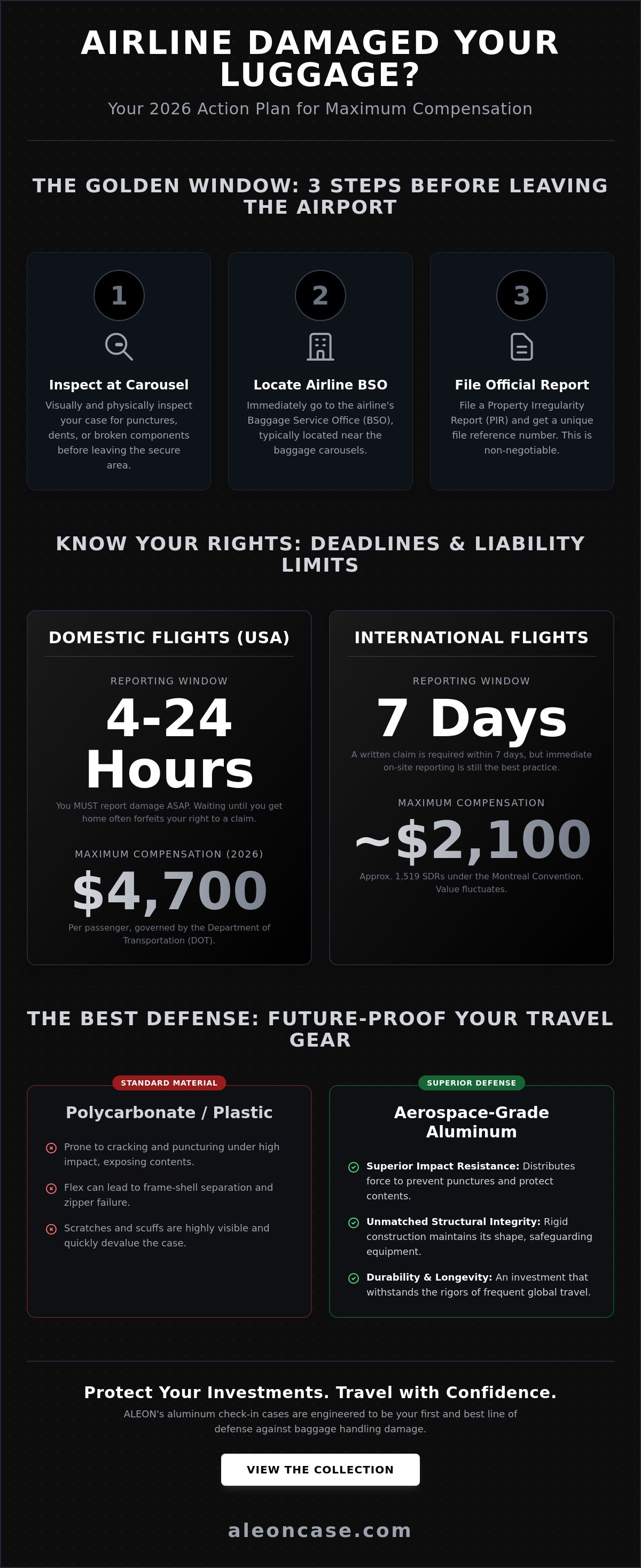
Success in a baggage claim depends on immediate, decisive action. You should never walk away from the carousel until you've performed a tactile and visual inspection of your case. Check for structural compromises, punctured shells, or sheared wheels. Understanding what to do if airline damages your luggage starts with recognizing that your legal leverage is highest while you're still on-site. Once you exit the secure area, the airline's ability to claim the damage happened elsewhere increases significantly.
To better understand the financial stakes of this process, watch this helpful video:
Locate the airline’s Baggage Service Office (BSO) immediately. This office is typically found near the carousels. You must file a formal report and obtain a Property Irregularity Report (PIR) before leaving the terminal. This document, combined with your unique file reference number, serves as the official foundation for your claim. Without a PIR, your request for compensation will likely face immediate rejection.
Documentation: The Key to a Successful Claim
Visual proof is undeniable. Photograph the luggage tag while it's still attached to your aluminum luggage. This links the specific flight and carrier to the damage. Keep your physical boarding pass and the adhesive baggage claim ticket; these are essential physical evidence. When describing the issue, be clinical. State, "The aluminum shell suffered a 4-inch puncture on the lower left quadrant," rather than using vague or emotional language. This precision helps when referencing Montreal Convention liability limits for international travel.
The 4-Hour Rule and Domestic Deadlines
Time is your enemy. While you have up to seven days for international claims, most US domestic carriers enforce much stricter windows. Airlines like American and Delta often require a report within 4 to 24 hours of arrival. Noticing a dent at your hotel is not the same as reporting it legally. If you wait until the next morning, you risk a summary denial. Secure your PIR and your file reference number before you call for your car to ensure you stay within the 2026 domestic liability limit of $4,700.
Navigating Liability Limits and Compensation Rights
Understanding the legal framework behind your claim is as essential as the initial report. For domestic flights within the United States, the Department of Transportation (DOT) established a maximum liability limit of $4,700 per passenger in January 2026. This figure represents the ceiling of what an airline is required to pay, though it's rarely a flat payout. Knowing what to do if airline damages your luggage involves preparing for the "fair market value" argument. Airlines often depreciate the value of your gear based on its age and condition. To counter this, keep digital copies of your original receipts for premium investments like an aluminum check-in case.
You must also distinguish between actionable damage and "normal wear and tear." Airlines typically won't pay for minor scratches, scuffs, or small nicks that occur during the standard rigors of transit. However, structural failures such as broken frames, punctured shells, or non-functional wheels are clear violations of their duty of care. As established in the previous section, it's vital to report any damage before leaving the airport to prove the failure occurred under the airline's watch.
The Montreal Convention for International Travelers
For those crossing borders, the Montreal Convention governs your rights. Liability is calculated using Special Drawing Rights (SDRs), a global reserve asset. The current limit is 1,519 SDRs, which translates to approximately $2,019 to $2,175 depending on currency fluctuations. While you technically have a 7-day window to submit a written claim for international damage, don't delay. The administrative burden of international claims is higher, and promptness signals a serious intent to recover your losses.
Handling Denied Claims and Secondary Insurance
If an airline denies your claim by citing pre-existing damage, don't accept the first "no." You can escalate the issue through the DOT’s consumer protection portal or leverage secondary insurance. Many premium credit cards offer travel protections that cover the gap between the airline’s depreciated payout and the actual replacement cost of your luggage. This secondary layer of protection is particularly useful for frequent travelers who value the reliability of high-end, all-aluminum equipment.
Future-Proofing: Why Aerospace-Grade Aluminum is the Best Defense
The best strategy for handling luggage damage is ensuring it never occurs. While knowing what to do if airline damages your luggage is a vital survival skill, selecting the right material is your primary defense against the conveyor belt gauntlet. Polycarbonate and soft-shell cases often fail under the extreme pressure of automated sorting systems. In contrast, high-quality aluminum alloys offer a superior strength-to-weight ratio. Aluminum doesn't shatter. It absorbs energy. While a plastic shell might crack and expose your belongings to the elements, an aluminum case maintains its structural integrity, protecting your investments through every transition.
Precision engineering is visible in the details. Reinforced corners and rivet construction act as the case's crumple zones, absorbing heavy impacts that would otherwise compromise the frame. Security is equally paramount. Traditional zippers are the most vulnerable point of any suitcase; they're easily punctured or burst under stress. Latch-based systems provide a rigid, secure seal that reinforces the entire unit. This creates a fortress-like protection for your gear, moving beyond the concept of disposable luggage toward a philosophy of enduring travel equipment.
The ALEON Advantage: Engineered for the Journey
Our commitment to reliability is evident across all aluminum luggage collections. Every component is selected for its ability to withstand the rigors of professional travel. TSA-approved locks are integrated directly into the frame, eliminating the external failure points common in lesser designs. Furthermore, our multi-directional wheels are engineered to reduce mechanical friction. This ensures that even our largest 32" aluminum check-in case moves with the same fluid precision as our 17" aluminum pilot case.
Choosing Your Next Resilient Travel Companion
Selecting the right case requires a shift in mindset. You're not just buying a bag; you're acquiring a lifetime travel companion. Whether you require a 16" underseat unit for short business sprints or a 30" aluminum check-in case for extended international voyages, the priority remains the same: durability. By investing in high-end aluminum, you reduce the likelihood of ever needing to file a Property Irregularity Report. You gain the confidence that comes from knowing your gear is built to survive the journey, not just the flight.
Secure Your Journey with Intent
Navigating the aftermath of transit damage requires a disciplined approach. You've learned that immediate reporting at the Baggage Service Office is the foundation of any successful claim. Precise documentation and a firm grasp of 2026 liability limits ensure you aren't left bearing the financial cost of an airline's error. While knowing what to do if airline damages your luggage is a powerful skill, the most sophisticated travelers focus on proactive prevention. True peace of mind comes from knowing your equipment is engineered to withstand the rigors of the modern airport environment.
By choosing hardware designed for professional durability, you move beyond the cycle of claim filings and frequent replacements. ALEON cases feature aerospace-grade aluminum construction and TSA-approved integrated locks, providing a level of structural security that standard shells cannot match. It's time to invest in a companion that respects the value of your belongings as much as you do. You deserve a seamless experience from the first check-in to the final carousel.
Upgrade to Aerospace-Grade Protection: Shop ALEON Aluminum Luggage
Your next destination awaits. Step onto your next flight with the quiet confidence that only superior craftsmanship and intelligent design can provide.
Frequently Asked Questions
Does the airline have to pay for a broken suitcase wheel or handle?
Airlines are generally responsible for functional damage that renders your luggage unusable. While many carriers attempt to classify broken wheels, handles, or straps as "normal wear and tear," the Department of Transportation typically requires them to cover damage to these essential components. If a wheel is sheared off or a telescoping handle is bent during transit, the airline must repair the case or provide compensation for its depreciated value.
What happens if I only notice the damage after I leave the airport?
Filing a claim after leaving the terminal is more challenging but remains possible within strict timeframes. For domestic US flights, most airlines require an electronic report within 4 to 24 hours of arrival. International travelers have a 7-day window to submit a written claim under the Montreal Convention. You'll need to provide clear evidence, such as time-stamped photos, to prove the damage occurred while the bag was in the airline's possession.
How much compensation can I realistically expect for a damaged aluminum suitcase?
Compensation is calculated based on the fair market value of the item, capped at the 2026 domestic liability limit of $4,700. Because an all aluminum check in luggage unit is a premium investment with a long lifespan, its depreciated value stays significantly higher than that of polycarbonate alternatives. Knowing what to do if airline damages your luggage includes presenting original receipts to ensure the airline recognizes the high replacement cost of your professional gear.
Are airlines liable for fragile items inside my damaged luggage?
Liability for contents depends on whether your flight is domestic or international. US domestic carriers explicitly exclude fragile items, electronics, and valuables from liability in their contracts of carriage. However, on international routes, the Montreal Convention generally holds airlines responsible for all items in their care. They're only exempt if they can prove the damage resulted from an inherent defect in the item or insufficient packing by the passenger.


