


Selecting the wrong suitcase for a fourteen-day itinerary is no longer just an inconvenience; it's a direct tax on your journey. Following the industry-wide fee hikes of April 2026, where major carriers like Delta and United raised first-bag costs to $45, the stakes for choosing what size luggage for a 2 week trip have never been higher. You need a vessel that commands respect at the check-in counter while offering the internal architecture to organize a fortnight of essentials. It's about finding that precise intersection where high-capacity volume meets effortless mobility.
You likely feel the tension between wanting enough space for every occasion and the anxiety of a bag that's too cumbersome to manage or too flimsy to survive the cargo hold. This guide identifies the ideal liter capacity for your 14-day window to ensure you never overpack or compromise on security. We'll analyze the engineering trade-offs between the 26-inch traveler and the 30-inch macro case, providing you with the technical clarity needed to protect your belongings. By the end of this article, you'll understand how to select a case that offers both a sophisticated aesthetic and the rugged resilience required for modern, high-frequency travel.
Key Takeaways
- Determine the precise volume requirements for a 14-day journey, focusing on the 60L to 90L range to maintain mobility without sacrificing essentials.
- Identify why the 26-inch aluminum traveler is the engineering sweet spot when deciding what size luggage for a 2 week trip.
- Learn to utilize the "Grid System" and compression cubes to optimize the internal architecture of a 50/50 split opening aluminum case.
- Evaluate the structural trade-offs between medium and macro cases to ensure your belongings remain secure across varying climates and itineraries.
- Discover how aircraft-grade aluminum alloys and advanced fastening systems provide a permanent, high-security solution for the discerning traveler.
Table of Contents
The 14-Day Packing Dilemma: Understanding Volume and Dimensions
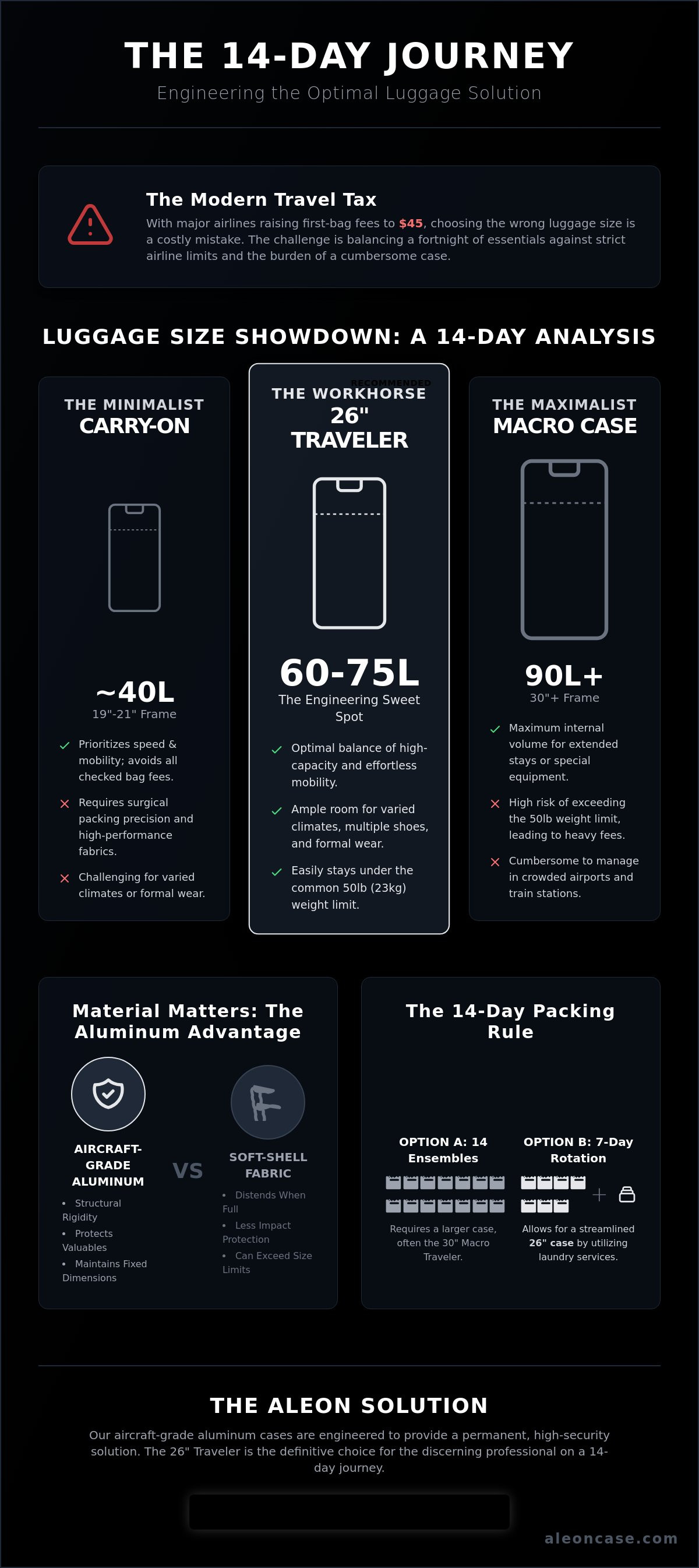
A two-week journey is a rigorous test of both traveler stamina and equipment reliability. It requires enough internal volume to sustain a professional lifestyle without the physical burden of excessive mass. When you are determining what size luggage for a 2 week trip, the engineering standard generally lands between 60 and 90 liters. This specific range provides the necessary depth for varied climates and formal requirements while remaining within the strictures of modern airline regulations. It's the point where capacity meets manageable mobility.
While volume measures the internal capacity in liters, dimensions dictate your legal standing at the check-in counter. Airlines prioritize the external footprint of your case. Understanding the nuances of a global baggage allowance is essential for avoiding the steep fees introduced in early 2026. A case that is technically high-volume but physically oversized will result in gate-side penalties that disrupt your transit. Precision in measurement is not a luxury; it's a financial necessity in the current travel landscape.
Your packing philosophy ultimately defines your structural requirements. The 14-Day Rule offers two distinct paths: packing fourteen unique ensembles or curating a seven-day rotation supported by laundry services. The latter allows for a more streamlined 26-inch case, such as the Aleon Traveler. Choosing a rigid material like high-performance aluminum alloy ensures that your internal organization remains intact. Unlike soft-shell alternatives, these metal structures do not distend or lose their form. This rigidity protects your belongings and ensures the case always fits within its designated dimensions.
Liters vs. Inches: Decoding Luggage Specs
Liters represent the fluid volume of the interior, while inches describe the exterior frame. A 26" Traveler typically offers 65 to 75 liters of space. This is the optimal volume for what size luggage for a 2 week trip, as it balances the need for multiple shoe pairs and formal wear with the physical reality of lifting and stowing your own gear. It provides enough "breathing room" for souvenirs without exceeding the 50-pound weight limit common to most major carriers.
The Carry-On Challenge: Can You Survive 2 Weeks with 40L?
Attempting a 14-day trip with a 19" or 21" Classic Carry-On is a feat of engineering minimalism. This approach is reserved for the traveler who prioritizes speed and technical efficiency over variety. You'll need high-performance fabrics that resist odors and dry quickly. While a 40L limit is tight, it's a viable strategy for those utilizing elite status to bypass the recent 2026 fee increases on checked items. It requires surgical precision in your packing list and a commitment to a very specific, high-utility wardrobe.
Choosing the Right Size: Carry-On, Medium, or Large?
Selecting the optimal hardware for a fourteen-day journey is a matter of mathematical precision. You aren't just choosing a container; you're selecting an engineering solution that must withstand the rigors of international transit. When evaluating what size luggage for a 2 week trip, the choice typically narrows to the 26-inch medium case or the 30-inch macro traveler. Each offers a distinct advantage in volume-to-weight efficiency. Aerospace-grade aluminum is the critical factor here. It provides a rigid, protective shell that maximizes internal space without the structural failure points common in plastic or fabric alternatives.
Your selection must also account for the physical constraints of the 50lb (23kg) economy weight limit. A larger case offers more volume but carries the risk of exceeding weight thresholds if packed without discipline. Consulting the TSA Travel Checklist ensures your packing list is optimized for security compliance, preventing the need to reorganize your meticulously balanced load at the airport. This level of preparation is the hallmark of the professional traveler.
The 26-Inch Traveler: The Versatile Workhorse
The 26" Traveler is the definitive standard for most two-week itineraries. With a capacity of approximately 63 liters, it provides ample room for a summer wardrobe, multiple footwear options, and essential electronics. It's built for the traveler who values mobility. The medium frame is significantly easier to navigate through the narrow corridors of European rail stations or the crowded terminals of major hubs. It strikes a perfect balance between high-capacity storage and effortless handling. This size is particularly effective for staying under the 50lb limit, as the physical dimensions naturally discourage the inclusion of unnecessary bulk.
The 30-Inch Macro: For the "Just in Case" Packer
There are scenarios where the 87L+ volume of the 30" Macro Traveler becomes essential. If your itinerary involves extreme climates requiring heavy winter layers or if you're transporting specialized photography gear, the macro size is the logical upgrade. It offers the expansive architecture needed for bulky items that would compromise the organization of a smaller case. The trade-off is a mandatory checked-bag status and a greater emphasis on weight management. The security of an aluminum shell ensures that even a fully loaded 30-inch case maintains its structural integrity under the pressure of the cargo hold. For those who refuse to leave anything behind, the precision-engineered Traveler series provides the ultimate peace of mind.
The 2-Week Matrix: Destination and Style Requirements
Your destination is the ultimate stress test for your equipment. A cobblestone street in Prague demands a different mechanical response than a carpeted executive lounge in Singapore. When considering what size luggage for a 2 week trip, the environment dictates the wheel assembly and the locking mechanism as much as the internal volume. High-frequency transit requires 360-degree spinner wheels built with reinforced bearings to maintain a smooth, silent glide across varying surfaces. The tactile feedback of a high-performance wheel system communicates a sense of unwavering confidence as you navigate through complex terminals.
Security is the often-overlooked variable in long-haul travel. For a 14-day journey, your case will spend significant time in cargo holds and hotel storage rooms. Dual TSA-approved locks provide a redundant layer of protection, ensuring the structural perimeter remains uncompromised. This mechanical security is a hallmark of elite equipment, providing a level of permanence that zipper-based systems cannot match. The audible click of the compression latches serves as a signature reassurance that your belongings are encased in the pinnacle of protection. It's a design philosophy that values substance over fleeting trends.
Urban Professional: The 14-Day Business Trip
Success in the boardroom begins with a pristine presentation. Integrating a 17" Business Case with a 26" Traveler creates a modular system that segregates critical electronics from your main wardrobe. The rigid aluminum environment of the larger case prevents compression, keeping suits and formal wear wrinkle-free. This combination allows you to transition from the airport to a meeting without the need for urgent steaming or pressing. It's an elite strategy for the modern professional who views their equipment as an essential tool rather than a mere accessory. Protecting sensitive electronics in a rigid shell ensures your data and hardware survive the most rigorous travel schedules.
Global Explorer: 2 Weeks Across Continents
Traversing multiple climate zones requires a case that functions as a mobile fortress. Aerospace-grade aluminum alloys thrive in high-humidity and heavy-rain environments where porous materials fail. This material heritage ensures your 14-day wardrobe remains dry and protected from external elements. When calculating what size luggage for a 2 week trip for leisure, leave approximately 15% of your volume empty. This tactical reserve accommodates souvenirs and local acquisitions without forcing you to compromise the case's mechanical closure system. It allows for effortless utility during the return leg of your journey, maintaining the visual cohesion of your luggage set even when at maximum capacity.
Packing for a fortnight requires more than just volume; it demands a disciplined approach to internal architecture. Selecting what size luggage for a 2 week trip is only the first step; the second is mastering the internal physics of the case. When you evaluate what size luggage for a 2 week trip, you must account for the 50/50 split opening of a professional aluminum traveler. This creates two primary zones, allowing for a "Grid System" where items are categorized by utility rather than stacked at random. This symmetrical design maximizes every cubic inch of the interior while maintaining an organized, accessible layout that remains stable through every leg of the journey.
Weight distribution is a critical component of this architecture. Placing heavy items, such as footwear or high-density electronics, near the wheel assembly ensures the case remains stable during transit. This lowers the center of gravity and prevents the case from tipping or feeling cumbersome. The resulting mobility is a direct product of thoughtful packing. Interior compression boards further enhance this stability by applying uniform pressure across the load. This prevents the internal shifting that leads to disorganized contents and potential damage to sensitive items during high-frequency travel.
Organizing with Precision: Aleon Packing Cubes
Categorizing a 14-day wardrobe into modular units is the most efficient way to manage a long-haul journey. Aleon packing cubes allow you to segregate garments by type or day, ensuring that you never have to disturb the entire contents of your case to find a single item. This system is particularly useful for separating clean garments from soiled laundry over the course of two weeks. It maintains the internal hygiene of your case while preserving the crispness of your professional attire. Explore our specialized packing cubes to refine your internal organization and maximize your available volume.
Securing the Load: The Mechanical Advantage
Standard zippers are often the first point of failure under the strain of a 14-day load. In contrast, the mechanical buckle closures found on aircraft-grade aluminum cases provide a superior seal that won't be compromised by over-packing. These latches offer a tactile confirmation of security, snapping into place with a precision that suggests permanence. This fastening system works in tandem with the rigid shell to protect your belongings from external pressure and unauthorized access. It's a design that prioritizes long-term reliability over the disposable nature of soft-shell alternatives. For those who demand the pinnacle of protection, the Aleon collection offers the ultimate in travel security.
The Aleon Solution: Engineered for the 14-Day Journey
Selecting the correct hardware for a fourteen-day itinerary is an exercise in managing variables. You require a vessel that balances internal volume with external maneuverability, all while providing an impenetrable barrier against the hazards of global transit. When you evaluate what size luggage for a 2 week trip, the Aleon 26" Traveler emerges as the definitive engineering solution. It is not merely a container; it is a precision tool crafted for the high-frequency traveler who views their equipment as a reflection of their standards. This case provides the structural certainty needed to navigate complex schedules with unwavering confidence.
Materials define the lifespan of your investment. Aleon utilizes high-performance aerospace-grade aluminum alloys to ensure a level of permanence that fast-fashion alternatives cannot achieve. This material heritage provides a rigid perimeter that protects sensitive electronics and formal attire from the crushing pressures of the cargo hold. The inclusion of reinforced corners and a seamless aluminum frame creates a sanctuary for your belongings. Every component, from the dual TSA-approved locks to the high-density wheel assemblies, is designed to perform under pressure. Furthermore, our commitment to longevity extends beyond the product itself; Aleon supports solar energy initiatives with every piece of luggage sold, ensuring your journey contributes to a sustainable future.
Aleon 26" Traveler: The Professional Choice
The 26" Traveler is designed for the surgical organization of a 14-day wardrobe. With a 63-liter capacity and a weight of 13.2 lbs, it offers the ideal volume-to-mass ratio for international checked baggage standards. The sensory experience of the mechanical click as the compression latches engage provides immediate tactile reassurance. It is a case built for those who demand effortless utility and visual cohesion. Shop the 26" Traveler to secure the pinnacle of protection for your next journey.
Aleon 30" Macro: For Maximum Capacity
When your itinerary demands more than the standard 60 liters, the Aleon 30" Macro Traveler provides the necessary architecture. Offering 87 liters of internal volume, this case is engineered to handle the heaviest checked luggage requirements without sacrificing its sleek, minimalist aesthetic. It provides the expansive space required for winter layers, specialized gear, or extended multi-continent tours. The rugged engineering of the macro series ensures that even at full capacity, the case maintains its structural integrity and silent glide. View the full Macro Traveler collection and discover the ultimate answer for what size luggage for a 2 week trip when capacity is your primary objective.
Mastering the Art of the Fortnight Journey
Selecting the right equipment is the difference between a journey defined by chaos and one defined by composure. We've explored how the 26-inch frame provides the necessary volume for fourteen days while remaining agile in transit. Determining what size luggage for a 2 week trip is ultimately a decision about security and permanence. You need a vessel that resists the external pressures of the cargo hold while maintaining its refined aesthetic. Aerospace-grade aluminum construction and integrated TSA-approved security systems ensure your belongings remain untouched and organized. With a 10-year limited warranty, your luggage becomes a long-term asset rather than a temporary accessory. It's an investment in a philosophy of enduring longevity. Take control of your travel experience with equipment that matches your standards for excellence. Upgrade to an Aleon 26" Traveler for your next 2-week journey and travel with the confidence that only world-class engineering can provide. Your next destination awaits.
Frequently Asked Questions
Is a 26-inch suitcase big enough for a 2-week international trip?
Yes, the 26-inch frame is the engineering sweet spot for a fortnight. It provides the necessary volume to house a professional wardrobe without the physical burden of an oversized case. This size ensures you remain agile in transit hubs while staying well within the standard linear inch limits of most global carriers. It's the ideal choice for those who value both capacity and mobility.
How many liters of luggage do I need for a 14-day holiday?
A range of 60 to 90 liters is the technical requirement for a 14-day journey. When determining what size luggage for a 2 week trip, this volume allows for diverse attire and essential gear. A 63-liter case like the 26" Traveler is ideal for summer climates, whereas a 30-inch case offering over 80 liters is better suited for winter layers or specialized equipment.
Will an aluminum suitcase put me over the airline weight limit?
Aluminum provides a superior strength-to-weight ratio that rivals synthetic alternatives. While the material is inherently robust, a 26-inch aluminum case typically weighs around 13 lbs, leaving nearly 37 lbs of payload before hitting the 50lb airline limit. It's an elite choice that prioritizes structural integrity and security without sacrificing significant weight capacity. Precision engineering ensures you don't compromise on durability for the sake of lightness.
Can I use a carry-on for a 2-week trip if I do laundry?
You can successfully navigate a two-week itinerary with a 21" Classic Carry-On by utilizing a high-efficiency packing strategy. This approach requires access to laundry services and a commitment to technical, low-volume fabrics. It's a calculated choice for the minimalist professional who prioritizes speed and bypasses the checked baggage process entirely. It requires surgical precision in your selection of essentials to maintain a streamlined profile.
What is the difference between a 26-inch and a 30-inch suitcase for long trips?
The primary difference lies in internal volume and physical footprint. A 26-inch case offers approximately 63 liters of space and superior maneuverability in urban environments. In contrast, a 30-inch Macro Traveler provides over 85 liters, making it the necessary choice for travelers transporting bulky items or those who prefer not to utilize laundry services during their stay. Each serves a distinct purpose based on your itinerary requirements.
Are hard-shell aluminum suitcases better than soft-shell for 2 weeks?
Aluminum hard-shell cases offer a level of permanence and protection that soft-shell luggage cannot match. The rigid perimeter prevents contents from being crushed and provides a secure seal against theft or environmental damage. For a 14-day trip, the structural certainty of a metal alloy case ensures your belongings arrive in the same condition they were packed. It's a choice that reflects a commitment to quality and security.
How do I organize a 2-week packing list in a hard-shell case?
When deciding what size luggage for a 2 week trip, utilize the 50/50 split architecture to create a modular organization system. By integrating compression packing cubes, you can categorize 14 days of attire into accessible units. This method prevents internal shifting and maintains a minimalist aesthetic, ensuring that even a fully loaded case remains organized and professional throughout the duration of your travel. It's about maximizing every cubic inch with precision.
Does Aleon luggage come with TSA-approved locks for checked travel?
Every Aleon traveler is equipped with dual TSA-approved locking systems as a standard security feature. These locks are integrated directly into the aluminum frame to ensure a flush, tamper-resistant seal. This mechanical superiority provides the peace of mind required for checked baggage, knowing your belongings are encased in the pinnacle of protection across every border. The audible click of the latches serves as your signature reassurance of safety.


