


Checking a suit is no longer just a risk to your schedule; it's a direct tax on your efficiency. With major U.S. carriers raising checked bag fees to $45 as of April 2026, the overhead bin has become the only logical sanctuary for the modern professional. Learning how to pack a suit in a carry on is a fundamental skill for anyone who refuses to let a hotel iron touch their high-value wool.
You shouldn't have to choose between a $50 baggage fee and a wrinkled lapel. We understand that your garment is an investment, and the typical soft-sided bag offers little more than a suggestion of protection against the pressures of travel. You will master the precise folding techniques and structural secrets required to arrive at your destination with a perfectly crisp suit, all within a single 22 x 14 x 9 inch case. From the geometry of the shoulder-tuck to the protective seal of aircraft-grade aluminum, this guide provides the blueprint for seamless, wrinkle-free transit.
Key Takeaways
- Master the "Shoulder-into-Shoulder" folding technique to preserve the structural integrity of your jacket’s chest piece and lapels.
- Discover how the torsion-resistance of aircraft-grade aluminum prevents external pressure from crushing delicate wool fibers during transit.
- Implement the "Base Layer" strategy to isolate heavy items like footwear and tech, ensuring they don't migrate and cause deep-set creases.
- Refine your process for how to pack a suit in a carry on by utilizing internal compression panels to secure your wardrobe in place.
- Transition to a high-efficiency one-bag strategy that eliminates the "checked bag gamble" and prioritizes garment preservation.
The Architecture of the Carry-On: Why Professionals Never Check a Suit
Professionals view time as their most valuable asset. Waiting at a baggage claim for twenty minutes is a failure of logistics; it's a gap in a carefully managed schedule. The "checked bag gamble" places your bespoke tailoring at the mercy of ground crews and automated sorting systems. In 2026, where major airlines have increased checked bag fees to $45 or more, the tactical advantage of one-bag travel is undeniable. It's about mobility and security. Knowing how to pack a suit in a carry on ensures that your wardrobe remains within your immediate control. You move from the jet bridge to the boardroom without the anxiety of lost or mishandled luggage. This "Carry-On First" mindset is the hallmark of the high-frequency traveler who values substance over convenience.
The Cost of a Wrinkled First Impression
A suit is more than fabric. It's a statement of authority. When you arrive at an international summit with a jacket marred by "set-in" creases, your sartorial presence is compromised. These creases occur when fabric is subjected to sustained pressure and fluctuating cabin temperatures. This causes the fibers to lock into a distorted shape. Relying on hotel dry-cleaning is a significant risk. Many establishments use industrial steamers that can damage high-twist wools or cause bubbling in fused interlinings. By mastering the geometry of the fold, you protect your investment from the unpredictable quality of third-party garment care. You maintain total control over your professional image, ensuring you look as sharp as the reinforced aluminum case you carry.
Carry-On Constraints vs. Professional Needs
Precision is required when navigating various carry-on luggage guidelines. While domestic U.S. carriers typically permit a 21-inch case, international routes often enforce a stricter 19-inch limit. This reduction in volume demands a strategic approach to internal architecture. A standard two-piece suit requires specific cubic volume to avoid the "crush factor" common in soft-sided bags. Understanding these dimensions is the first step in successful transit. For a detailed breakdown of current regulations, consult our Guide to Carry-On Size Limits 2026. The goal is a seamless fit that respects both airline mandates and the physical requirements of your clothing. Elite travelers don't just pack; they engineer their luggage for maximum efficiency, utilizing every square inch of aircraft-grade protection.
Mastering the Geometry: Proven Suit Folding Techniques
Precision packing is an exercise in engineering. When you understand the physics of fabric tension, you eliminate the need for a steamer at your destination. The objective is to minimize the sharp angles that lead to permanent fiber deformation. Learning how to pack a suit in a carry on requires a shift from "folding" to "sculpting" the garment within the available volume. Professionals prioritize the structural integrity of the jacket's chest piece and lapels, as these define the suit's silhouette. By utilizing a layer of dry-cleaner plastic between folds, you create a slick barrier that prevents the fabric from gripping itself. Friction-reduction serves as the fundamental mechanism for neutralizing micro-creases before they bond to the fabric.
The choice between the "Master Roll" and the "Flat Fold" depends entirely on the material's weight and weave. A lightweight tropical wool or linen responds best to the Flat Fold, which maintains the garment's broad planes. Conversely, heavier flannels or high-twist travel wools benefit from a soft roll, which distributes pressure evenly. Many travelers reference to visualize how these geometric principles apply to high-end tailoring. Regardless of the method, the goal remains the same: protecting the investment you’ve made in your professional wardrobe.
The 5-Step Shoulder-Tuck Execution
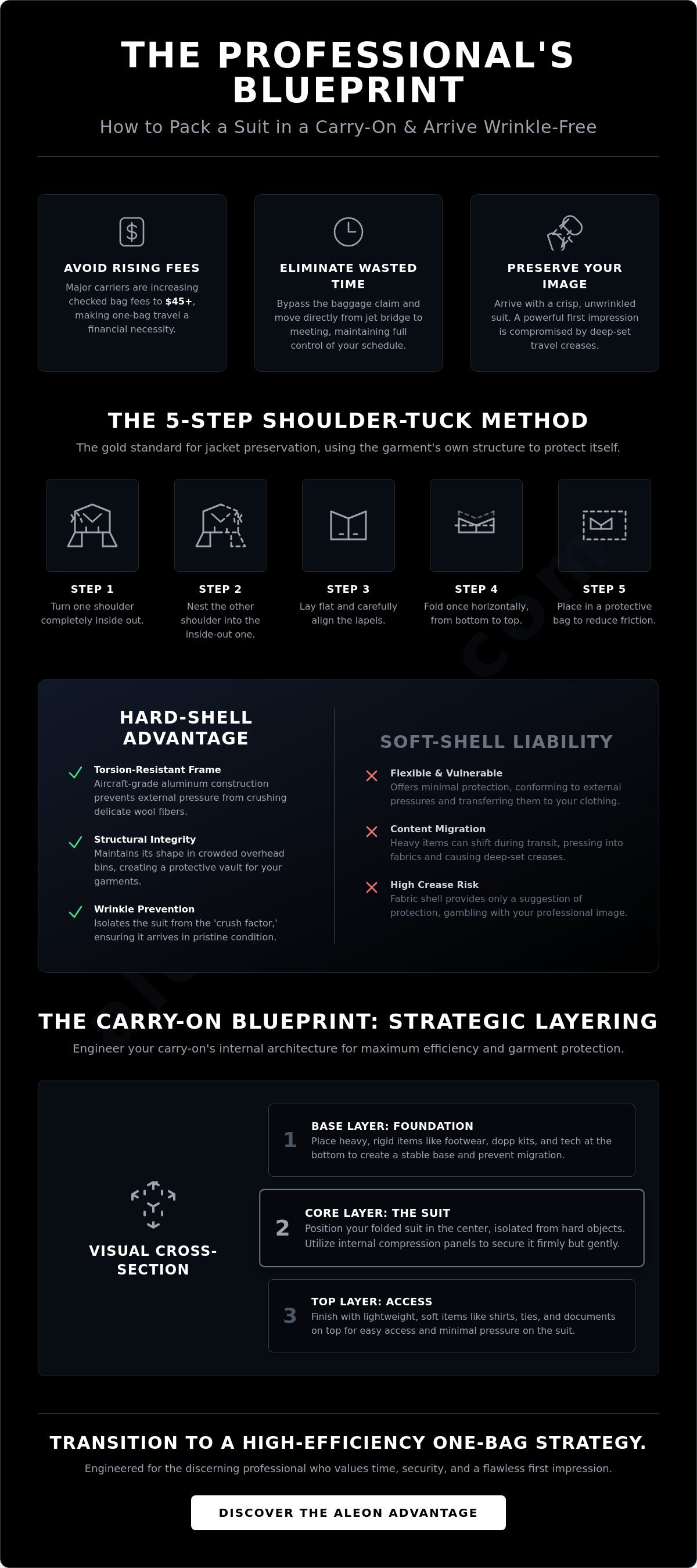
This method is the gold standard for jacket preservation. It utilizes the garment's own structure to create a protective pocket for the delicate shoulder padding.
- Step 1: Turn one shoulder inside out while keeping the sleeve aligned and tucked within the interior lining.
- Step 2: Nest the opposite, right-side-out shoulder directly into the pocket created by the inside-out shoulder.
- Step 3: Lay the jacket flat on a clean surface and meticulously align the lapels to prevent rolling or crushing.
- Step 4: Fold the jacket once horizontally at the waist, ensuring the buttons don't press directly into the face of the fabric.
- Step 5: Place the folded jacket inside a plastic bag to maintain the "air cushion" that prevents other items from compressing the fibers.
Managing the Trousers and Dress Shirt
Trousers should never be folded at the knee; this creates a visible horizontal line that's difficult to remove without high-pressure steam. Instead, use the "interweaving" technique. Lay the trousers flat across the case with the legs hanging over the edge. Place your folded jacket in the center, then fold the trouser legs back over the jacket. This uses the jacket as a soft cushion, preventing a hard break in the trouser fabric. For dress shirts, collar integrity is paramount. Plastic or metal collar stays are non-negotiable tools for maintaining a crisp presentation. To ensure your meticulously folded garments stay in place, consider the stability provided by ALEON’s internal compression boards, which lock your wardrobe into a secure, shift-free environment.
Hard Shell vs. Soft Shell: The Structural Secret to Wrinkle-Free Suits
The most sophisticated fold is rendered useless if the container lacks structural integrity. Soft-sided luggage is a liability for the business traveler; it offers no defense against the "crush factor" of a crowded overhead bin. When other passengers force their bags into the remaining space, a soft bag compresses. This pressure is transferred directly to your suit fibers, bonding creases into the fabric. Mastering how to pack a suit in a carry on requires a move toward torsion-resistant materials. Aircraft-grade aluminum creates a rigid, unchanging environment where your garment’s volume is protected by engineering rather than luck.
The "Seal and Click" of a zipperless closure is a functional necessity, not just an aesthetic choice. Traditional zippers are points of failure where moisture and dust can penetrate. They also pose a constant risk of snagging fine wool or silk linings. A hardside aluminum case provides a seamless rubber seal that maintains a consistent internal climate. This temperature stability is vital for protecting natural fibers from the humidity shifts common during international transit. Even the most precise techniques for how to pack a suit in a carry on, like those found in an , require this level of environmental control to succeed.
Why Aluminum is the Sartorial Choice
Fabric exteriors are prone to abrasion and puncturing, whereas an anodized aluminum finish reflects the resilience of the professional who carries it. ALEON’s reinforced corners are designed to absorb kinetic energy from impacts, ensuring the frame never warps. This structural permanence is why high-frequency travelers prioritize metal over nylon. You can explore the technical specifications of our alloy in our guide on Why Aerospace-Grade Aluminum is the Superior Material. It's a "buy it for life" philosophy that protects your high-value wardrobe investments.
Internal Compression Systems
Movement is the primary cause of wrinkles during flight. As the aircraft experiences turbulence or changes in pitch, loosely packed items shift and collide. ALEON’s internal compression boards act as a secondary skeleton, fixing your suit in a static position. This creates a controlled "vacuum" effect that secures the fold without the fiber-crushing force of plastic vacuum bags. By eliminating shifting cargo, you ensure that the geometry you established at home remains intact until you reach the hotel. It's about maintaining tension and position through every mile of the journey.
The Blueprint: Layering Your Carry-On for Success
Successful transit requires a deliberate internal architecture. You aren't just filling a void; you're balancing a payload. The "Base Layer" strategy dictates that heavy, high-density items like dress shoes and electronics belong at the bottom of the case, nearest the wheels. This placement prevents these items from shifting downward during transit and crushing your lighter garments. When considering how to pack a suit in a carry on, the suit must always occupy the "Top-Tier" position. It should be the final item placed inside, resting atop a buffer of softer items. This hierarchy ensures that the suit faces minimal compression from the rest of your wardrobe. It's a system built on the laws of physics and the requirements of fine tailoring.
The "Middle Buffer" serves as a transition zone between your heavy gear and your delicate suiting. Utilize packing cubes to organize casual wear, undergarments, and gym attire. These cubes act as a structural stabilizer, creating a flat, uniform surface for the suit to rest upon. This prevents the lumpy interior that often leads to localized creasing in tailored garments. Additionally, isolate your toiletry kit in a peripheral compartment or a dedicated waterproof pouch. As of April 2026, TSA liquid rules remain at 3.4 ounces (100ml). A leak of this size can permanently ruin high-twist wool or silk linings. By maintaining a strict separation between liquids and textiles, you mitigate the risk of a catastrophic wardrobe failure.
Maximizing the 21-inch Classic Carry-On
The 21" Classic Carry-On offers refined volume for the executive traveler. Maximize this space by utilizing the interior of your dress shoes for socks, ties, or small accessories. This prevents the shoes from collapsing and reclaims dead space for organization. For tech, use the small gaps around the frame for cables and chargers. This Tetris-like approach ensures that every item has a dedicated home. Placing the heaviest items directly over the wheel axle provides the optimal center of gravity for a stable, effortless roll through the terminal. It's about precision in every square inch.
The First 5 Minutes After Landing
Your responsibility doesn't end when the plane touches down. Unpack your suit within the first five minutes of entering your hotel room. Gravity is your ally; hanging the jacket and trousers immediately allows the natural fibers to relax and release minor travel lines. If a stubborn crease persists, utilize the "Steam Shower" hack. Hang the suit in the bathroom while running a hot shower for ten minutes, then let it air-dry in the main room. This provides a secondary safety net for the fibers. Finally, inspect the lapels and vents for alignment. This ensures that the internal canvas hasn't shifted during the journey. Mastering how to pack a suit in a carry on is only half the battle; the recovery is just as vital for a crisp presentation.
The ALEON Advantage: Engineered for the Discerning Professional
Mastering how to pack a suit in a carry on is a tactical skill, but even the most precise geometry requires superior hardware to be effective. The foundation of wrinkle-free travel is a case that refuses to compromise on its dimensions. Our 21" Classic Carry-On is engineered specifically to accommodate the proportions of a tailored jacket. While soft-sided bags bulge and distort, the aircraft-grade aluminum shell remains static. This structural permanence ensures your suit isn't subjected to the fluctuating pressures of a crowded overhead bin. It's a "buy it for life" philosophy that prioritizes the protection of your professional wardrobe over the fleeting trends of fast fashion.
Security is a non-negotiable requirement for the global elite. Each case features dual TSA-recognized locks, providing a seamless experience through international hubs while maintaining an impenetrable seal. The minimalist aesthetics of the anodized finish complement a high-end business wardrobe, projecting an image of quiet authority. This isn't just luggage; it's a reinforced sanctuary for your most valuable professional assets. By choosing a case that balances rugged engineering with sophisticated design, you ensure that your first impression is never left to chance.
Why ALEON is a Tool, Not an Accessory
The tactile experience of an ALEON case begins with the "click" and "seal" of the zipperless closure system. This design eliminates the primary point of failure found in traditional luggage, ensuring a moisture-resistant environment for delicate wools. Our multi-directional spinner wheels provide effortless navigation through premium lounges and tight jet bridges, maintaining a steady center of gravity. We also believe that permanence should be paired with responsibility. Your purchase supports our commitment to sustainability, as our manufacturing processes are powered by integrated solar energy initiatives. It's a holistic approach to luxury that values both performance and the planet.
Choosing Your Professional Companion
Selecting the right case depends on your specific flight path and wardrobe requirements. The 19" International Carry-On is the definitive choice for navigating the strict dimensions often enforced on European and Asian routes in 2026. For domestic travel where volume is less restricted, the 21" Classic Carry-On provides the ideal width for preserving the lapels of a bespoke suit. If your journey is focused on rapid-fire meetings, the Vertical Business Unit offers specialized organization for tech and a single change of attire. Regardless of your destination, the objective remains the same: arriving ready to perform. Discover the ALEON Carry-On Collection and refine your approach to how to pack a suit in a carry on with the pinnacle of aluminum protection.
Arrive Ready for the Boardroom
Travel in 2026 demands a level of precision that soft-sided bags simply cannot provide. You've learned that wrinkle-free transit is a synergy between the geometry of the shoulder-tuck and the structural permanence of your luggage. Mastering how to pack a suit in a carry on is the ultimate logistical advantage. It ensures you move from the jet bridge to your meeting without hesitation. By utilizing a rigid interior and strategic layering, you protect the investment of your tailoring from the unpredictable pressures of the overhead bin.
Your luggage should be a tool of your profession. Every ALEON case is built with aerospace-grade aluminum and a TSA-approved dual-locking system to provide unwavering security for the global elite. We also believe in a legacy of responsibility. Every sale powers our donation to solar energy initiatives. Secure your wardrobe with an ALEON Aluminum Carry-On and experience the tactile superiority of a seamless, zipperless closure. Travel with the confidence that your first impression is encased in the pinnacle of engineering.
Frequently Asked Questions
Can I fit a three-piece suit in a standard carry-on?
Yes, a three-piece suit fits comfortably within the 22 x 14 x 9 inch dimensions of a standard case. The waistcoat is a low-volume garment that you should lay flat against the internal compression board to minimize bulk. This preserves the structural integrity of the jacket while maximizing the internal capacity of your aircraft-grade aluminum shell.
Should I use a garment bag inside my aluminum carry-on?
No, a traditional garment bag is often counterproductive as it adds unnecessary mass and creates friction. Instead, utilize a thin plastic dry-cleaner bag to create a slick layer that prevents the wool fibers from catching. This method is the professional choice for how to pack a suit in a carry on without sacrificing valuable internal volume.
How do I pack a tie so it doesn't get crushed?
Roll your silk ties loosely from the narrow end to the wide end to maintain their natural drape. Place these rolls inside your dress shoes or within the peripheral gaps of your packing cubes. This technique protects the delicate interlining from being compressed by heavier items like laptops or toiletry kits during the flight.
Is it better to roll or fold a suit jacket?
Folding using the shoulder-tuck method is superior for maintaining the silhouette of a structured jacket. While rolling is effective for casual knits, it can distort the canvas and padding of a high-value suit. Precision folding ensures the lapels remain crisp and the chest piece retains its engineered shape throughout the journey.
What happens if my aluminum carry-on is gate-checked?
Your belongings remain secure due to the reinforced corners and torsion-resistant frame of the aluminum construction. Unlike soft-shell bags that offer no protection against external pressure, a hardside case maintains its internal volume even when stacked under heavy luggage. The TSA-recognized locks ensure your investment is protected from unauthorized access if the bag leaves your sight.
How do I prevent my dress shoes from smelling up my suit?
Use aromatic cedar shoe trees to absorb moisture and neutralize odors before you begin packing. Always place shoes inside individual fabric dust bags before nesting them at the bottom of the case near the wheels. This creates a sanitary barrier that protects your fine wools from the leather and soles of your footwear.
Can I pack two suits in one 21-inch carry-on?
Yes, a 21" Classic Carry-On can accommodate two suits if you utilize the interweaving technique. Place the trousers of the first suit, followed by the second, and then layer the folded jackets on top. This distributed layering prevents any single point of high pressure, ensuring both garments arrive in pristine condition for a multi-day summit.
What is the best way to fold a dress shirt for business travel?
The A4 fold is the most efficient method for maintaining shirt integrity and minimizing surface area. Ensure your plastic collar stays are inserted to prevent the collar from collapsing under the weight of the suit jacket. Place shirts in a dedicated packing cube to keep them static, as this prevents the shifting that causes micro-creases in cotton fibers.


